




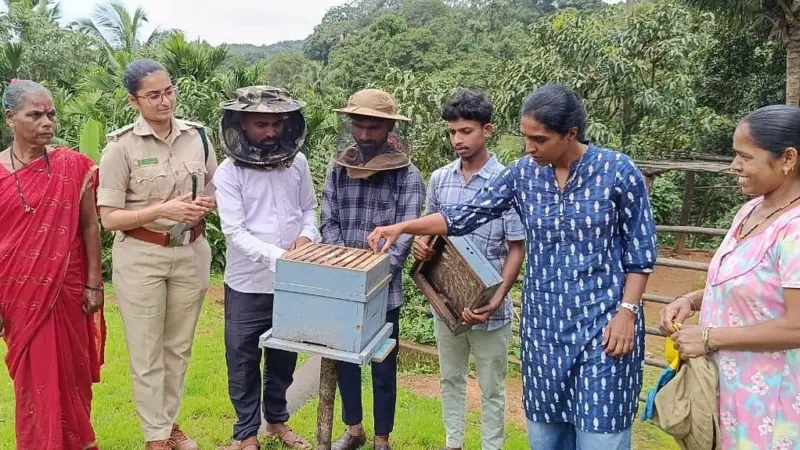

For years, tailoring had ceased to be a reliable source of income for Shanta Mirashi of Minal village in Uttara Kannada's Joida taluk.
At 52, Mirashi, who also served as the village priest, found himself at a crossroads. Migrating to Goa in search of work was not an option, yet staying back in the village without a steady livelihood seemed equally uncertain.
It was around three years ago that he first heard about the apiculture initiative launched by the Kali Tiger Reserve (KTR), a programme that would gradually help stabilise his family's income.
"After I started keeping bees in my backyard, my annual income increased by at least Rs 30,000," says Mirashi.
Mirashi is among the 235 forest dwellers in one of Karnataka's dense forest regions who, through the initiative called Adavi Jhenkara, have found an additional source of livelihood with minimal investment. Adavi Jhenkara translates to 'Forest bee-buzz' in Kannada.
"Initially, the Forest Department gave me three bee boxes. After receiving training from experts, I increased them to 17 boxes. Now, I produce between 25 kg and 43 kg of pure honey every year and sell it to the department for Rs 800 per kg," he says.
Launched in 2023-24 under KTR's SWAYAM-ENEC (Saving Wildlife in Association with Young Aspiring Minds - Eco-development and Nature Education Centre), Adavi Jhenkara seeks to impart scientific beekeeping skills to forest dwellers while creating sustainable livelihood opportunities. SWAYAM is a livelihood generation and nature education programme of the forest department. So far, nearly 250 tribal residents have been trained and around 600 bee-colony boxes distributed under the programme.
The initiative also aims to foster what officials describe as a 'biophilic connection' between local communities and the forests around them, strengthening conservation efforts through livelihood support. Of the 235 current beneficiaries, 130 are women.
Community participation
"Adavi Jhenkara is not just a honey initiative; it is a model of how community participation can strengthen conservation. When local communities, especially women, become partners in sustainable livelihoods, they also become stakeholders in protecting forests, wildlife and biodiversity for future generations," says Nilesh Shinde, Field Director of KTR.
To maintain the quality of honey production, the Forest Department has established a bee-breeding centre to ensure a healthy supply of bee colonies for the beneficiaries.
Deputy Range Forest Officer Gayatri Badiger, who monitors the programme, says the entire process, right from bee cultivation and quality monitoring to the sale of honey collected from tribal communities, is largely managed by locals with support from SWAYAM.
Gayatri points out that the honey produced in Joida is unique because of the region's pristine forest ecosystem. "Since Joida is an organic taluk, the nectar collected from forest flowers carries medicinal properties," she explains.
Sunnyside: Where valour and patriotism find a homeTo ensure high-quality honey production, the department has appointed seven trained personnel who remain in constant contact with participants, providing scientific guidance and helping maintain healthy bee populations.
Officials say Adavi Jhenkara is among the first honey brands developed directly by the Karnataka Forest Department. At present, the products are sold through the SWAYAM office in Kumbharwada near Joida and during department-organised exhibitions.
The department has also tied up with the postal service to deliver 250-gram bottles priced at Rs 200 and 500-gram bottles priced at Rs 400 directly to customers.
Encouraged by the response, the department now plans to expand the initiative to another 1,200 forest dwellers across the forest department's Canara Circle. From the current annual collection of 1.25 tonnes of honey, officials hope to increase production to nearly five to six tonnes in the coming years.
Gayatri says the expansion will be guided by findings from an Indian Institute of Science study conducted by faculty member T V Ramachandra which highlights the immense potential for beekeeping in Uttara Kannada, especially in areas with rich vegetation and effective beekeeping practices.
In the coming years, KTR also plans to diversify into honey by-products such as lip balms, soaps and candles with the involvement of women entrepreneurs.
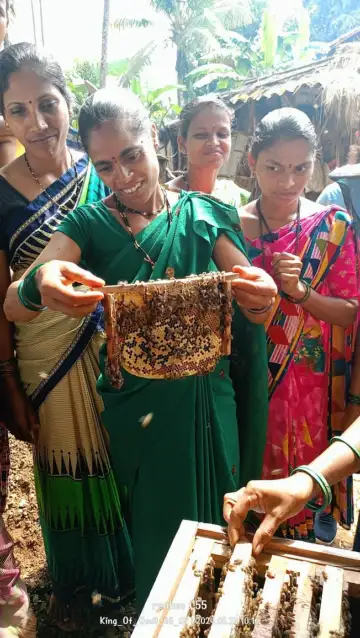 Women attend a training session on beekeeping in Joida. Photo/Swayam of KTR
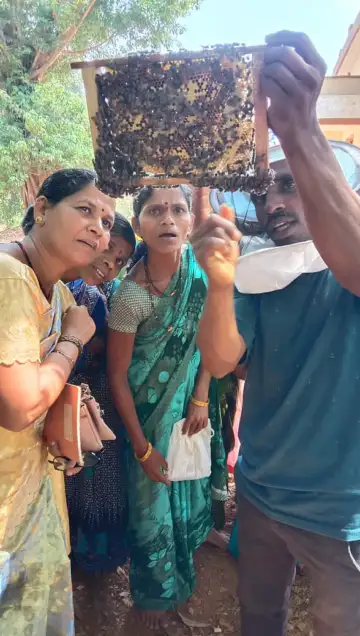 Women attend a training session on beekeeping in Joida.Photo/Swayam of KTR
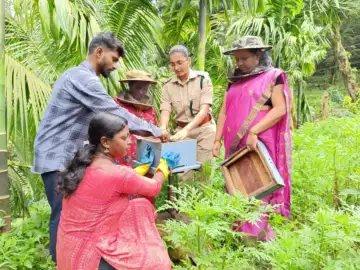 Deputy RFO Gayatri Badiger monitors the progress of the beekeeping training session conducted under Adavi Jhenkara initiative. Photo/Swayam of KTR
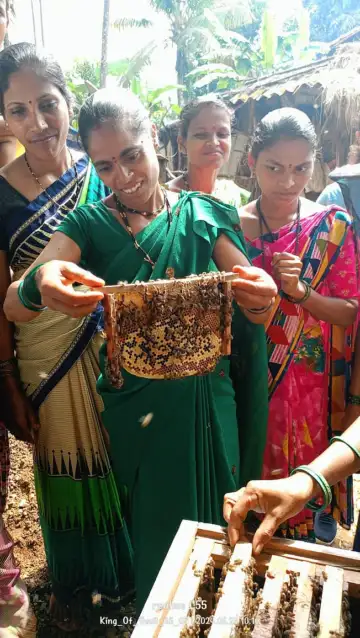 Women attend a training session on beekeeping in Joida. Photo/Swayam of KTR