

It was a sunny morning when I set out from Guwahati for Byrnihat. A day earlier, a local contact had warned me, "Don't forget to wear a mask.
The pollution is high." But I was wearing a full-face helmet and felt that was enough.
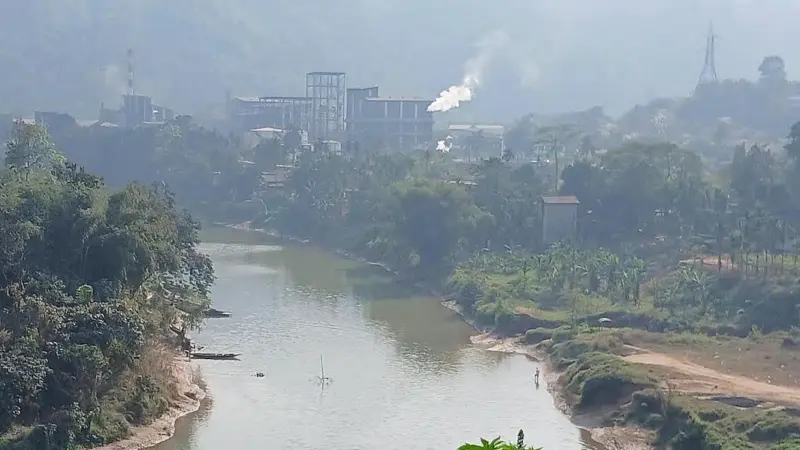
Traffic was light as I cruised along National Highway 2 on my scooter. After about 20 km, I reached Jorabat, a T-junction connecting Guwahati and Nagaon in Assam with Shillong in neighbouring Meghalaya. Turning right, I continued towards the 13th Mile area. By now, the scenic beauty of the hill state had given way to an industrial sprawl - the visibility was hazy, and the smell more acrid. Dark clouds of smoke hung over the distant hills, while trucks lined both sides of the highway. "Trucks aren't allowed to run during the daytime as they cause congestion in and around Shillong," a driver told me. A few kilometres ahead, the air grew heavy with the stench of burnt material, and plumes of smoke billowed from tall chimneys of factories. I knew I had arrived at Byrnihat.
In 2023, and again last year, Bengaluru's Centre for Research on Energy and Clean Air (CREA) ranked Byrnihat as India's most polluted place. In 2024, Switzerland-based IQAir went further, declaring it the world's most polluted, surpassing traditionally notorious cities like Lahore in Pakistan, Hotan in China, and our national capital, New Delhi.
Meghalaya mine blast: Assam announces ex gratia of Rs 5 lakh each for 3 victims' familiesPM2.5 refers to fine particles that can penetrate deep into the lungs and harm health. Under the National Ambient Air Quality Standards (NAAQS), the daily average limit is 60 µg/m³, and levels above this are unsafe. According to CREA's 2025 report, Byrnihat exceeded this limit on 278 of the 356 days monitored. That year, the town recorded 13 days of severe pollution, 30 days of very poor air, 160 days of moderate pollution, and only 78 days of satisfactory air quality. Its annual average PM2.5 concentration reached 100 µg/m³, exceeding the levels in Delhi (96 µg/m³) and Ghaziabad, Uttar Pradesh (93 µg/m³).
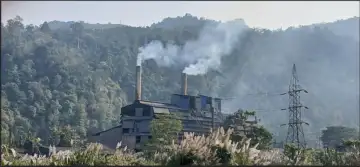
Byrnihat is home to nearly 100 factories, mainly cement and coke plants.
The poor air quality is disrupting daily life and threatening generational livelihood in Byrnihat, a semi-urban industrial hub. Tourists who visit Meghalaya to catch a breath of crisp mountain air have to first contend with the smog of Byrnihat, the state's main entry point. They drive past without stopping, keeping their windows rolled up at all times. The 'most polluted' tag has also triggered a blame game between Assam and Meghalaya. Byrnihat sits on their border. National Highway 6, which connects Jorabat in Guwahati with Shillong, cuts through the town. On the Assam side, the town is called Barnihat and in Meghalaya, it is known as the greater Byrnihat.
Going downhill
"Hope you can feel the smoke in the air. We grapple with breathing problems round the year, but it gets severe during winter," Margaret Shullai, a local, told me when I reached the town of about 40,000 people in mid-January. I learned that falling temperatures create a low-pressure zone, while the hills surrounding the town trap pollutants, preventing them from dispersing.
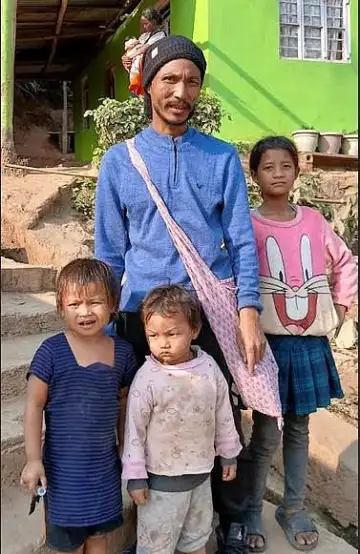
Augustine Sangma, a farmer, says his children struggle to sleep because of the contstant smoke
But Manoj Kumar, lead author of CREA's 2025 report and an air pollution analyst, says Byrnihat's pollution crisis is not just seasonal. "Persistently high concentrations point to continuous emissions from industrial activity and vehicular traffic, rather than episodic events alone," he explains. The town hosts nearly 100 industrial units on both sides, mostly coke and cement plants. Every day, more than 1,000 trucks ferry raw materials to these factories, and a similar number of tourist vehicles cross the highway.
According to Bijoy Rahang, secretary of a local NGO, Byrnihat was once a sleepy town, with green fields, clear skies, and clean water. That started changing in the mid-1990s when industries began arriving. "All those were paddy and corn fields. There were also many orange orchards," says the 52-year-old, pointing to a factory nearby.
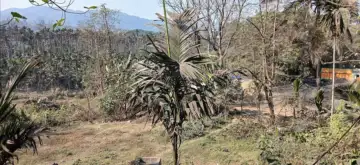
Betel nut trees, an important crop for local farmers, are drying up due to air pollution.
The town is home to tribal communities such as the Karbi, Khasi, and Garo, and most of the land is reserved for them, with outsiders allowed only to lease land. "The land was given to the industries in exchange for money," Rahang explained. Industries were drawn to Byrnihat for two main reasons. Meghalaya has rich reserves of limestone and coal, raw materials for cement and coke plants, while Byrnihat offers good highway connectivity to transport goods. The next wave of industrial push came in 2007 when the Centre offered incentives.
Today, rooftops and tree leaves covered in soot are a common sight. "We have been living with pollution for a long time, but it got attention only after reports named Byrnihat the most polluted town," rued Rahang, from the Karbi tribe.
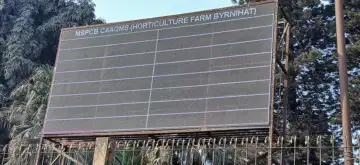
An air quality monitoring system on the Meghalaya side of Byrnihat has been non-operational for some time, say locals.
No public advisory
Some steps have been taken to tackle pollution, but wherever I went, the plea "The government must do something" kept coming up.
Around 2.30 pm, I saw a group of children returning from school. One pinched his nose to block out the stench. None wore masks. There are no banners or posters around the town advising people on how to survive air pollution. "Masks may help if the problem lasts a few days or weeks. It's not possible to wear them all the time," said Suraj Sharma, a BA student who travels 20 km to Dispur in Guwahati for college. "I don't feel like coming back home because of the pollution here," he said, waiting for a vehicle to reach college.
"Children and elders are suffering the most," complained Marak, a farmer, pointing to thick smoke spewing from the chimneys of three factories barely 500 metres from his home. Augustine Sangma, another farmer, agreed. "My children can't sleep at night. Their eyes burn, and they struggle to breathe because of the constant smoke," said the father of five children, aged between two and 14.
A visit to Byrnihat Public Health Centre, the only government hospital in the area, revealed the scale of the public health crisis. A motley crowd of patients, some wearing masks, waited outside a doctor's chamber. Many complained of breathing difficulties and asthma.
Byrnihat's notorious pollution has become a matter of shame for the two states, and public servants are wary of speaking to the media. A doctor, speaking anonymously, said respiratory diseases are now common in almost every family, primarily due to high levels of air pollution. "We see at least 15 to 20 such patients every day," he said. Skin disease is another concern. He fears it is caused by industrial effluents contaminating the streams that run through town. Some residents, including children, still use these streams for bathing and washing clothes.
Livelihoods hit
Cultivation of betel nuts and betel leaves is a major source of livelihood in and around Byrnihat. I passed many withered betel nut trees, while the surviving ones had leaves coated in thick layers of soot. "Betel leaves get damaged because of pollution. Production is falling, and we are facing losses," said Augustine.
Vegetable and fruit yields are also falling. He led me around his farm and stopped at a patch of potatoes to show me how slowly they were growing. "Very few orange and pineapple trees are left in our orchards. The fruits simply don't grow in this polluted air," he said.
Prabal Saikia, a chief scientist at the zonal station of Assam Agriculture University, Lakhimpur, says air pollution interferes with photosynthesis, stunting plant growth and reducing yields. "It also causes soil toxicity when particles settle on the ground due to rain or fog," he says.
As the town industrialised, many residents abandoned generational farming to work as labourers and supervisors in the factories. "Locals do the lower-level work such as loading, unloading, packing, while managers and senior staff come from outside. Most of them don't even live here because of the air pollution. They commute daily from Guwahati," said Biju Das, a resident of Tamulikuchi.
Some, like Sanjukta Debnath, a public sector bank employee, recently took a transfer from Byrnihat to Beltola in Guwahati, about 12 km away, to escape the pollution. "Many others in our branch have been trying for a transfer too. They fear it will impact their health," she says.
Now, as these industries come under scrutiny and face possible closure, Byrnihat's residents are caught in a dilemma. "People have lost their land and now depend on these factories for livelihood. Some residents are already unemployed after the coke plants closed following crackdowns by pollution control boards. Assam and Meghalaya must come up with a joint action plan to tackle pollution instead of shutting down industries," Das said.
Mainland politics
In some sense, the story of Byrnihat is not unique. It reflects a pattern seen across many industrial towns in India. Factories in people's backyards fuel the nation's economy, producing cement, steel, iron, and more, yet the local community pays the price. The promise of jobs and better lives often gives way to choking air, contaminated rivers, and an uncertain future.
"You talk about Delhi, but not Byrnihat. Is it because we are far from the 'mainland'?" a school teacher asked, criticising the media's skewed coverage of the country's pollution crisis.
After Byrnihat started topping the pollution rankings, both the Assam and Meghalaya governments came under heavy criticism and took some action. An official from the Assam State Pollution Control Board said at least 15 industrial units on the Assam side have closed, reducing the number to 40 now. Yet 17 to 18 red category units - industries with the highest pollution potential - remain operational. On the Meghalaya side, R Nainamalai, chairman of the state pollution board, said levels have dropped to moderate after the closure of several red category units. But for locals, little has changed. Iron and steel factories, along with breweries, continue to operate intermittently, spewing smoke into the air.
The Assam official, however, insisted that industries are not the main culprit; vehicular traffic is. "Trucks are not allowed to run during the day in Shillong, so they all run at night. This causes sharp spikes in pollution within a short window," he explained. He also questioned Byrnihat's ranking as the most polluted town. "Many other towns have higher pollution, but their ambient air quality is not monitored properly. If it were, Byrnihat would not come close in comparison," he said. The state of denial runs through Meghalaya's top leadership too. Last year, Chief Minister Conrad K Sangma said, "The high pollution levels cited are on the Assam side, while air monitoring equipment on our side shows moderate or satisfactory levels."
While the authorities claim they are taking action, residents remain unconvinced. "We don't feel any change in pollution levels. Some factories that appear closed during the day operate at night, while others have simply shifted to the Assam side," said Mahananda Goyari, president of the Byrnihat-Tamulikuchi Market Development Society, who lives on the Assam side of Byrnihat. His neighbour, Amarendra Das, who is in his 80s, has been frequently suffering from coughs and colds, and he is sure it is "because of air pollution". His daughter-in-law, Shrutimala, adds, "We can't dry clothes outside. They get dirty because of the soot."
Pollution control boards in both states have installed Continuous Air Ambient Quality Monitoring Systems. Yet, during my visit, one device inside a horticulture campus on the Meghalaya side was not working. "It remains non-operational most of the time," a shopkeeper across the road said. However, a device installed a few kilometres ahead, in Assam, was functioning and it showed moderate pollution levels. But even a report by the Meghalaya government admits that moderate pollution may cause discomfort for people with heart or lung disease.
After spending six hours in Byrnihat, I began feeling dizzy and had a burning sensation in my eyes. On my ride back to Guwahati, I realised why my local contact had insisted I wear a mask along with my helmet.