




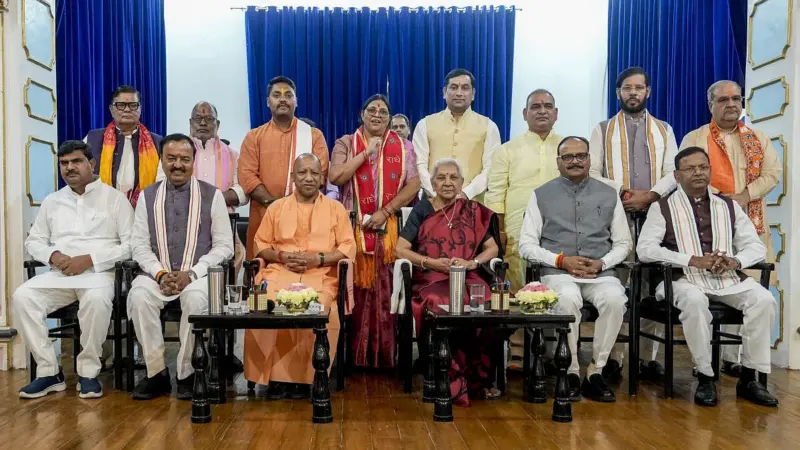

Lucknow: With the Assembly elections in the politically crucial State of Uttar Pradesh barely nine months away, the BJP, through the recent State Cabinet expansion, has attempted to set the caste and regional equations right and also counter the 'PDA' (Pichda, Dalit, Alpsankhyak) formula of the Opposition Samajwadi Party (SP).
Quick summary - click for full detailsConcise summary of key highlights
Caste, regional equations dominate Yogi Adityanath's Cabinet expansion
In one lineBJP's Uttar Pradesh Cabinet expansion strategically balances caste and regional representation ahead of 2027 polls.Key points• Caste-based inclusionThree OBC, two Dalit, and one Brahmin Minister inducted to counter SP's 'PDA' formula and address community grievances.• Regional representationThree Ministers from western UP included to address poor BJP performance in the 2024 Lok Sabha polls.• Targeted Dalit outreachNon-Jatav Dalit leaders like Krishna Paswan and Surendra Diler included to expand beyond BSP's core Jatav vote bank.• Brahmin appeasementManoj Pandey, an SP rebel Brahmin, inducted to placate Brahmin protests over UGC regulations and perceived marginalisation.• Electoral strategyCabinet expansion aims to dilute SP's 'PDA' formula while balancing upper-caste support amid UGC regulation backlash.Key statistics60Total ministers in expanded cabinet6Newly inducted ministers3OBC ministers in expansion2Dalit ministers in expansionNine months awayAssembly elections timelineProcessed with AI. Reviewed by DH Digital Team.
Six new Ministers were inducted into the Cabinet on Sunday, taking the total number of Ministers to its maximum quota of 60 in the State. Of the six newly inducted Ministers, three are from the other backward classes (OBC) community, two are Dalits and one is from the Brahmin community.
With 3 OBCs & 2 Dalits, Cabinet rejig signals BJP's bid to blunt SP's PDA push ahead of 2027 Uttar Pradesh pollsThe inclusion of Manoj Pandey, an SP rebel and Brahmin, appeared to be an attempt to placate the electorally influential community and came in the wake of protests by several Brahmin outfits against the new UGC regulations on promoting campus equity and preventing discrimination through the Promotion of Equity in Higher Education Institutions Regulations 2026 and a meeting by Brahmin MLAs of the party where many of them complained that the community was being sidelined and pushed to the margins in the State.
Two of the newly inducted Ministers, Surendra Diler and Krishna Paswan, hail from the Dalit community, indicating the BJP's attempt to reach out to the non-Jatav Dalits, who were not considered to be the core vote bank of the BSP.
Krishna Paswan's inclusion in the Cabinet is electorally significant as Paswan community voters were considered to be influential in several Assembly seats in central UP and Bundelkhand regions. Surendra Diler hails from the Pasi community, a deciding factor in many constituencies in the State.
Interestingly, as many as three newly inducted Ministers are from the western region of the State and their inclusion is being viewed as an attempt to give more representation to the region where the BJP fared badly in the 2024 Lok Sabha polls.
''The Cabinet expansion, which is likely to be the last before the Assembly polls, is clearly an attempt to set the caste and regional equations right and dilute the PDA formula of the SP and at the same time placate western UP leaders,'' said Lucknow-based political analyst J P Shukla.
Another analyst said the BJP is certain to go all out to expand its support base among the non-Yadav OBCs and non-Jatav Dalits while keeping its 'upper caste' supporters in good humour. ''It may be a tough task given the resentment among the upper caste on the issue of UGC regulations,'' he added.