




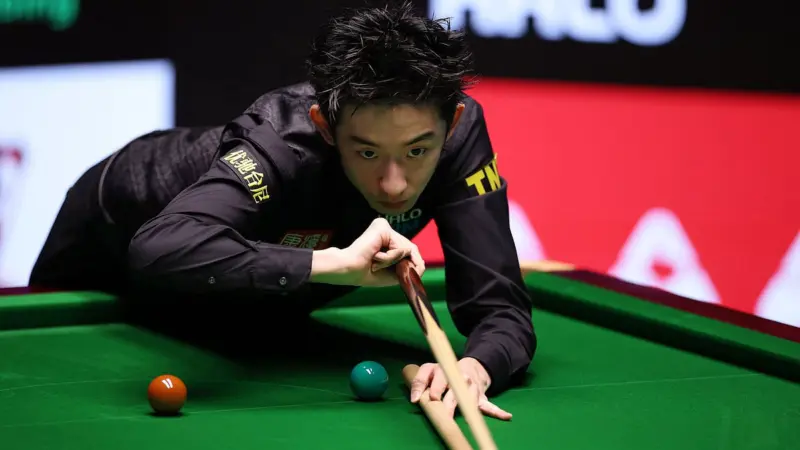

Bengaluru: In May 2025, Zhao Xintong did the unthinkable. Returning to professional snooker in January following a 20-month ban for being involved in match-fixing, China's Zhao pulled off one of the greatest miracles in the history of professional snooker by lifting the coveted World Championships after entering the draw as a qualifier.
Once the bastion of English players who ruled The Crucible with an iron fist for a century, "The Cyclone" Zhao dismantled living legend Ronnie O'Sullivan 17-7 in the semifinal before sweeping aside another great Mark Williams 18-12 in the title clash to become the first Asian to lay his hands on the coveted trophy.
With the glass ceiling shattered, it was time for the Chinese, who barely fail when they set their sights on something, to step on the pedal. This year, a record 11 Chinese entered the main draw of 32, and Wu Yize went on to win the World Championship with one of the mesmerising performances ever seen. Hailed as the next big thing by O'Sullivan himself, the 22-year-old Wu became the second youngest player after the legendary Stephen Hendry to emerge victorious. In a pulsating final against Shaun Murphy, where fortunes swung back and forth, Wu, nicknamed the Priest, showed the calmness of a seasoned monk to script a career-defining era-shifting 18-17 win.
The back-to-back triumphs by the Chinese cueists are the culmination of a near three-decade-old plan. Just like in India, where snooker parlours are found in every nook and corner of most metros and plenty of youth can be spotted playing, mostly for fun, administrators there initially wanted to change that negative perception. Having seen lots of pro snooker videos from UK, they believed the sport could be a possible profession. The Chinese Billiards Sports Association (CBSA) immediately went about restructuring the game, got in a lot of sponsors, started conducting plenty of tournaments, firstly at the amateur level before migrating to staging rankings events on the professional circuit. Slowly, kids started getting serious about the sport - like seen in Olympic disciplines such as swimming, badminton, shooting, weightlifting, etc., to name a few - but they needed that breakthrough moment that would capture the imagination of the next generation for a niche game.
It arrived in April 2005 at the China Open when then 18-year-old Ding Junhui stunned Hendry to wear the crown. ed by over 110 million people, Ding instantly became a national hero, and the image of the sport also got a complete makeover. It was no longer viewed negatively. One of the guys watching Ding on TV was an eight-year-old Zhao. Similarly, thousands of kids aspired to play snooker. Aspiration is one thing, but the migration from amateur snooker at home to the gruelling professional world in the United Kingdom is another. It's like walking into a jungle with hardly any ammunition.
Firstly, until then, most of professional snooker events were largely confined to the UK with some in other parts of Europe. While earning a professional ticket is in itself a painstaking process, living and playing in the Old Blighty is no cup of tea, especially for the Chinese who don't speak the language. While now the competition is simplified and players are guaranteed a sum at the end of the season, back then players had to win at least two or three matches to make money. The investments would far outweigh the returns.
But the Chinese believed they could change the world order. Benevolent sponsors pumped in a lot of money, and a good number of ranking events were staged at home. Ding built his own academy in Sheffield - a stone's throw away from The Crucible - where his compatriots stayed and practised on tables and conditions exactly as on the pro tour. Ding's academy was a home away from home for the Chinese, and that nursery has now become the breeding home of champions - present and future.
Compare this with India, where the sport was conceived by the British circa 1875. While snooker, along with billiards, enjoys good patronage even now and has produced several champions at the amateur level, very few have been able to crack the professional code. Only a handful, like Geet Sethi, Yasin Merchant, Aditya Mehta, Pankaj Advani and Lucky Vatnani tried their hand professionally before opting out for various reasons. Currently, Ishpreet Singh Chadha, a protege of Merchant, is the only Indian on the professional tour.
"It's simple, we prioritise the amateur game while they (Chinese) have made it very, very clear from day one that they prioritise only the professional game," a candid Mehta, who played on the pro tour for a decade, told DHoS. "The amateur game is only a stepping stone for them to move into the big leagues, whereas for us, the amateur game is to effectively be all and end all. So you can say that this is 30 years in the making and 30 years of relentless pursuit of one goal. It's not about any confusion as to what the priorities are. In India, we've never had a goal, except for, you know, winning world titles at the amateur level. This is despite the fact that we have talented cueists."
Mehta, however, defended a cueist's priority to play only amateur snooker. "The moment you turn professional, you are on your own in India. Living and playing in the UK, unless you have sponsors, is no joke. One needs at least Rs 25 lakh a year. The word pro is like a taboo. But when you play and win titles on the amateur circuit, you are guaranteed government funding and jobs. Sports is a profession and we need financial security. So unless sponsors come on board and the mentality changes towards professional snooker, things are going to be bleak in India. We will still be stuck at the amateur level."
BSFI president S Balasubramaniam, who was instrumental in conducting five Indian Open (a professional ranking event) tournaments from 2013 to 2019, said getting sponsors for a non-Olympic sport is extremely challenging. "Firstly, although snooker originated in India, it was billiards that was more loved. In China, plenty of sponsors come on board and are committed to the cause. In India, to get sponsors for snooker is a Herculean task.
Sourav Kothari urges for cue sports' inclusion in Commonwealth Games 2030"This is the reason why many of our cueists prefer playing on the amateur level. If your ranking is below 50, it's really hard to make money. Most sports in India rely a lot on government funding. But since we are not an Olympic sport, we are not in the top category as far as the government is concerned. Funding works accordingly. However, at the same time, I admit we can't always rely on government funding. We can't say the government is not giving us money; we are not able to progress.
"Corporate sponsorship is not forthcoming for a sport like snooker. People started off with a lot of other leagues like badminton, volleyball, etc, what happened? Nothing sustained. Take even ISL, after the 10-year deal with Reliance ended, they struggled. Imagine if an universally popular sport like football is unable to get sponsorship, then think about a niche one like snooker. There's a lot of scope in pool, however, and we are trying to tap into that. And most of our players are warming up to it." Balasubramaniam offered.
That sums up what the future holds. Professional snooker will still be like climbing Mount Everest for Indians, while for the Chinese, who are at the summit now, it's about creating a new world order.
 Zhao Xintong
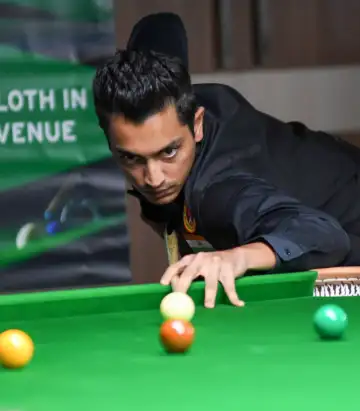 Aditya Mehta