

Global greenhouse gas emissions at the current rate will unleash heatwaves in 74% of the geographic ranges of a whopping 33,936 species of vertebrates (mammals, birds, amphibians and reptiles) by 2050, a new study has warned, underscoring the urgent need to cut emissions to align with the Paris Agreement to reduce damage.
The study published on Friday in Nature Ecology and Evolution, authored by an international team of 18 scientists, and led by the Potsdam Institute for Climate Impact Research (PIK), said the current emissions match more closely with the medium-high emission scenario (SSP-3.70) projected by the Intergovernmental Panel on Climate Change.
While some animals may adapt to an extreme weather event, the study noted that climate change was intensifying extreme events beyond what many species were likely to be able to adapt to, especially within a short period of time. As a result just one heatwave, flood or fire can devastate animal populations.
The researchers set out to study the vulnerability of species by examining how exposure to different types of extreme events and to multiple hazards is projected to change compared with the base year of 2000.
If countries commit to the Paris Agreement of staying below 2 degrees Celsius warming, 63% of the area within species' ranges will be exposed to heatwaves by 2050, this corresponds to a 45% increase of area exposed compared to 2000 levels.
Wildfires
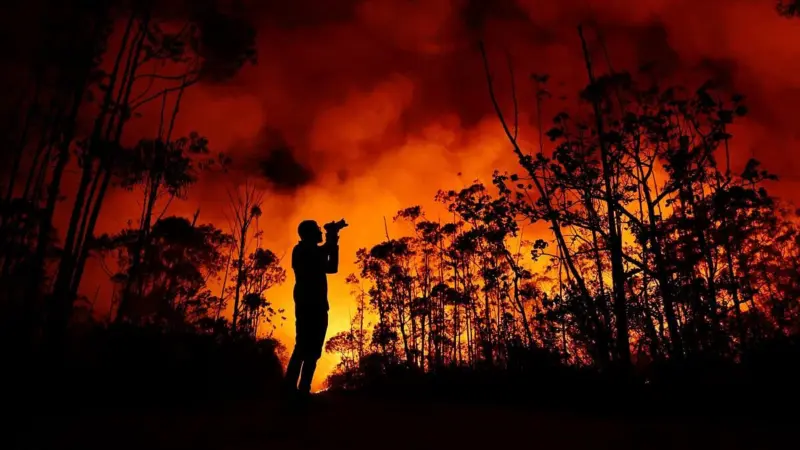
Extreme wildfires are projected to be the second most prevalent event with the current rate of emissions exposing 16% of the range by 2050 and this is projected to increase to 25% of the range by 2085. Hotspots for increased wildfire frequency in species-rich areas are the Amazon basin, southern Africa, and Southeast Asia.
While drought exposure was low at 8% of the species' range, it was projected to increase to 14% by 2085. However, strong increases in flood exposure were projected for localised areas in Central Africa, taiga and tundra by 2085.
Notably, 14% of the range area will experience at least two extreme events by 2050 and the area will go up to 36% by 2085. Under the low to middle emission scenario (SSP-1-2.6) the affected area will be relatively low at 9% of the range.
"I think climate change, and in particular extreme events, are still really being underestimated when it comes to conservation planning. It's not just going to be a gradual shift of temperature over many years," said lead author Stefanie Heinicke, a postdoctoral researcher at PIK.