
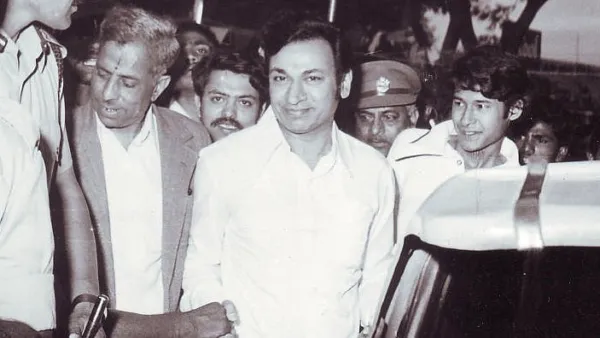

This season of recollections and reflections on one of the greatest Kannada cultural icons, Rajkumar, brings to mind an occasion when I met him about 44 years ago.
When I was working with DH in Chennai, I was tasked with getting his reaction to incidents of violence against Tamils and Tamil Nadu during a Kannada language agitation.
The Editor had told me that the purpose was not to provoke him to say something that would worsen the raging agitation in Karnataka, but to focus on what he says that perhaps could calm tensions.
After hearing a lot about the formidable Rajkumar from my colleagues in Chennai, I was in even more awe of the star. I had made it my duty to see some of his films and read up on him, because his hold on the public mind made him more than a film star.
It was with trepidation that I set out to meet him for his comments on the issue. He was in Madras for a film shoot, along with actor Jayaprada. Anti-Tamil violence was raging in KGF. I expected a fire-breathing linguistic chauvinist, and was apprehensive about how we would communicate: I knew no Kannada then, and he was not comfortable in English. Would he speak in Tamil?
I was disarmed the moment we met on the sets and shook hands. Rajkumar spoke softly, in Tamil: "We have nothing against Tamils or Tamil Nadu; any (violent) incidents are unfortunate, not intended." His message was that those fighting for Kannada should not resort to violence. It was a very brief interview.
In many films, the first sight of Rajkumar is a glimpse of his feet. In life as in films, the evergreen Kannada matinee idol stood firmly on his feet; steadfast, never swayed by passing political winds. His politics was his love of the Kannada language. His passion was to ensure that its primacy prevailed in Karnataka, and he led many campaigns for Kannada.
Rajkumar, a rare phenomenon who put his love for Kannada language above politics and ruled heartsRajkumar was a rare phenomenon. His mammoth fan following swelled with the release of each of his over 200 films, in a career spanning over 50 years. As a screen phenomenon, he had no peer, perhaps except MGR, though the latter was more of a totemic fetish despite being a product of the cultural politics of the Dravidian movement. Yet, in a general sense, Rajkumar, along with MGR, belonged to a firmament of film stars the like of which may never be seen again. NTR too had a place in this universe, for these were cultural icons defined by the multitudes they moved.
Rajkumar has played every conceivable role in his films, and barring the early few, every one of them was a runaway success. The surging crowds to see his film would build up days before they were released, and rare was the occasion when on the opening day, the theatre did not announce 'House Full for the Week'. People often cycled from distant towns and villages to see his films on the first day, if not the first week. Some would shell out a whole month's salary - running to several hundred rupees - to buy a ticket in 'black'.
Such was Rajkumar's hold on the popular mind in Karnataka.