
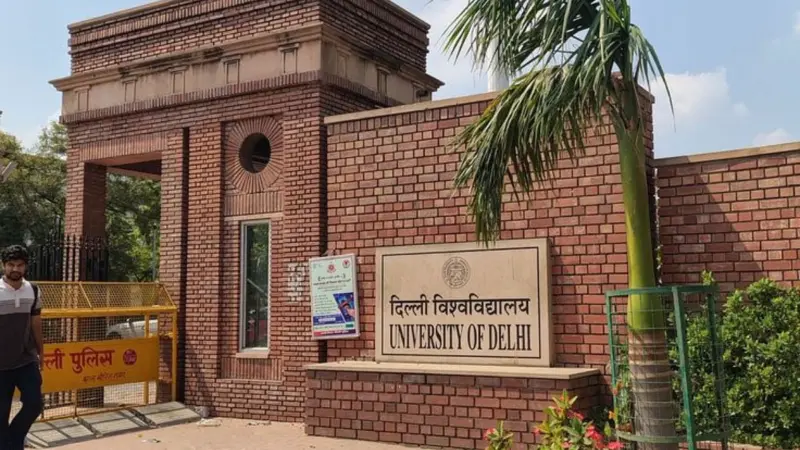

The University of Delhi (DU) has cleared a proposal to introduce a 'Semester Away Programme' (SAP) at the recent Academic Council meeting, a move that could significantly reshape undergraduate education by allowing students to spend a semester at foreign universities.
Aligned with the Undergraduate Curriculum Framework (UGCF) 2022 and the broader vision of the National Education Policy (NEP) 2020, the proposal aims to bring greater academic flexibility, global exposure, and interdisciplinary learning opportunities to DU students.
What is the Semester Away Programme?
The Semester Away Programme is a proposed academic initiative that would allow DU undergraduate students to:
Spend one semester at a recognised foreign university.
Pursue academic coursework, internships, or training.
Transfer the credits earned abroad back to DU.
In simple terms, students remain enrolled at DU, but temporarily study at a partner international institution without losing academic continuity.
Delhi University UG admissions 2026 to begin in June; Check eligibility, fee structure and moreWho will be eligible?
According to the proposal, students enrolled in undergraduate programmes from the 2022-23 academic batch onwards will be eligible for the programme.
Participation will be allowed only in specific semesters, including third, fifth and seventh semesters.
This restriction is to ensure that the students have already built foundational knowledge and that their degree progression remains unaffected.
How will it work?
One of the most important aspects of the programme is credit transfer. Students can earn between 12 to 26 credits during the semester abroad
These credits will be recognised under UGC Regulations, 2022, as well as integrated into the student's DU academic record.
This means no loss of academic year and no need to repeat coursework.
What can students do during the semester abroad?
The SAP is not limited to classroom learning. As per the proposal, students can:
Take academic courses in their field or interdisciplinary areas.
Pursue internships or training programmes.
Engage in research projects.
Experience different teaching methods and academic systems.
Why is DU introducing this?
The programme is part of a larger shift in higher education policy.
Key objectives include:
Global exposure: Familiarising students with international academic environments
Flexibility: Allowing personalised learning pathways
Skill development: Enhancing employability and global readiness
Academic collaboration: Strengthening ties with foreign universities
It also builds on existing reforms such as multiple exit options, credit-based systems and interdisciplinary learning under UGCF 2022.
Will all students be able to afford it?
Cost is a major concern, and DU appears to be aware of this. The proposal includes financial assistance for meritorious students from economically weaker sections (EWS)
Details are yet to be finalised, but this could include scholarships, financial support and possibly travel or living assistance. However, the extent of funding and coverage remains to be clarified.
Concerns raised: Teachers flag gaps in policy
The proposal has also drawn criticism from sections of the teaching community, including the Academic Action Committee of Delhi Teachers' Association (AADTA), which has opposed the move, calling it top-down and warning of academic instability.
Teachers have pointed to vague criteria for selecting foreign universities, raising concerns about potential misuse, and flagged the absence of clarity on reservation policies. Questions have also been raised about affordability, with concerns that the scheme could increase financial burden on students and the university.
Faculty members have further highlighted practical challenges, including difficulty in ensuring course equivalence, possible loss of credits or non-transfer of grades, and programme mismatches that could delay graduation. They have also cautioned that the focus on mobility and credit accumulation may come at the cost of in-depth subject learning, alongside administrative delays and increased costs.