




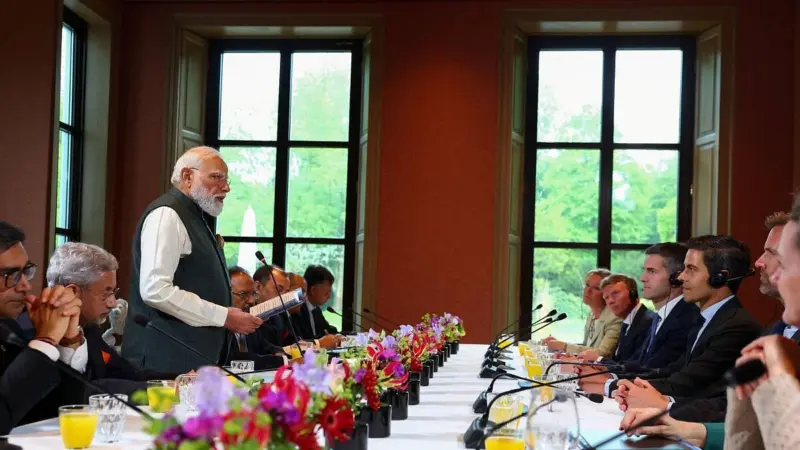

New Delhi: India and the Netherlands have agreed on a roadmap to elevate the bilateral relations to a strategic partnership, with particular focus on defence industrial cooperation, which once remained limited, partially due to the Dutch submarine and naval technology exports to Pakistan.
Before Prime Minister Narendra Modi concluded his visit to The Hague on Sunday, he and his Dutch counterpart, Rob Jetten, witnessed the signing of 13 other pacts, in addition to the roadmap for strategic partnership.
A Memorandum of Understanding on Mobility and Migration between the two governments and a Roadmap for Cooperation in the Development of Green Hydrogen were among the pacts inked during the visit.
The two sides also agreed to negotiate a mutual legal assistance treaty and a new extradition treaty.
India, Netherlands elevating ties to strategic partnership: PM Modi after talks with Dutch counterpartThe roadmap to strategic partnership, agreed upon during the Modi-Jetten meeting, focuses particularly on defence industrial cooperation with the opportunities to be jointly explored by the Society of Indian Defence Manufacturers and the Netherlands Industry for Defence and Security.
Since the Cold War years, India-Netherlands defence engagement remained restrained amid New Delhi's concerns over Dutch military supplies to Pakistan, particularly in the naval sector.
Pakistan's navy acquired Dutch-origin platforms and technologies over the decades, including mine countermeasure vessels, offshore patrol ships, radar systems and submarine-related expertise. In 2022, the Netherlands transferred two retired Alkmaar-class minehunters - HNLMS Haarlem and HNLMS Middelburg - to Pakistan, strengthening Islamabad's naval inventory and renewing Indian apprehensions over European military support to its neighbour.
The issue came up during Defence Minister Rajnath Singh's discussions with his then Dutch counterpart, Ruben Brekelmans, in New Delhi in March 2025. Singh conveyed New Delhi's unease over military exports to Pakistan and stressed that nations seeking closer strategic ties with India should avoid supplying defence equipment or sensitive technologies to countries that support terrorism and destabilise the region.
India, however, is looking to expand defence cooperation with the Netherlands in areas such as naval shipbuilding, submarine technologies, underwater surveillance systems, mine countermeasure capabilities, radar and sensor technologies, maritime domain awareness and high-end electronics.
Dutch expertise in naval engineering, semiconductor equipment and dual-use technologies is also seen as valuable for India's broader push towards defence modernisation and indigenous manufacturing, sources in New Delhi told DH.
"My talks with Prime Minister Rob Jetten were extensive, covering a wide range of topics. One such area is related to defence and security. I spoke about the possibility of a defence industrial roadmap at the earliest," Modi wrote on X after meeting the prime minister of the Netherlands. "We can also work together in sectors such as space, marine systems and maritime security."
The two leaders expressed deep concern over the situation in West Asia, noting its serious implications for the region and the wider world. They expressed hope for lasting peace in the region. They also called for freedom of navigation and unimpeded flow of commerce through the Strait of Hormuz, opposing any restrictive measures on the maritime traffic.
Since the launch of the war on Iran by Israel and the US on February 28, the widening conflict in West Asia has led to the disruption of maritime traffic through the critical choke point between the Persian Gulf, on one side, and the Gulf of Oman and the Arabian Sea, on the other. Modi and Jetten welcomed the ceasefire between Iran and the United States announced on April 8, underscoring the importance of de-escalation, dialogue and diplomacy.
"The closure of the Strait of Hormuz has resulted in high energy prices. As in the Netherlands, the impact on India has been severe too," Jetten said after meeting Modi. "So, it's vital that this conflict be ended and that a lasting solution be found."