
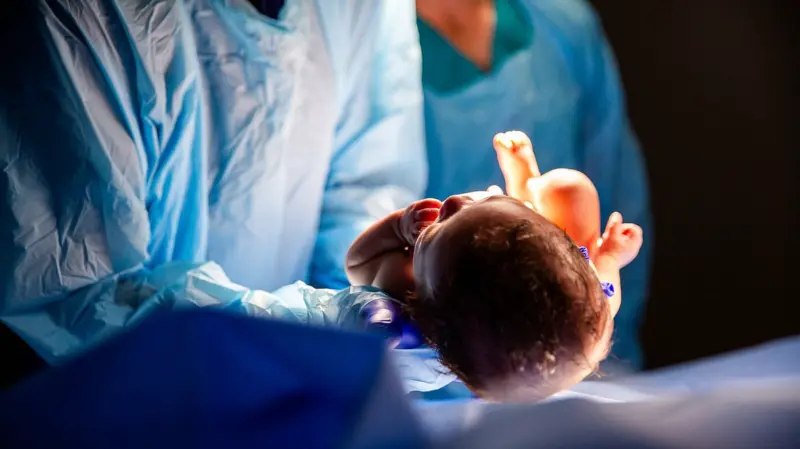

A woman with leaking amniotic fluid kept waiting for labour pains. By the time she went to the hospital, she had already developed severe infection (sepsis), was in shock with very low blood pressure, and could not be saved.
This is not an one-off instance. Another case in point is a woman who had not taken proper antenatal check-ups continued to wait at home for natural labour, then went to emergency in a critical condition after developing convulsion (eclampsia).
Were women supposed to give birth against gravity? Expert explainsThen there are other instances where patients waited beyond due dates expecting normal labour, but the baby had already died inside the womb by the time they reached the hospital.
Why the deadly wait, you ask? It all boils down to the fear of C-section and, in some cases, the never-ending wait of labour pains to come.
But why the fear of C-section?
"Fear of C-sections is largely driven by cultural beliefs, misinformation, and social pressure. Even today, there are families who believe that vaginal delivery is the only natural method, while C-sections are viewed as a medical failure or unnecessary procedure," said Dr Nirmala Chandrashekar, Consultant, Obstetrics & Gynaecology, Fortis Hospital, Nagarbhavi, Bengaluru.
Dr Pranathi Aravind, Senior Consultant, Obstetrics and Gynaecology Specialist, Gleneagles BGS Hospitals, Kengeri, BangaloreOne important point I would like to highlight is that while the expected date of delivery is around 40 weeks, most babies are mature enough to be delivered after 37 weeks. During antenatal check-ups, if there are high-risk factors such as diabetes or pregnancy-induced hypertension, these patients require closer monitoring and may also require a C-section.Add to it the concerns about post-surgical pain, longer recovery, future fertility, expenses, and even myths such as developing severe backache after spinal anaesthesia.
"This fear often leads to delay in decision-making, even when doctors clearly advise a C-section for the safety of the mother and baby," Dr Chandrashekar added.
While reports suggested that fear of pain was the reason behind increasing C-section rates in urban areas, especially in Bengaluru, the bigger picture is that C-sections are still one of the most feared form of deliveries.
"While C-section rates may appear to be increasing in urban areas, the larger issue is that many necessary C-sections are still delayed due to stigma and fear. The decision for a C-section is made based on medical indications such as fetal distress, prolonged labour, or maternal health risks. It is not a matter of preference alone but of safety for both mother and baby," Dr Chandrashekar explained.
Dr Yasmin Imdad, Senior Consultant - Obstetrics and Gynecology, Rainbow Children's Hospital, MarathahalliMany women believe normal delivery is the only "right" way and see C-section as a failure.Coping with hormonal shiftsThe top three fears that patient voice about C-sections are post-surgical pain, delayed recovery, and concerns about future pregnancies.
Then, there's the stigma of being judged. Because even today a vaginal delivery is called "normal delivery". But the reality is far from it.
"There's vaginal delivery and then there's C-sections. Terms like 'normal delivery' are commonly used in society. They can create unnecessary perceptions and stigma around C-sections, even when they are medically appropriate and life-saving," Dr Chandrashekar opined.
She added that she has seen many patients with fears that arise from the fact that women often feel judged if they are not going to have a "normal" or vaginal delivery.
"Many women feel that they are not good enough if they do not deliver through the natural passage," Dr Pranathi Aravind, Senior Consultant, Obstetrics and Gynaecology Specialist, Gleneagles BGS Hospitals, Kengeri, Bangalore, said.
At the same time, many women feel emotionally drained or inadequate if they are not able to have a vaginal delivery.
"There is often immense pressure on the woman to prove herself, that she can bear the pain and push the baby out, which adds to the emotional burden," Dr Aravind said.
However, she highlights that a C-section that is performed at the correct time will prevent major medical issues such as fetal distress, obstructed labour, or uterine rupture.
"Both C-section and vaginal delivery have their own risks, the safest approach depends entirely on the clinical situation. At the same time, a prolonged or complicated vaginal delivery can increase the risk of infection, maternal exhaustion, and reduced oxygen supply to the baby. The focus is always on choosing the option that offers the safest outcome rather than following a fixed preference," Dr Aravind explained.
Debunking myths
The fear and stigma behind C-section also arise from the colossal amount of myths it is surrounded with.
From being tagged as the easier option to believing one C-section means more C-sections in future, there's a lot of burden on this life-saving surgical option to bare.
"One of the most common myths is that a C-section is the "easier" or "less natural" birth than compared with other births, although the procedure requires extensive surgical work," Dr Aravind said.
Another misconception is that once a woman has a C-section, all future deliveries must also be surgical, even though many women may be eligible for a vaginal birth after C-section (VBAC).
"One common concern I have come across with patients is related to regional anaesthesia. Many believe that the effects of spinal or epidural anaesthesia are long-standing and may lead to future spinal problems or continuous low back pain," Dr Aravind pointed out.
However, that is not the case. The back ache, in most cases, usually stems from failure of taking supplements, poor nutrition, lack of rest and poor posture during breastfeeding.
"Patients often forget that post-delivery, they need to continue taking iron and calcium supplements, which are important for recovery. Chronic back pain, in most cases, has no direct relation to the regional anaesthesia administered during the surgery," Dr Aravind explained.
Another common myth is that C-sections always result in a very long and difficult recovery.
"While it is true that it is a major surgery and requires some recovery time, advances in surgical techniques, anaesthesia, pain management, and post-operative care have significantly improved outcomes. Many women are able to start moving within a day, resume basic activities within a few days, and recover well over a few weeks with appropriate medical guidance and family support," Dr Chandrashekar explained.
Then there's another big fear that C-sections negatively affect bonding with the newborn or breastfeeding.
"With early support and guidance, skin-to-skin contact and breastfeeding can be initiated soon after surgery, and most mothers are able to establish a healthy bonding experience with their baby," Dr Chandrashekar added.
 What really happens after childbirth? Experts explain how postpartum depression can look like
 High costs add to patient's woes
That said, while better awareness and improved dialogues can help fight off the fear of C-section, another major problem still stands tall - the cost included.
C-section, at most private hospitals range from anywhere between Rs 1,30,000 to Rs 2,50,000 depending on the condition of the patient and the newborn. The high costs usually add to C-section aversions with many people believing that C-sections are merely money-making machines.
"Cost is often perceived as a major concern, but it is also important to address the misconception that C-sections are done primarily for financial gain, which is not true. The primary goal is always the safety of the mother and baby," Dr Chandrashekar explained while adding that in many settings, costs have become more regulated and accessible, and options such as insurance coverage can help reduce the financial burden.
Dr Imdad agrees and says that cost is definitely a concern for many, especially in private hospitals, as a C-section involves surgery, anesthesia, more consumables, and a longer hospital stay.
"To make it more accessible, hospitals should offer transparent and affordable maternity packages, and encourage people to have insurance coverage for both vaginal and C-section deliveries," Dr Imdad explained.
She added that government schemes and public hospitals can further help by providing low-cost or free C-sections.
"Ultimately, cost should never delay a medically necessary, life-saving procedure," Dr Imdad concluded.
Probe ordered after woman, newborn die after C-section performed on instructions given by doctor over phone