

A few months ago, I walked into a classroom, looked at a group of high school students, and asked them a simple question:
"How many of you would ever consider studying agriculture?"
The silence that followed wasn't just quiet-it was almost clinical.
A few students smiled awkwardly. One boy finally said, "Ma'am, I'm aiming for the IITs. I want to build AI, not drive a tractor. Agriculture is for farmers, right?" Another student added, "We want something modern-data science, machine learning. The future is tech, not farms."
I didn't blame them. Their answers were honest. But those responses also revealed something deeper: we have failed to show young people what agriculture actually looks like today.
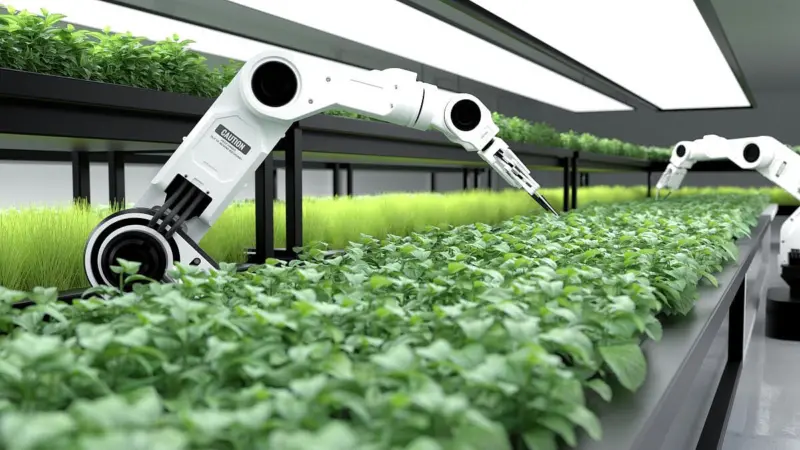
Most students still imagine a man standing in a field with a plough. What they do not realise is that some of the most advanced technologies in the world-drones, artificial intelligence, genetic engineering, and satellite imaging-are already transforming how food is grown.
The future of farming is no longer confined to soil and fields. It now lives in laboratories, data centres, startup offices, and research stations.
And for students willing to look beyond old stereotypes, that future is full of opportunities they may never have considered.
Feeding a Planet Under Pressure
According to the United Nations, the global population could reach nearly 10 billion by 2050. At the same time, climate change is disrupting the very systems that sustain agriculture. Temperatures are rising. Rainfall patterns are becoming unpredictable. Water resources are shrinking.
These are not problems that traditional farming methods alone can solve.
Agriscience is no longer simply about growing more food-it is about growing food smarter. It means using data to predict crop diseases, designing seeds that can survive drought, and developing technologies that reduce water usage while increasing productivity.
Agriculture has quietly become one of the most interdisciplinary fields in the modern world. It draws from biology, artificial intelligence, robotics, climate science, genetics and business.
India's next agricultural revolution will be AI-driven: Minister Jitendra SinghIndia and the Next Agricultural Revolution
For India, the importance of agriscience is even greater. Despite rapid urbanisation and the growth of technology sectors, agriculture continues to sustain a large portion of the population and remains a crucial pillar of the economy. Yet the sector faces enormous challenges-declining soil health, falling groundwater levels, and the growing impact of climate change and shortage of trained graduates.
The encouraging news is that India has been investing in agricultural science for decades.
The Indian Council of Agricultural Research (ICAR) leads a vast network of research institutes and agricultural universities across the country. Institutions such as Punjab Agricultural University, Tamil Nadu Agricultural University, and the Indian Agricultural Research Institute in Delhi have long been centres of innovation.
These were the institutions that powered the Green Revolution of the 1960s and 1970s, transforming India from a food-deficient nation into one of the world's leading agricultural producers.
Today, these same institutions are preparing for the next agricultural revolution-one driven not only by improved seeds and fertilizers, but by technology, sustainability and scientific research.
India's Quiet Agri-Tech Boom
There is another story unfolding in India that many students rarely hear about.
Over the past decade, the country has built one of the world's most dynamic agri-tech startup ecosystems. More than a thousand startups are now working to modernise agriculture using technology.
Companies like Ninjacart, DeHaat, AgroStar and CropIn are building digital platforms that connect farmers directly with markets, improve supply chains, and provide real-time advisory services.
Some startups use satellite data and artificial intelligence to monitor crop health and predict yield. Others develop smart irrigation systems and soil sensors that help farmers conserve water and optimise inputs. Some platforms even deliver hyper-local weather forecasts tailored to specific villages.
These companies are not looking only for agriculture graduates. They need software developers, data scientists, engineers, economists and entrepreneurs.
For a student interested in innovation or building a startup, agriculture is quietly becoming one of the most exciting frontiers.
Careers That Didn't Exist a Generation Ago
Perhaps the most fascinating aspect of agriscience is the emergence of careers that simply did not exist a decade or two ago.
Precision agriculture specialists analyse large volumes of data collected from drones and satellite imagery to guide farmers on when to irrigate, fertilise or harvest.
Plant biotechnologists are developing crop varieties that can withstand drought, resist pests and adapt to changing climate conditions.
Agricultural drone operators now monitor thousands of acres of farmland using high-resolution aerial imaging.
Engineers are designing vertical farms inside urban buildings, where vegetables grow in controlled environments under LED lighting without soil or sunlight.
Researchers are also converting agricultural waste into biofuels, biodegradable plastics and sustainable materials, creating new industries from what was once discarded.
Agriculture is not becoming high-tech. It already is.
Young people who want their careers to have a tangible impact on the world, agriscience offers something rare: the chance to combine scientific innovation with real societal value.
Ironically, the biggest challenge facing agriscience today is not a lack of opportunity. It is a lack of awareness.
Many students still believe that success lies only in glass-walled corporate offices in Gurugram, Bengaluru or Mumbai. They see agriculture as something traditional and outdated.
What they do not see are the laboratories, research centres, drone technologies, data platforms and startups quietly reshaping the sector. This perception needs to change as the next generation of agricultural professionals will not only be farmers. They will be scientists, engineers, entrepreneurs, coders and climate innovators.
The roots of agriculture will always remain in the soil. But its future belongs to the young minds willing to reimagine what is possible.
Agriculture once defined our past. Agriscience will define our future.
(The writer is Education counselor.)