




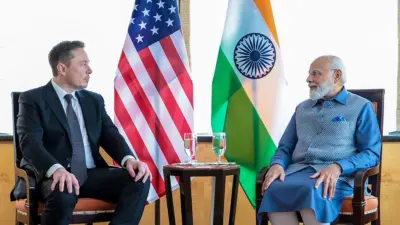

Elon Musk appears to feel 'Elon-gated' in India. After years of preparing to launch Starlink, his satellite-Internet business, he is still waiting for the final regulatory clearances to begin commercial operations.
Frustrated, he has suggested that powerful Indian business interests are protecting their monopolies, even asking whether Mukesh Ambani is the "real boss of India".
It is a clever play for global attention, but it raises a question far more consequential than Musk's impatience: must India lower its guard whenever a global technology billionaire wants access to its market?
The facts, however, deserve more attention than the theatrics. Starlink has obtained an initial licence, but security clearances and spectrum-related approvals remain outstanding. The government says the regulatory process applies to Starlink, Reliance Jio Satellite Communications, and Eutelsat OneWeb, and has rejected allegations of discrimination.
A company's global reach, its technological sophistication, and its owner's extraordinary wealth and closeness to the White House cannot confer a special right to enter the Indian market on its own terms. Nor does a delay in regulatory approval automatically establish that somebody is protecting a monopoly.
We should understand the strategic importance of Satellite communications. A network that can connect a remote village, a ship at sea or an area beyond the reach of conventional broadband can be transformative. Yet the same technology can carry communications across borders, operate beyond the familiar footprint of terrestrial networks, and create dependencies that may become difficult to unwind. The promise is immense, but so are the questions about security, surveillance, data, jurisdiction, and control.
But satellites cross borders, and sovereignty cannot depend on a foreign company's assurances. Where does Indian data travel? Can our agencies lawfully intercept communications or restrict services when security demands it? And if things go wrong, how easily can Indian consumers or the government hold a foreign operator accountable? Indian ownership does not guarantee better conduct, but domestic jurisdiction offers more direct avenues for legal redress and political accountability.
Sovereignty cannot be outsourced to billionaires
For decades, countries worried about who controlled their ports, oil supplies, power grids, and defence systems. The digital age has added communications networks, cloud infrastructure, data centres, and satellite systems to that list. The strategic question is increasingly about who owns the infrastructure, who controls its operations, and what happens when commercial interests collide with national priorities.
India needs a deep sovereign moat around critical digital infrastructure. That means domestic capabilities, secure networks, regulatory authority, and credible alternatives when foreign suppliers become unreliable or strategic relationships change.
This is why the government has every right to examine Starlink's security arrangements and decide what safeguards are necessary. The same right belongs to every sovereign country.
'Is Ambani the real boss of India?': Musk doubles down as govt rejects Starlink charges; 'Wait till you discover the other guy', Rahul respondsOf course, sovereignty must not become a convenient excuse for endless paperwork. If clearances are pending, the government should explain what remains to be done, and complete the process within a reasonable timeframe. Rules must be consistent, and regulators must be accountable for delays. But there is a world of difference between demanding administrative efficiency and suggesting that India owes a company unconditional entry because it has already entered other markets.
Indian business needs no foreign moral lectures
Musk's allegation against Indian conglomerates raises another question. Why should an established Indian business be expected to surrender its market simply because a formidable foreign competitor wants a share of it? Every business has a right to defend its commercial terrain through investment, innovation, pricing, and competition within the law. Protecting market share is part of business everywhere, not some uniquely Indian affliction.
Look at the Western world, where corporate giants fight fiercely to protect their markets, acquire competitors, lobby governments, and influence the rules under which they operate. Technology companies have built enormous businesses around platforms that shape how people communicate, consume information, and conduct commerce. Their private capital gives them the ability to compete across borders and influence public narratives on a scale that few institutions can match. The sharks in Western waters are no less formidable than those in India.
India has its own market quirks, and allegations of preferential treatment towards certain conglomerates deserve scrutiny. But our leading business groups have demonstrated project management, execution at scale, and the ability to deliver complex infrastructure that can stand alongside the global best. A country accounting for roughly one-sixth of humanity, with a young population and enormous technological ambitions, cannot afford to hand over its frontier industries to Western companies before building the capacity to compete on its own terms. Our dependence on US Big Tech for much of our digital infrastructure is already a strategic vulnerability that India must learn to manage.
A foreign billionaire cannot turn suspicion into a verdict simply by posting it to millions of followers. Nor should his company's commercial ambitions be confused with the Indian public interest.
Centre, Elon Musk clash over Starlink licensing delaysThere is an irony in seeing global technology leaders cast themselves as champions of fairness while commanding extraordinary economic and narrative power. Their businesses have interests to protect, markets to capture, and competitors to outmanoeuvre. They are entitled to make their case in India, just as Indian businesses are entitled to defend theirs. They are not entitled to a higher moral standing merely because they operate at a global scale.
Political theatre must not eclipse national interest
The political response to Musk's remarks has been equally revealing. Rahul Gandhi's exchange with the entrepreneur, including his reference to another powerful figure in India, turned a regulatory question into an opportunity for political theatre. Politicians are entitled to question corporate influence and demand answers from the government. They should also understand what is at stake when they endorse a foreign billionaire's framing without examining the technology behind the controversy.
There are two possibilities. They may be underestimating the risks that frontier technologies pose to sovereignty, security, and democratic accountability. Or they may recognise those risks but find Musk's complaint politically useful.
The real test of sovereignty is whether India can engage with the world's most powerful companies without being overawed by their money, technology or ability to command global attention. We should welcome innovation, invite investment, and compete with the best. But the terms must be India's to set, because the consequences will ultimately be borne by Indians.
Srinath Sridharan is a corporate adviser and independent director on corporate boards. X: @ssmumbai. Anand Venkatanarayanan is a strategic security and digital policy researcher. X: @iam_anandv.(Disclaimer: The views expressed above are the author's own. They do not necessarily reflect the views of DH.)