





Bengaluru: The EV boom isn't just about cars or two-wheelers. It is also about jobs. While hiring across IT, FMCG and traditional manufacturing remains moderate in 2026, the country's electric vehicle industry is surging ahead as one of the fastest-growing job engines in the country.
Workforce experts say the EV ecosystem is projected to generate 30-40 million jobs by 2030, outpacing growth in most legacy sectors as investments shift from assembly lines to batteries, software, charging infrastructure and circular manufacturing.
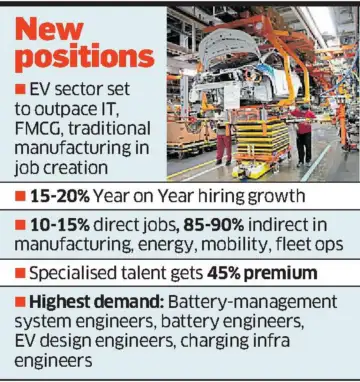
According to Adecco India, an HR solutions company, annual EV hiring is set to grow 15-20% year-on-year. Of these, 10-15% will be direct jobs and 85-90% indirect, spread across manufacturing, energy systems, mobility services and fleet operations.
"India's EV journey is creating an opportunity to reimagine how talent is developed for the industries of the future. We expect nearly 70% of the workforce demand over the next five years to emerge from technician, specialist and frontline operational roles, making vocational education, apprenticeships and industry-certified learning pathways increasingly critical," said Deepesh Gupta, director and business head, general staffing, Adecco India.
As the sector expands, the country's competitive advantage will extend beyond manufacturing capacity to create a pipeline of 30-40 million skilled professionals who can support domestic growth while strengthening the country's position in the global electric mobility value chain, Gupta added.
The EV ecosystem is expected to contribute 60% of the country's projected green jobs by 2030. Since there is scope for growth in the industry, attrition rates are also decreasing in the sector. Sanjeev P, founder and CEO of E3 Electric.AI, during the launch of the company's electric scooter, TRION, said that over the last nine months, they had zero attrition.
Specialised roles see salary surge
The sharpest salary movement is in roles combining electrical engineering, digital systems and on-ground execution. Shantanu Rooj, founder and CEO, TeamLease Edtech, said internal data projects salary growth of 9.6%-10.2% across EV and EV-infrastructure roles, with electrical engineers at 11.2%, project engineers at 10.7%, EV-charger installation technicians at 10.3%, and quality-assurance engineers at 10.2%. Battery-management systems, power electronics, embedded software, functional safety and testing are also commanding premiums because experienced talent remains limited.
This is not a uniform wage boom across EV; companies are paying more for specialised capabilities that can be deployed immediately. Adecco India notes that specialised EV talent is attracting premiums of up to 45% over traditional ICE (internal combustion engine) roles. Top roles with strong growth include battery management system with 30%-40% hiring growth, automotive software/firmware developer at 25%-28%, and power electronics architecture at 15%-20%.
India could achieve 90-100% localising of EV manufacturing by 2030Electric intercity bus operator Fresh Bus founder and CEO Sudhakar Chirra added that battery engineers, BMS engineers, EV design engineers and charging infrastructure engineers are among the highest-paid roles today. Experts say hiring is no longer limited to traditional automotive talent. "This is less a movement from automotive to technology and more a convergence market," said Rooj. Fresh Bus noted successful teams now combine automotive engineering expertise with software, telematics, analytics and digital operations talent. Nearly 70% of new hiring mandates are expected to originate outside conventional hubs, with Tier-II and Tier-III corridors like Hosur, Sanand and Dholera emerging as new employment zones driven by gigafactories and battery recycling facilities.
For freshers, especially EV bus drivers, the role is evolving to include charging schedules, battery health, regenerative braking and telematics. Employers will look for digital aptitude, problem-solving, adaptability and data-driven operations skills.
"Build a strong engineering foundation and add one demonstrable specialisation - battery and BMS, power electronics, embedded systems or EV testing," advised Rooj. Chirra added that hands-on experience through internships and live projects will make a significant difference.