




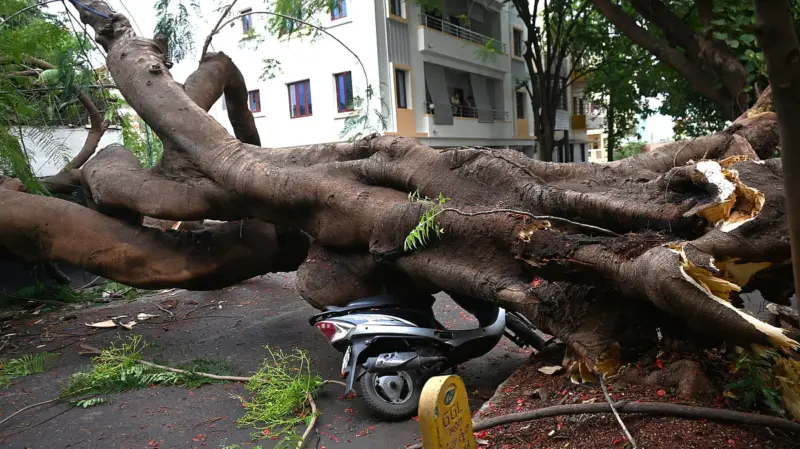

Bengaluru: Bengaluru's exotic trees, whose bloom brightens the city's landscape are becoming a liability, thanks to old age and unscientific civil works.
Greater Bengaluru Authority data showed that such trees accounted for over 66 per cent of those that fell during the thunderstorm on April 29.
The Forest Cell of the GBA recorded the fall of 516 trees belonging to 20 species between April 29 and May 1.
Officials found that a staggering 343 (66.47%) of these trees belonged to just four species: Copperpod or Yellow Gulmohar (117), African Tulip (101), Gulmohar (91) and Nile Tulip (34).
While reasons behind the tree failures are multifactorial, GBA Deputy Conservator of Forests Sudarshan G K said the sheer number of exotic trees in the fallen list drew his attention.
"Most of the fallen trees were exotic species and softwood in nature. These trees were planted about 30 years ago. We need a scientific evaluation of the trees across the city and phasing out of these species in a time-bound manner. In their place, we need to plant native species which can withstand heavy rains and storms," Sudarshan said.
The GBA routinely takes up pruning of branches and cutting down dead trees. However, the record rain on April 29 showed that it was not enough.
To a question, the officer acknowledged that the forest cell has to consider the extreme weather events linked to climate change while choosing saplings. "At the same time, we need to prevent unscientific pruning and damage to roots during drain and footpath construction as they create entry points for decay fungi and destabilise root anchorage," he added.
The forest cell's reasoning is backed by a field study by the Institute of Wood Science and Technology (IWST) set up under the Indian Council of Forestry Research and Education.
Greater Bengaluru Authority enlists students to map, remove hazardous treesOf the 454 street trees in Malleshwaram covered under the study, 223 (49%) were unhealthy.
The majority of them were exotic ornamental species such as Gulmohar, Copperpod, African Tulip and Rain Tree. Moreover, many of the exotic trees were living beyond their lifespan of 30 to 50 years.
A Muthu Kumar, Scientist-F and head, Forest Protection Division, ICFRE- IWST, said the Greater Bengaluru Authority has three major issues to deal with.
"First, there is a need for a scientific study of the old-age trees to see how healthy they are. We now have non-invasive tools like Resistograph, sonic tomography and others. Secondly, we need to fix the basics. Right at the point of planting a sapling, we need to plan for the entire tree's lifespan by leaving enough space for its growth and ensuring there is no disturbance to its roots in the future. Lastly, we need to phase out exotic trees and adopt indigenous trees that can fare better during weather extremes," he said.
He said selecting the right type of tree for the right location was equally important. Species selection should vary for avenues, residential areas, apartments, parks and boundary plantations based on space availability, ecological suitability and public safety.
For instance, trees with compact canopies and less aggressive root systems, such as Ashoka (Saraca asoca) and Bakul (Mimusops elengi), are more suitable for road medians and constrained urban spaces.
Avenue plantations may include species such as Indian Laburnum (Cassia fistula), Bahera (Terminalia bellirica), Mahua (Madhuca longifolia) and others, while boundary plantations and institutional campuses may be better suited for species such as Arjuna (Terminalia arjuna), Jamun (Syzygium cumini), Honge (Pongamia pinnata), and Azadirachta indica (Neem).