
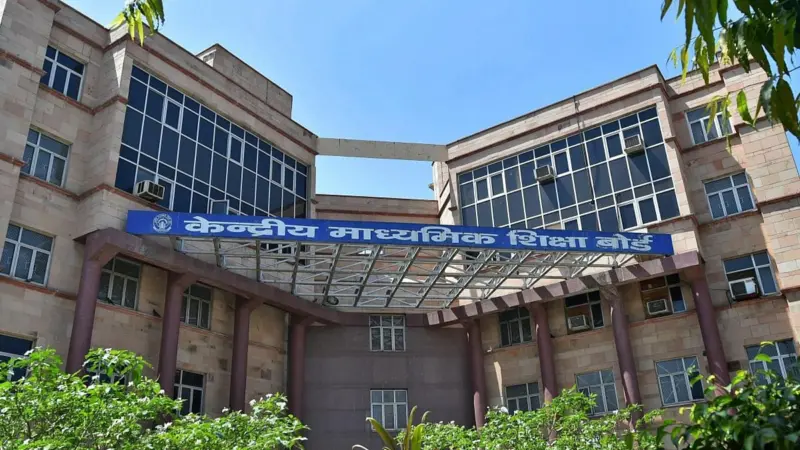

The recent controversy surrounding a QR code printed on the Class 12 Mathematics board examination paper has drawn attention to a lesser-known security feature used by the Central Board of Secondary Education (CBSE).
During the examination held on Monday (March 9), some students reported that scanning a QR code on their question paper redirected them to a YouTube video of Rick Astley's 1987 song Never Gonna Give You Up, an internet prank popularly known as "rickrolling". Images and videos of the paper quickly circulated on social media, sparking confusion and debate among students and parents.
CBSE class 12 paper QR code leads to YouTube song, board says paper security uncompromisedResponding to the issue, CBSE issued a clarification on March 10, stating that the question papers were genuine and that the examination process had not been compromised.
However, the incident has led to one important question: why do CBSE question papers have QR codes in the first place?
Background: The 2018 CBSE paper leaks
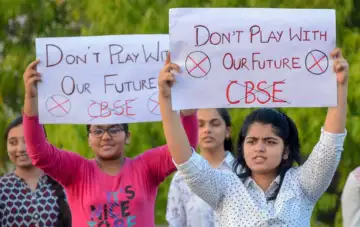
CBSE students protested against paper leaks in 2018
It all started after the major CBSE paper leak controversy in 2018, which raised serious questions about CBSE's security systems and put the central education body to the test.
In March 2018, the Class 12 Economics and Class 10 Mathematics papers were leaked, leading to widespread protests from students and parents. The board later acknowledged the paper leak and ordered re-examination for the Class 12 Economics paper. Investigations revealed that the leaked papers had been circulated through WhatsApp groups before the exam, highlighting serious vulnerabilities in the system.
Following the incident, the central government set up committees to recommend reforms aimed at strengthening exam security.
Committee recommendations
The Ministry of Human Resource Development (MHRD) panel examining the leak suggested several technological and structural changes to prevent paper leaks in the future.
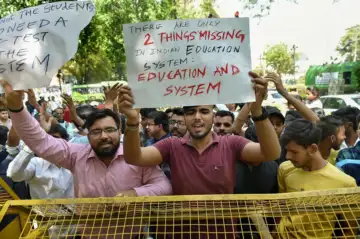
CBSE students protested against paper leaks in 2018
One key recommendation was the introduction of unique codes or QR codes on question papers, which would allow authorities to authenticate the question papers and trace the source of a leak more accurately.
Other recommendations included:
Printing different sets of question papers from a question bank
Introducing encrypted digital dispatch of question papers
Installing CCTV monitoring at strong rooms where papers are stored
Restricting access to sealed papers and improving monitoring at exam centres
QR codes in question papers
Following these recommendations, CBSE began embedding QR codes in question papers starting from the academic year 2018-2019 as part of anti-leak reforms.
These codes, typically linked to a secure database, contained information about the question paper, such as the examination centre, the specific paper set and distribution batch details.
If a leaked paper appeared online before the exam, authorities could scan the code and trace its origin, helping investigators identify where the breach occurred.
After 8 years, the QR codes on question papers serve more than just one purpose in CBSE board exams. These are:
1. Authentication: QR codes help authorities confirm whether a question paper is genuine if doubts arise about its legitimacy.
2. Leak tracing: Each code can potentially help investigators identify which batch or centre the paper originated from, making it easier to track leaks.
3. Tamper detection: Security codes embedded in papers make it harder to substitute fake papers or circulate altered versions.
4. Exam monitoring: In some cases, codes can help exam authorities track distribution and printing patterns of question papers.
Of course, this feature is not limited to the CBSE alone. Tools such as QR codes are increasingly being used globally as examination bodies adopt technology-based safeguards against leaks. Even several state boards in India have begun implementing this technology in recent years.
The 'rickrolling' incident
The latest 'rickrolling' controversy emerged after videos showed that scanning a QR code on some Class 12 Mathematics papers appeared to redirect users to a YouTube video of Rick Astley's 1987 song Never Gonna Give You Up.
CBSE acknowledged that "in a few question paper sets" scanning one of the QR codes linked to the video, led to doubts about the authenticity and sanctity of the paper among students and parents.
However, the board reiterated that the incident did not affect the integrity of the exam and that the issue was being taken seriously to prevent a repeat in future examinations.
Student concerns and online reactions
Exam leaks remain a recurring challenge for testing agencies across India, from school boards to national entrance examinations.
While the CBSE has maintained that the incident was nothing more than an isolated technical issue and that the integrity of the examination was not compromised, some social media users have argued that such glitches could still create uncertainty during high-stakes national examinations, where millions of students depend on the fairness and reliability of the process.
Commentby u/More_String8478 from discussion
in CBSE
While many treated the viral incident humorously, others raised concerns about whether exam authorities had adequately tested such systems before implementing them in large-scale public examinations.