
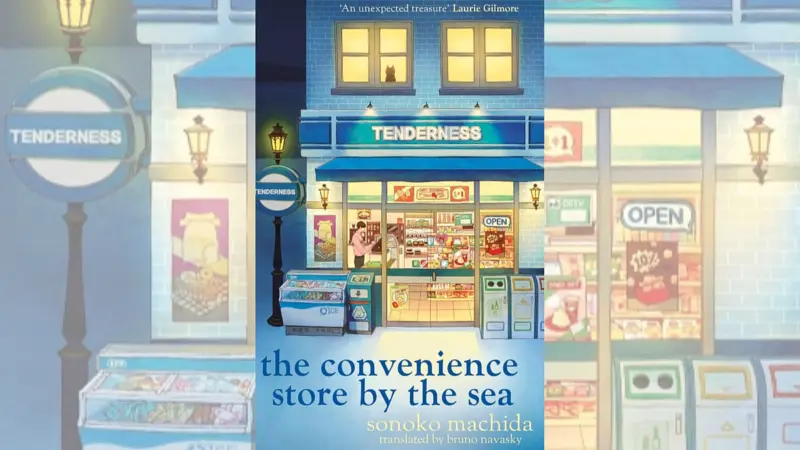

There is a particular stillness to The Convenience Store By The Sea by Sonoko Machida. The kind that doesn't announce itself, but quietly settles into your reading rhythm.
It is not a novel that demands urgency; instead, it invites attention.
Set in a coastal town, the story revolves around a small convenience store called Tenderness, a space that becomes less of a retail setting and more of an emotional dilemma.
Much like in 'Convenience Store Woman' by Sayaka Murata, the store is not just a backdrop but a character in itself. People drift in and out - employees, regulars, strangers - and through them, Machida constructs a mosaic of lives that are fragile, searching, and quietly hopeful.
In what I've come to think of as a very personal reading preference, I gravitate towards books where nothing much happens, but everything shifts. This novel sits comfortably in that space.
There is no dramatic arc, no looming conflict waiting to explode. Instead, Machida relies on accumulation - small gestures, fleeting interactions, the unspoken comfort of routine. Much like how I live my life. An individual finds a moment of belonging in accumulated patterns. These are not transformations you can pinpoint, but you feel them nonetheless.
The prose, soft and unintrusive, mirrors the emotional landscape of the book. Even in translation, it carries a kind of restraint that feels intentional. Nothing is overstated. Emotions are rarely spelt out. And yet, there is a lingering warmth in the way characters are treated, as if the narrative itself believes in their quiet resilience.
That said, the novel may not work for everyone. Its gentleness can, at times, border on sameness. The characters occasionally blur into each other, their struggles echoing in similar tones.
'Ek Din' movie review: Bittersweet tale of love in JapanIf you're looking for narrative sharpness or psychological intensity, this might feel too subdued. But to judge it by those standards is to miss the point. This is not a book about disruption; it is about continuity, about the small, steady ways in which people endure.
Cultural phenomenon
While reading The Convenience Store By The Sea, it's hard to ignore the lens of what's now being called the 'Japan Effect'. This isn't just about literature; it's a broader cultural phenomenon shaped by social media. A simple street, a vending machine, a quiet alley - these become instantly aesthetic, even poetic, the moment they are framed as "Japan". The ordinary is elevated through association.
This book operates in a remarkably similar way. On paper, very little about its setting is extraordinary. A convenience store. Packaged meals. Coffee machines. People are going about their routines. Strip away the context, and these could be scenes from anywhere. But the novel's cultural framing - its Japanese sensibility of attentiveness, order, and emotional restraint - transforms these mundane details into something almost meditative.
It's not that the book romanticises Japan in an overt manner. Rather, it benefits from the same psychological bias that fuels the 'Japan Effect'. As readers, we are already primed to see beauty in these details. The neatly arranged shelves feel more meaningful. The quiet interactions seem deeper. Even loneliness appears more contemplative than bleak.
What's interesting, though, is that Machida subtly resists this romanticisation. Beneath the aesthetic calm, there is isolation, dissatisfaction, and emotional fatigue. The store may be called Tenderness, but not every life within it is gentle.
In the end, this is not a book that will overwhelm you. It will not leave you stunned or shaken. Instead, it lingers softly, like a familiar place you didn't realise you needed. And perhaps that is its greatest strength: it makes the everyday feel seen, without insisting that it be anything more.
Jimbocho is an occasional column where we sift through popular Japanese books. Often called the 'town of books', Jimbocho is a neighbourhood in Tokyo that celebrates Japan's rich literary heritage.