




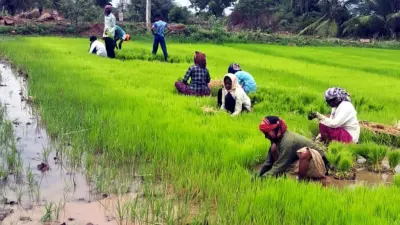

Kalaburagi: Erratic climatic conditions have put farmers in Kalyana Karnataka region in a state of paradox. While the irrigation system has brought relief to farmers in irrigated land, farmers in dryland areas reel under acute rain deficit.
This has left a massive economic divide between farmers of these two regions.
Good showers in the Western Ghats, including upstream catchment areas in Maharashtra, have boosted heavy inflows into the Krishna River basin, pushing the Almatti Dam storage to its maximum capacity. Heavy rainfall across the Malnad catchment region of Shivamogga and Chikmagaluru also triggered a massive surge of inflow into the Tungabhadra reservoir, easing fear of drought for thousands of farmers across the command areas.
Out of a targeted 8.90 lakh hectares, sowing has been undertaken in 7.63 lakh hectares (86%) in Kalaburagi district. More than 90% of the farmland in the district depends on rainfall; hence, farmers are facing drought even though they received some showers in the last two weeks. Tur crop has been grown in 5.34 lakh hectares, followed by cotton (90,489 hectares), sugarcane (35,544 hectares) and soybean (28,831 hectares). The district received only 37.3 mm of rainfall against a normal of 68.7 mm in August, and 90.4 mm against a normal of 138.4 mm in July. As a result of this, these farmers are gambling with the monsoon as they rely almost entirely on unpredictable seasonal rains to water their crops.
Kalaburagi: Prepare scientific action plan for development of Kalyana Karnataka, say leaders, experts"The sowing operation has improved in Kalaburagi district following a good spell of rainfall in the last few days. The rain has brought some hope to the tur growing area after the dry spell for nearly two months. Farmers have completed sowing in more than 80% of agricultural land," said Agriculture Department Joint Director Samad Patel.
Meanwhile, the drought in dryland areas has triggered protests from farmers seeking adequate compensation. "The underground water has receded considerably due to the monsoon's failure in the region. The sugarcane crop is also drying up due to the absence of rain. Steps must be taken to open Goshalas by arranging adequate fodder and water supply. Farmers' loans should be completely waived," Karnataka Prantha Raitha Sangh district president Sharanabasappa Mamashetty said.
Raichur district
In Raichur, release of water from Tungabhadra reservoir has come as a blessing. Raichur Agriculture Department Joint Director Prakash Chavan said that sowing operation has been completed in only 3 lakh hectares out of the total targeted area of 5.71 lakh hectares in the district. Pointing out that sowing has been undertaken in nearly 50% of the area, he said that releasing water from Tungabhadra will accelerate the transplanting of paddy seedlings.
"Nearly half of the agricultural land in the district depends on rainfall, as we have the largest area (1.77 lakh hectares) under cotton cultivation, followed by paddy (1.5 lakh hectares) and tur crop (70,000 hectares). Most of the paddy growers rely on the Tungabhadra water. The Irrigation Consultative Committee, in its recent meeting, decided to release water for the next 90 days, and this has brought some respite to farmers after two months of dry spell. But the farmers in dry land are facing a drought situation as the district has received 27% deficit rainfall," explained Prakash Chavan.
The farmers have almost completed transplanting paddy seedlings in Yadgir district after the release of water from Narayanapur reservoir. The dam has reached its full following heavy discharge of water from Maharashtra. The district has a total irrigated command area of over 1.64 lakh hectares under the Upper Krishna Project.
Concern over yield
Farmers have started transplanting paddy seedlings which are already over 65 days old in the paddy growing belt of Koppal, Ballari, Vijayanagar and Raichur districts after the release of water from Tungabhadra reservoir. The dam has reached 84.5% full out of its total capacity of 105.788 tmc ft. Its command area covers over 9 lakh hectares in these districts, which are known as the 'Rice Bowl' of Karnataka for growing Sona Masuri rice. The farmers were deprived of water for the second crop last year due to the replacement of the dam's 33 crest gates.
Meanwhile, Karnataka Rajya Raitha Sangha Honorary President Chamarasa Malipatil said that the yield will be reduced and the cost of cultivation will also increase due to the delay in transplanting paddy seedlings. He opined that the cold winter temperatures will further harm crop pod formation.
"It is difficult for the farmers to get a good yield due to the delay in water release from the reservoir. Paddy seedlings over 2 months old require more water and fertiliser. Releasing water for only 90 days will affect a few varieties of paddy and other crops. Therefore, we seek the release of Tungabhadra dam water at least for the next 110 days," said Chamarasa Malipatil.
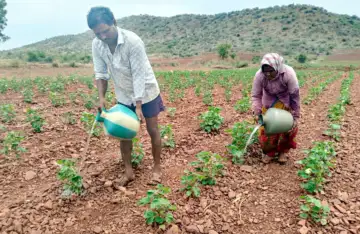 Farmers struggle to protect the cotton crop by watering the plants adjacent to state highway-29 in Kampli taluk of Ballari district.
 Quote - "Nearly half of the agricultural land in the district depends on rainfall as we have the largest area (1.77 lakh hectares) under cotton cultivation followed by paddy (1.5 lakh hectares) and tur crop (70000 hectares). Most of the paddy growers rely on the Tungabhadra water. The Irrigation Consultative Committee in its recent meeting decided to release water for the next 90 days and this has brought some respite to farmers after two months of dry spell. But the farmers in dry land are facing a drought situation as the district has received 27% deficit rainfall: Prakash Chavan Raichur Agriculture Department Joint Director