





As a regular attendee of events at Bangalore International Centre (BIC) in Bengaluru's Domlur, I did not need any convincing when a friend suggested that we attend an event called 'Sound of Women'.
It was a musical project by Mumbai-based hip-hop artiste Krantinaari and Chennai-based musician Charu Hariharan.
Before that Monday evening, I hadn't heard of Krantinaari or the project, which was founded on the belief that hip-hop is equivalent to folk. I may not have enough knowledge of hip-hop, but I was familiar with folk. As a theatre kid, I grew up listening to and singing folk songs - they were part of the cultural landscape of Kannada and Karnataka. I was intrigued by the idea and curious as to how it would translate onto the stage.
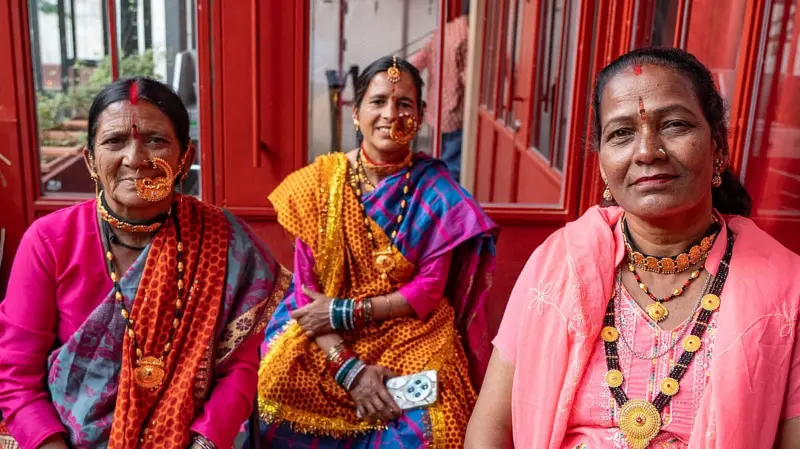
The performance was led by three women - Hemanti Devi, Pushpa Devi and Kashti Devi - from Uttarakhand, who were joined by Charu and Krantinaari. Together, they made up the Nyoli Ensemble under the umbrella of the 'Sound of Women' project.
The region is known for its incredible natural beauty, which is as breathtaking as it is brutal. So the songs talked about the beauty of their homeland ('Himali hawa'), the flowers blooming in the Himalayas ('Burusika phola'), hunger and survival ('Bhokmari'), and the indiscriminate felling of trees ('Banj ni kata').
That these songs were in Kumaoni was not a hindrance. Audiences instantly connected with their eco-feminist themes. The percussion, bass, and hip-hop elements merely acted as accompaniments without overpowering the folk characteristic of the Kumaoni tunes. Yet, a discerning audience member could detect some missed beats, mismatched tempo and a few off-key notes.
Folk and Tonic: All-women ensemble explores global folk musicBut, it hardly mattered, as the audience was encouraged to join in and actively participate, often becoming a human metronome themselves!
It reminded me of the freedom I felt when I was introduced to folk songs, with fewer barriers compared to classical music, which continues to be heavily gatekept by certain caste groups.
So, the performance was indeed folk - or as we call it in Kannada, "janapada" - the voice of the people. The voices were untrained, raw, but also honest.
How deep do the roots go?
Mera roots hai mazboot,
Kala hai mera dastoor
Kalakaari mai basa mera fitoor
This hook from Krantinaari's 2024 release, 'Roots', is an earworm that is not only memorable and catchy but also encapsulates the thematic focus of the Mumbai-based artiste's musical oeuvre. A communication designer by training, Krantinaari aka Ashwini Hiremath quit her cushy Microsoft job to follow her destiny: to make music. However, she does not have a musical background nor is she trained in music.
Originally from Hubballi in North Karnataka, Ashwini grew up in cosmopolitan Mumbai, in a linguistically rich environment where Kannada, Hindi, and Marathi were commonly spoken. She also picked up Kutchi and Gujarati in the chawls. In fact, she recalls how her first song, 'Krantinaari', had 50 drafts in five different languages! English was not one of them. For her, it was a foreign language and still is. Despite being a student of an English-medium school, she struggled with the language. This language barrier meant a lack of opportunities: from the classroom to the playground to extra-curriculars.
"In school, they would tell me: since I'm not one of the top 10 rank holders in the class, I cannot join the singing group," recalls Ashwini. "How does that make sense?"
As a young adolescent, Eminem's 'Beautiful' gave her an outlet for the suffocation she felt in her immediate environment. This was her first exposure to hip-hop. "The lyrics were so powerful that they forced me to develop my own voice," says Ashwini.
Ashwini to Krantinaari
The name 'Krantinaari' is a play on the word, 'krantikaari', the revolutionary. The word evokes a masculine image - perhaps of freedom fighters, often a man. Ashwini wanted to challenge this assumption.
"When you call yourself 'Krantinaari', you are motivated to see yourself as one," asserts Ashwini. "I always say that 'Krantinaari' is not (only) me, but every woman who has taken birth on this planet," she says, alluding to the female foeticide cases in India that are widespread even today.
Krantinaari's journey has not been smooth. "The men are the curators," says Ashwini. "They said there is no audience for a woman hip-hop artiste. So we never got a stage."
As someone who often raps about the identity and experience of being a woman, she was bothered by the lack of exposure needed for an artiste in order to hone her craft. That's when she decided to take matters into her own hands.
Wild Wild Women, Krantinaari's first "experimental crew", is believed to be the first all-female hip-hop band of India. Born on the streets of Mumbai, it has now made it to international venues and will soon be touring Europe. "If something like this can happen in Mumbai, why not the rest of the country?" This thought led her to travel to 72 regions across the country to witness the relationship between women and music. The project 'Sound of Women' is the result of this adventure.
Soundmakers, changemakers
In Jaisalmer, Rajasthan, Ashwini remembers coming across a globally renowned alghoza player. Made by joining two beak flutes, the alghoza is a traditional musical instrument of the Sindhi community and used by folk musicians in the region and beyond. She remembers how this alghoza player kept his wife away from the instrument, even barring her from entering the room when he played. Ashwini saw this play out again and again as she travelled across the country.
"The women were not allowed to sing, not allowed to perform beyond the four walls of their homes," recalls Ashwini. "Many see music and performance as something vulgar. I wanted to change that."
The absence of women in the public musical scene of rural India, led to the founding of 'Sound of Women' with the belief that hip-hop is folk. This assertion is not surprising, given the history of hip-hop, which grew out of the Black American experience in '70s New York. Much like folk music, it was once the music of the marginalised. "With Sound of Women, I think we have left our past work behind us," says Charu Hariharan, Krantinaari's collaborator and producer of the project. "We wanted to start afresh with a new sound and some new writing."
A musician and percussionist in the Karnatik tradition, Chennai-based Charu had been involved in the documentation of folk and tribal musical traditions of North Kerala. A serendipitous meeting in 2024 with Krantinaari in Bengaluru led to the founding of their own company, called Folk Soul, and the project 'Sound of Women', in the same year.
Using the Manil Mystic's Music Bus, a mobile recording studio, the project has documented the music of 23 folk artistes across Uttarakhand and Uttar Pradesh.
Eventually, they want these songs to be accessible to the larger public under the 'FolkSoul Library'. However, the specifics of the plan - whether to make this a digital or physical library and what this would look like - are yet to be decided. With the advent of GenAI, Ashwini worries about the possible misuse and misappropriation of this intangible cultural heritage.
Folk Soul as a company has been running by the generosity of the people involved, like the Manil Mystic's bus, as well as successful crowdfunding initiatives. Additionally, the money Ashwini has earned from her act as Krantinaari, including the funding she received from the Global Fund for Women, has also gone into the project. The Uttar Pradesh leg of the 'Sound of Women' project was possible due to the Studio Monkey Shoulder Grant.
While Ashwini handles the logistical parts of the project, Charu is focused on the creative process of bringing a song to life. She works with the women to put the tracks together with all the accompaniments, like the percussion and the bass. In the initial stages, Charu would sing with them during the recording, as the women were not yet comfortable singing in front of the microphone. She would then remove her own voice in the editing process.
"Now, they want to share that part of their lives with the world."
As a producer, she knows her job is only to make the songs fit into the larger narrative of performance: "I don't mess with the recipe. I just work on the presentation."
Kinship with Kumaoni
But why choose Uttarakhand as the first region for this project? Ashwini credits the kinship she felt with the Kumaoni language for her decision.
"The way they speak is so fast that it felt like everyone was rapping!" chuckles Ashwini. "It was an instant connection for me as a rap artiste."
The Kumaoni language is spoken across the Kumaon region in Uttarakhand as well as in Nepal. However, it is a language in decline. According to UNESCO's 'Atlas of the World's Languages in Danger', Kumaoni is designated as "vulnerable" to extinction. For Ashwini, who has always been vocal about linguistic rootedness and identity, it felt natural to "try to preserve [Kumaoni] through music".
"We are not running behind perfection," says Krantinaari. "It is about the experience of being on stage."
It's not surprising then that the performance also had a confessional element to it, where the women shared not only the music of their hometown but also the literal and metaphorical journey from the Kumaoni hills to a stage in Bengaluru: the excitement of being on an aircraft for the first time to the difficulties at home.
Hemanti, one of the women from the Nyoli Ensemble, is a third-generation singer. Her mother and grandmother were both singers. "They paved the way for me. My mother recognised my talent and encouraged me to sing. After I turned eight, I would accompany her on her performances in the village," Hemanti shares.
Currently in her 50s, Hemanti continues to be invited to perform at weddings and birthday parties in her village. They sing their own compositions. Her mother, in the 1970s, travelled to Bombay to record a song, she recalls. "It was a time when women did not even step out of their houses, where I come from. But my mother set a bold example for me," she states. Though Hemanti has three kids, none of them shares her passion for singing. Her husband is a tailor and makes steady money, but it is not enough to support the whole family. However, her collaboration with Krantinaari has made a significant difference to the family's finances.
It made me rethink what it means to expect perfection from folk artistes, who not only have managed to overcome familial and societal hurdles but also incredible shyness and aversion to owning the stage. Perhaps the rawness of the untrained voices is a change of pace in a world that's becoming sick of artificially achieved perfection - from autotuned concerts to algorithmically determined AI slop.
"If there is no freedom to make mistakes, you're not going to grow at all," says Charu. "I think the ultimate thing is to actually keep working."
Empowerment by choice
As musicians themselves, Ashwini and Charu are keenly aware of the exploitation that folk musicians face. It's a cliche at this point, how folk music is exoticised and looked at through an Oriental gaze, stripped of its context, ready to be appropriated and bastardised into mainstream pop or film music.
So they spent a considerable amount of time with the women to build trust and make them understand that "they were there to work together and not for anything else."
The project has kept every process "open and democratic," including the payment. When the ensemble performs, according to Charu, everyone gets paid the same amount. "Kashti tai and Hemanti tai earn around Rs 35,000 from each tour," reveals Ashwini.
This has brought about change in their villages. Ganga Devi is a member of the Nyoli ensemble but was unable to travel with the others due to opposition from her husband. She has informed Ashwini that she'd join them on their the next tour, come what may. "Through this entire project, we wanted to empower them in ways that they wanted to be empowered," says Charu. "We can't choose how to empower them, right?"
What began as a documentation and archival project with elements of storytelling has now become a conduit for change at the societal level, however small such a change might be.
Ashwini, who once faced pushback from the hip-hop music industry due to her gender, is no longer interested in its validation.
"More than the music industry, what matters to me is the change in attitude," asserts Ashwini. "Because that is the change I'm working towards."