
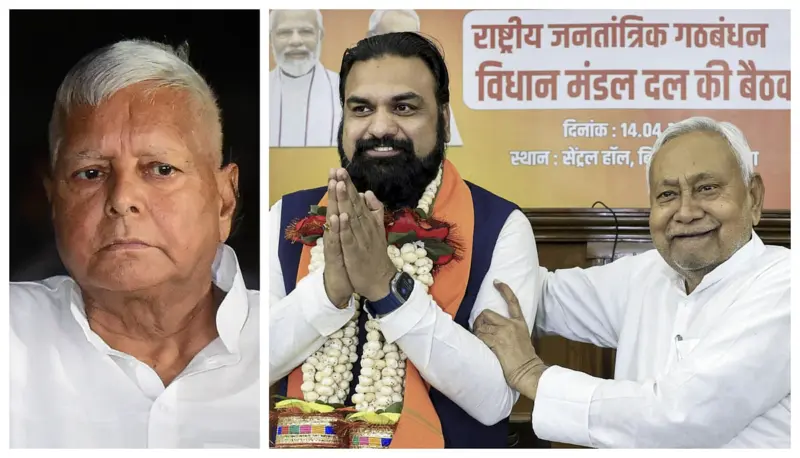

Banners across Bihar's capital Patna proclaiming 'Yodha se Samrat' are more than celebratory political graffiti. They signal a carefully curated reworking of identity in Bihar, where the making of a leader is increasingly tied to the making of a community narrative.
In elevating Samrat Chaudhary as Chief Minister, the Bharatiya Janata Party (BJP) has not only changed the face of government, it has also touched off a long-running struggle over who gets to inherit Bihar's political imagination and the new form of social-justice identity.
The slogan's subtext is revealing. 'Samrat' invokes Ashoka, the Mauryan emperor, whose association with the Magadh region lends this claim a civilisational depth rather than a just electoral register. For sections of the Kushwaha community, the appeal to Ashoka is not accidental. It is part of a larger effort to place the community within a historical lineage, much as Yadav politics has long drawn symbolic sustenance from Krishna and Kurmi politics has invoked agrarian or martial origin stories to assert status. In this sense, the politics around Samrat Chaudhary is also about a new language of power in which history is mined to stabilise current-day claims to rule.
This language rests on decades of backward-caste mobilisation. Since the 1990s, Bihar's post-Mandal political order has been defined by the rise of OBC assertion and the gradual replacement of upper-caste dominance in the State's power structure and governance system. Lalu Prasad and Nitish Kumar helped turn OBC politics into the central idiom of state power - one grounded in social resistance and symbolic inversion of hierarchies. Their efforts marked the consolidation of OBCs as a ruling bloc rather than a marginal pressure group.
That transition has intellectual and political roots. Jagdeo (Jagdev) Prasad, the legendary socialist from the Kushwaha community, articulated a radical backward-caste imagination by the early 1970s. His slogan "Sau mein nabbe shoshit hain, nabbe bhaag hamara hai" (90 out of 100 are exploited, 90 parts are ours), was not a mere rhetorical flourish, but the articulation of a politics of redistribution and humiliation, of a long-denied majority demanding its rightful share in land, wealth, and power. Jagdeo Prasad's insistence that "the first generation will be killed, the second will go to jail, and the third will rule" encapsulated a generational theory of struggle, sacrifice, and eventual rule for the oppressed. His legacy remains crucial because it shows that OBC politics in Bihar was never simply about electoral arithmetic, it was about dignity, visibility, and the demand to rule.
The historical roots of this moment lie in the formation of the Triveni Sangh in 1933, a coalition of Koeri, Kurmi, and Yadav leaders that modelled itself on the Triveni Sangam of the Ganga, Yamuna, and the mythical Saraswati. Emerging in the context of the Government of India Act, 1935, and debates on representation, the sangh demanded a greater share of power for 'middle peasant castes', and framed its struggle as an izzat ki ladai (fight for dignity) against entrenched upper-caste dominance.
Against this, the discussion on OBC leadership in Bihar has come full circle. Since Independence, and especially after the Mandal Commission, the State has had a Yadav Chief Minister (Lalu Prasad), a Kurmi (Nitish Kumar), and now a Koeri/Kushwaha (Samrat Chaudhary). This completes the Triveni Sangam that the 1930s coalition imagined, and signals that OBC elites increasingly perceive themselves not merely as a politics of resistance but as Bihar's ruling stratum.
While earlier OBC mobilisation defined itself primarily in opposition to upper-caste dominance, it's now about consolidating OBCs as a ruling elite whose thrust is the exercise and maintenance of power. Bihar, thus, becomes one of the first north Indian States where OBCs (and not upper castes) form the core of the ruling elite over multiple decades - a pattern long associated with Tamil Nadu and Karnataka, where intermediate and backward castes have dominated since the 1960s. It is in this context that the turn to Ashoka and the Magadh empire becomes intelligible. By identifying with Ashoka, sections of the OBC are anchoring their current dominance in a grand imperial past, signalling that they are the rightful inheritors of the region's ruling lineage.
This interpretation is not without a hard-demographic core. Bihar's recent caste survey shows that OBCs and Extremely Backward Classes (EBCs) account for ~63% of the population. Within the OBC bloc, Yadavs are the single-largest group at 14.26%, followed by Kushwahas at ~4.21%, and Kurmis at 2.87%, making Kushwahas one of the most consequential non-Yadav OBC groups in electoral terms. In a State where numbers are never just numbers, the projection of a Kushwaha Chief Minister can be read as the BJP's attempt to expand its social base beyond upper castes and deep into the heart of OBC politics.
But identity politics is never merely celebratory; it raises uncomfortable questions. If identity politics is reconfigured around a Kushwaha Chief Minister claiming Ashoka's lineage, then governance itself will be asked to carry a new burden - to convert symbolic inclusion into substantive development. Bihar's future will depend on whether this new politics can move beyond commemoration and deliver jobs, education, infrastructure, and social cohesion in a State still marked by high out-migration and structural underdevelopment. It requires statecraft to design and implement programmes for ordinary citizens, and it must grapple with markets shaped by liberalisation and globalisation while also attracting investment to one of India's poorest states. This, ultimately, is the real agni-pariksha for the new Chief Minister, whether he can produce a more equitable and prosperous Bihar for those who still stand at the margins of power and deprivation of land and resources.
Sanjay Kumar is founder, Deshkal Society, and co-editor, Interrogating Developments: Insights from the Margins. Shruti is Assistant Professor of English, MRIIRS, Faridabad. X: @Deshkal_Society, @nishishruti.
(Disclaimer: The views expressed above are the author's own. They do not necessarily reflect the views of DH.)