
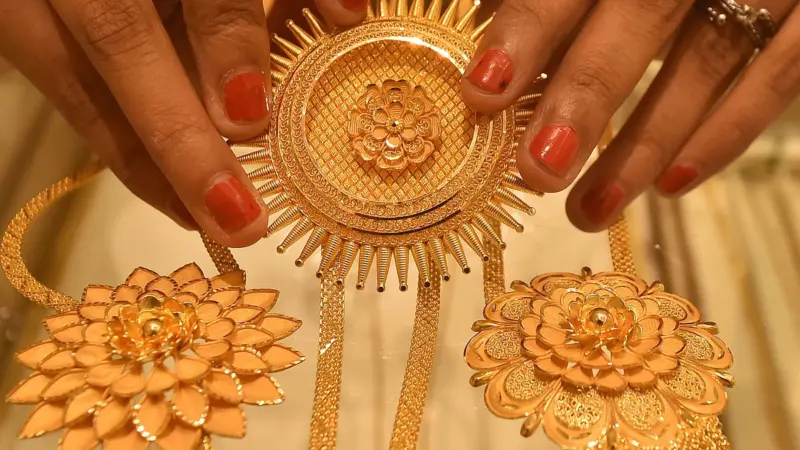

Bengaluru: India's appetite for gold and jewellery remains deeply entrenched, and the just-concluded Akshaya Tritiya once again reinforces this cultural and economic bond.
Yet beneath steady demand, a clear shift is underway - consumers are increasingly balancing tradition with value consciousness, favouring lighter, design-led jewellery, and more flexible purchase formats.
Even as gold prices hovered near record highs, driven by a strengthening US dollar and geopolitical tensions, demand remained resilient. Industry observers, including the World Gold Council (WGC), note that while volumes have moderated, value has held firm due to elevated prices and festive sentiment. Early estimates suggest Akshaya Tritiya accounts for roughly 15-20% of annual jewellery sales for many retailers, underlining its importance in India's consumption calendar.
What has changed most is demand composition. Buyers are shifting from heavy sets to lighter wearable pieces such as chains, bracelets and contemporary designs. Flexible schemes like gold rate protection and lower making charges are increasingly shaping purchase decisions. According to the Confederation of All India Traders (CAIT), gold jewellery sales during last Akshaya Tritiya were around Rs 12,000 crore, forming the benchmark for this year's assessment.
Global gold market shifts towards investment-led demand amid uncertainty, geopolitical tensions"While jewellery buying remains rooted in tradition, consumer behaviour has become more value-conscious. A key shift is the financialisation of purchases, with consumers viewing jewellery as both adornment and investment - making purity, transparency, and BIS hallmarking essential. Budgets are more planned, with growing preference for lighter, versatile designs, and a balanced approach between sentiment-driven and investment-led buying," said Kirit Bhansali, Chairman, Gem and Jewellery Export Promotion Council (GJEPC).
He added that Akshaya Tritiya continues to remain a cornerstone for the industry, supported by cultural significance and gold's enduring status as a symbol of prosperity and security.
This year's festival unfolded under significant price pressure, with gold rising to around Rs 1.55 lakh per 10 grams in 2026 versus about Rs 95,000 in 2025 - a nearly 60% jump - that has sharply reduced purchasing power. Yet demand remains culturally anchored, even as consumers become more selective. Value growth is expected to outpace volumes, reflecting smaller ticket sizes but sustained participation.
Retailers are responding with broader product mixes, regional designs and greater pricing transparency.
"The defining characteristic of 2026 is a pronounced shift toward investment-grade formats - coins, bars, and lighter jewellery that doubles as portable wealth - reflecting a maturing gold consumer comfortable evaluating gold through an investment lens. Buyers are also exploring lightweight jewellery and lab-grown diamond pieces, while digital tools like virtual try-ons and price-tracking features are enabling more informed purchases. Mechanisms like gold rate-protection pre-bookings and making-charge waivers are gaining traction," said Renisha Chainani, Head of Research at Augmont.
Ricky Vasandani, CEO and Co-founder, Solitario, said traditional gold continues to reflect a "value over volume" trend, while lab-grown diamonds are gaining momentum. "Customers are now value-conscious rather than just price-conscious. They understand that an IGI-certified lab diamond offers the same physical and optical brilliance as mined diamonds, but at 60-80% better value. While gold remains an investment, younger consumers increasingly view Akshaya Tritiya as an occasion for self-expression, choosing bold, contemporary designs over traditional heavy patterns," he added.
"Today's consumers are increasingly drawn to pieces that go beyond tradition, reflecting individuality and enduring value. We are also seeing preference for larger diamonds with excellent cut grades that are precisely crafted to maximise sparkle and brilliance," said Eshwar Surana, Managing Director, Raj Diamonds.
Digital gold, ETF interest
Conversely, strengthening investment demand now accounts for nearly 40% of overall consumption. Buyers are increasingly turning to Gold ETFs, digital gold and systematic purchases instead of lump-sum buying, reflecting a more financialised approach to the metal. According to a report by Kotak Securities, Gold ETFs in India saw continued inflows in March 2026 for the 11th straight month, but at a slower pace. Net inflows were $176.6 million, adding 1.1 tonnes, as investors booked profits after earlier gains.
"Even amid concerns over price volatility, there is steady demand for gold coins, bars and jewellery. Consumers continue to view gold as an investment," said Paul Alukkas, Managing Director of Jos Alukkas.
"While the investment aspect of gold remains important, there is a clear shift towards balancing investment with everyday usability and affordability, making purchases more practical," said Pawan Gupta, Chairperson of PP Jewellers.
Gold remains central to India's economy and households. The country consumes 700-900 tonnes annually, according to WGC, with households estimated to hold over 25,000 tonnes. Nearly 70-80% of demand is jewellery-led, driven by weddings and festivals such as Akshaya Tritiya, while imports remain a key macroeconomic factor.
WGC data shows that listed jewellery retailers posted revenue growth of 32-124% in Q1 2026, driven by weddings and steady demand. In 2025, however, total gold demand fell 11% to 710.9 tonnes, though value surged to around Rs 7.5 lakh crore due to higher prices. "We saw positive festive demand in both volume and value terms last year, despite elevated gold prices," said Saumen Bhaumik, Managing Director, CaratLane.
Over the past year, gold has risen over 60%, supported by geopolitical uncertainty, central bank buying and strong investment flows. Kotak Securities notes that consumption is gradually shifting toward investment behaviour.
Saumil Gandhi, Senior Analyst - Commodities at HDFC Securities, said, "Gold demand is expected to remain weak due to elevated prices, which are impacting affordability, especially for middle-income buyers... India's total gold demand in 2025 fell to 710.9 tonnes, the lowest in five years, mainly due to high prices. However, the cultural importance of Akshaya Tritiya will continue to support baseline demand." He highlighted a broader shift toward gold as an investment rather than consumption.
"We are seeing an increasing number of consumers opt for gold exchange," mentioned Sandeep Kohli, CEO, Indriya - Aditya Birla Jewellery.
In essence, India's gold story remains unchanged in spirit but evolving in structure, balancing tradition with a more financially-aware consumer mindset.