





After the COVID-19 pandemic, Google, as part of goodwill measures, reduced the gate-keeping fee for budding app developers. Later in 2024, it further reduced platform fees for developers to use Google Maps and also offered more incentives, so that they could scale up their teams with the new savings.
Now, Google has once again overhauled the billing system and is also further lowering the fees, bringing more developer-friendly programmes.
Airtel, Google bring AI-powered spam protection security to Android phonesThe company will be offering app developers the freedom to introduce their own billing system along with Google Play's billing platform. Also, app developers can reroute their subscribers to their official website to complete an in-app purchase. This way, they will avoid paying any commission to Google.
Sameer Samat, President of Android EcosystemAndroid has always driven innovation in the industry through its unique flexibility and openness. At this important moment, we want to continue leading the way in how developers distribute their apps and games to people on billions of devices across many form factors. A modern platform must be flexible, providing developers and users with choice and openness as well as a safe experience. Today, we are announcing substantial updates that evolve our business model and build on our long history of openness globally.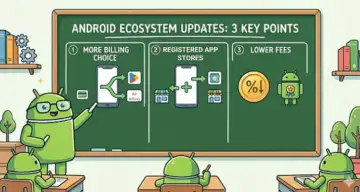
Google revamps billing and fees structure for app developers on Play Store.
Also, Google will make side-loading of apps from third-party app platforms to Android phones easier, provided the former meets certain quality and safety benchmarks. This is to ensure that the app doesn't have malware or any malicious code that may harm the Android phone owner.
As part of the revamp, Google is decoupling the fees for app developers using its billing system and introducing new, lower service fees. Earlier, the total gatekeepers' fee was 30 per cent.
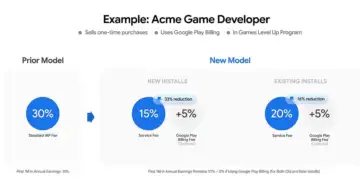
Google's new billing system.
Now, with the division of rates, app developers have to pay just 15 per cent as a service fee to Google Play to host their apps and five per cent for the Google Play Billing fee for every in-app purchase. As noted earlier, the latter is optional, as app developers can route their subscribers to their website and complete the transactions. This way, app developers can make a lot of savings.
And, for apps such as OTT platforms, they have to pay a service charge of 10 per cent on recurring subscriptions.
With these updates, Google has announced that it has resolved the disputes worldwide with Epic Games.
In August 2020, Fortnite, one of the online gaming divisions of Epic Games, announced 'Epic direct payment', an in-app feature for all transactions on PCs and mobiles. This was a measure to avoid paying platform fees to Google and Apple.
Expectedly, it did not go well with the tech giants, and they took down gaming titles from the respective platforms-- Google Play and Apple App Store. Since then, Epic Games has been fighting a legal case, and this drew the attention of anti-competition agencies around the world to investigate the matter.
Now, Google has resolved the issue by allowing Epic Games to reroute its subscribers to its own website to renew their subscription and not pay any commission to the platform. This is a win-win situation for developers and the subscribers as they will be paying less to make any in-app purchase or renew a subscription.
Apple has partially reached a truce with Epic Games to allow Fortnite on the App Store, but only in the US and Europe. They continue their legal battle in other global regions.
Fortnite gaming app ban sets stage for 'Epic' battle with Apple, Google