




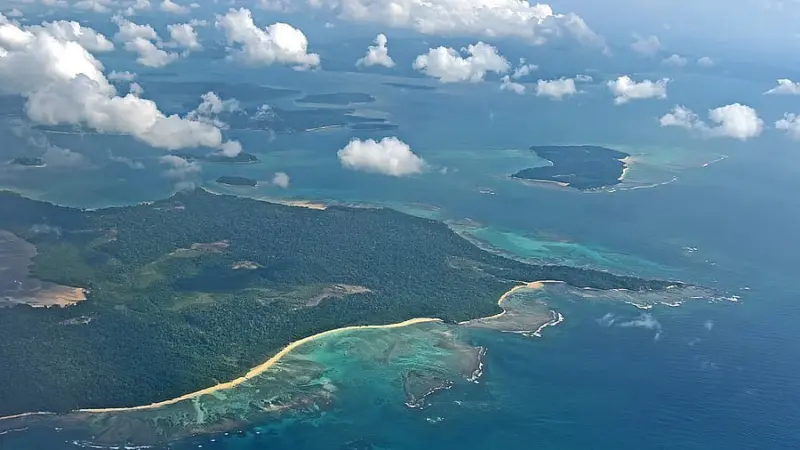

For close to a decade, the Narendra Modi government has championed the Great Nicobar Island (GNI) project as a mega-investment initiative that will establish India as a major player in the international shipping business.
The plan envisions a transshipment port, which would boost the economy and attract tourists to the tiny island.
Notably, none of the planning documents prepared by the Union government and the NITI Ayog suggest any underlying strategic considerations.
Yet, as criticism of the plan escalates, efforts are being made to create a new narrative on the importance of the GNI project highlighting its military significance in the Indian Ocean region where China is the dominant player. Such narratives treat the transshipment port mostly as an afterthought and never discuss whether the Union government has explored other military options to monitor the crucial Malacca Strait and the Six Degree Channel.
A transshipment port is a maritime transit hub where cargo containers are unloaded from large ocean-going vessels (mother ships) and reloaded onto smaller vessels (feeder ships) - and vice versa - to reach their final destination. Since ultra-large container ships require exceptionally deep water and extensive port infrastructure, they can dock only at a limited number of strategically located hub ports rather than at smaller regional ports.
Historically, most of the country's transshipment cargo is routed through foreign hubs like Colombo (Sri Lanka), Singapore, Dubai (UAE) and Port Klang (Malaysia).
The transshipment port at GNI was proposed because of the 10-15 metres of natural water depth close to the shore, which supports ultra-large container ships, and its proximity to the East-West international shipping corridor. The objective was to create a cargo hub that will attract the traffic currently going to Sri Lanka, Singapore and Malaysia.
To support the hub, the plan included an airport, power plant, township, road network and other amenities. The only military component is the airport, intended to be a dual use facility.
No alternate ideas?
While no one can deny the strategic importance of the Great Nicobar Island, the unanswered question is: whether the Modi government gave adequate considerations to alternate ideas before finalising the GNI plan?
In an analysis, Rear Admiral Sudhir Pillai (Rtd), a former Flag Officer of the Indian Navy, asked whether comparative assessments had been conducted for sites such as Galathea Bay, Campbell Bay, Nancowry Harbour and a Campbell Bay-Sabang distributed model, and whether commercial feasibility studies had benchmarked GNI against regional competitors like Vizhinjam, Vadhavan, Matarbari, Patimban and Tuas Port.
He also questioned whether a military utility analysis had distinguished the requirements of a dual-use air and hardened naval facility from those of a 16-million-TEU commercial mega-hub, and whether GNI has a green bunkering strategy aligned with the International Maritime Organization's net-zero emissions target for shipping by 2050, without which the port may struggle to attract customers by the time it reaches peak operations.
Democracy demands a public debate on Great Nicobar's environmental and strategic costs"None of these analyses appear, in structured form, in the publicly available planning record. The public record reads less like an analysis leading to a conclusion and more like a conclusion progressively surrounded by just enough analysis to satisfy formal requirements," Rear Admiral Pillai wrote.
Ever since the project gained momentum, environmentalists, rights activists and opposition parties have accused the government of violating environmental, forest, and wildlife clearance norms, as well as failing to comply with the provisions of the Forest Rights Act, 2006.
Nearly three weeks ago, Congress leader Rahul Gandhi visited the Great Nicobar island and met Nicobarese representatives and activists who raised concerns over displacement, ecological destruction and the impact on indigenous tribal communities, especially the Shompen tribe.
Subsequently, the opposition party intensified its attack on the Centre, calling the project an "ecologically disastrous" and "strategically opaque" exercise being pushed through without adequate consultation or safeguards. In two separate letters, former Union Environment Minister Jairam Ramesh flagged violations of regulatory norms.
"Studies, based on which environmental clearance has been granted, are not even rapid EIAs (environmental impact assessment), and are based on baseline data collection over a few days and weeks at best and are grossly inadequate. These reports are an insult to science and make a mockery of the EIA process," Ramesh wrote.
Judicial review
In a setback for the government, the Calcutta High Court earlier this month agreed to hear three public interest litigations alleging violation of forest rights to tribals while granting the clearance. Rejecting the government's objections, the HC noted that such projects would remain subject to judicial review because the Nicobar tribal population is a "very vulnerable tribal group."
The Union Government, on its part, has strongly defended the project, arguing that it is of "great national importance" and essential for India's maritime security, transshipment ambitions and Indo-Pacific strategy. In the wake of Rahul's visit, the Centre issued two press notes stating that the GNI project aims to transform the island into a strategic maritime and economic hub, while asserting that environmental norms are being followed. None have the answers to the questions raised by the critics so far.
Congress accuses Modi govt of 'muzzling debate' on Great Nicobar ProjectThere are more unanswered questions. GNI has a naval air station, INS Baaz and a natural harbour at Campbell Bay, facing the Malacca Strait. "For years, the A&N Command has pleaded for extending the runway & upgrading of the harbour to host large aircraft and ships, but to no avail," says Admiral Arun Prakash, former Chief of the Naval Staff.
"For years, the Nicobarese living in tsunami relief colonies have been writing repeatedly to the authorities expressing their wish to return to their ancestral, traditional lands and requesting the administration to facilitate their return. Nothing has come of these requests," notes Ramesh.
Even without drilling a single hole, the estimated project cost has gone up to more than Rs 92,000 crore. Since everything - from cement and steel to labours and workers - need to be taken and sheltered on the island for a long time, the project cost is sure to rise further manifold. Natural factors like monsoon, sea current and seismic risks would further add to the cost.
Would it not be wise for the Centre to undertake wider discussions and threadbare analysis before execution? Or would the Modi government adopt a Char Dham-like approach, where environmental concerns were set aside in court proceedings through last-minute national security arguments, even though military considerations were not part of the original plan? Only time can answer.