




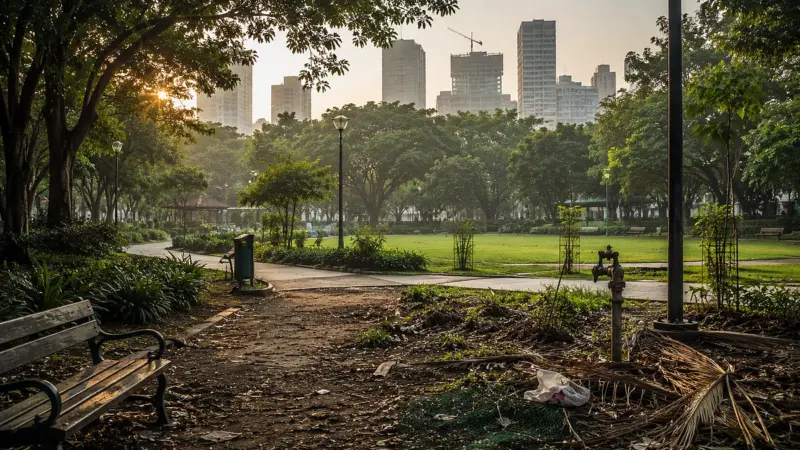

As Indian cities brave rising urban temperatures, declining green cover and mounting maintenance costs, urban green spaces can no longer be treated as aesthetic or recreational amenities alone.
For many residents, neighbourhood parks are among the last accessible public spaces left in an increasingly built-up city.
These parks function as critical climate infrastructure, helping regulate local temperatures, improve air quality and provide inclusive public spaces in dense urban environments. For Bengaluru, once celebrated as India's 'Garden City', the governance of neighbourhood parks is becoming inseparable from questions of urban liveability and climate resilience.
Against this backdrop, the Bruhat Bengaluru Mahanagara Palike (BBMP)'s - now Greater Bengaluru Authority (GBA) - Hasiru Mitra, a park monitoring system, was launched over two years ago. The initiative sought to directly involve citizens in the maintenance and monitoring of neighbourhood parks.
Introduced as part of Bengaluru's participatory governance initiatives, the programme invited residents to report maintenance issues and coordinate with officials through digital platforms.
At a time when urban local bodies face increasing financial and administrative constraints, such citizen-assisted monitoring systems potentially offer low-cost decentralised mechanism for maintaining urban green infrastructure. Urban governance systems frequently struggle with everyday maintenance gaps that remain invisible within centralised administrative structures.
Bengaluru's green lungs gasp for basic care amid neglect, urban growthNeighbourhood parks require continuous monitoring of watering systems, waste management, lighting, pathways, plant health and security. By involving residents familiar with these spaces, Hasiru Mitra attempted to create a distributed governance mechanism that could supplement administrative capacity.
Findings from a survey conducted by the author as part of ongoing research by the Institute for Social and Economic Change (ISEC), among Hasiru Mitra volunteers, reveal the institutional limitations of such participatory models when responsiveness mechanisms remain weak. While a majority of volunteers reported everyday monitoring of their allotted parks, administrative follow-up remained inconsistent.
Volunteers had to navigate multiple reporting channels, including the park monitoring systems portal, Sahaaya 2.0, Hasiru Mitra WhatsApp groups and direct communication with contractors or officials. Yet the absence of clear accountability structures resulted in fragmented responses or prolonged delays.
Participation existed, but responsiveness remained weak. Several volunteers also reported that repeated complaints often produced little visible action.
The survey reflected substantial civic willingness to engage with neighbourhood park governance. Many volunteers reported visiting parks daily and continuing to raise complaints despite limited responsiveness. The larger challenge lay in the inability of the institutional framework to translate citizen monitoring into coordinated administrative action. Citizens were mobilised into monitoring systems, but not into decision-making structures related to park management or long-term planning. Participation improved visibility of maintenance problems, but did not substantially alter the administrative design governing these green spaces.
A broader governance dilemma confronting Indian cities emerges here. Participatory initiatives are increasingly adopted within urban governance frameworks through digital platforms that enable reporting and citizen feedback. However, digital participation does not automatically translate into decentralised governance. In many cases, participation remains confined to information collection while planning authority and implementation decisions remain highly centralised.
The issue becomes particularly important at a time when Bengaluru is increasingly experiencing urban heat stress. Parks function as critical environmental infrastructure that improves neighbourhood liveability through shade, evapotranspiration and microclimatic cooling. As low-cost tools for mitigating urban heat, these spaces directly influence environmental quality, public health and the city's broader climate adaptation capacity. Yet public discourses on urban greening often remain limited to roadside plantation drives or symbolic tree-planting campaigns.
The transition from BBMP to the GBA in 2025 further complicated the initiative's institutional continuity. Most volunteers reported receiving little or no clarity regarding the future of the programme following this transition. While some digital reporting systems like Sahaaya 2.0 remain operational, the broader participatory structure appears administratively uncertain.
The GBA has recently introduced ward-level tree officers as part of its broader environmental governance reforms. While such measures may improve the maintenance of trees, the experience of Hasiru Mitra raises larger questions about whether participatory urban green governance can succeed without institutional responsiveness and administrative continuity. The larger lesson from Hasiru Mitra is not that citizen participation failed, but that participation alone cannot substitute for institutional capacity.
The writer is a doctoral scholar at the Centre for Research in Urban Affairs, Institute for Social and Economic Change, Bengaluru
(Disclaimer: The views expressed above are the author's own. They do not necessarily reflect the views of DH.)