


The greatest transfer of political power in Indian history, from an already overburdened South to the demographically mighty North, is being disguised as a victory for women.
The Union government is packaging its new legislative agenda, the Constitution (131st Amendment) Bill, 2026, and its companion delimitation Bills, as a historic step toward gender equality.
On paper, the legislation expands the Lok Sabha from 543 to a maximum of 850 seats, and finally operationalises the one-third gender quota. In reality, women's representation is a Trojan horse. By deleting constitutional safeguards that froze seat allocation based on the 1971 Census, the government is unfreezing the electoral map and tying parliamentary representation to the latest population figures. A newly established Delimitation Commission will wield absolute, unchallengeable power to redraw boundaries and apportion these 850 seats. State representatives will sit on this commission merely as toothless associate members, with no voting rights.
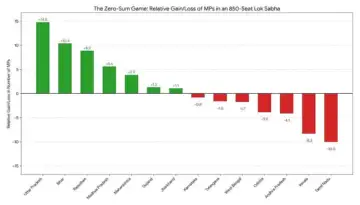
The government will defend this political engineering by noting that initially the change will be on a pro-rata basis: each state's current ratio will be retained. But that's a fig leaf. The Delimitation Commission will have explicit powers to use whichever Census data it chooses - 2011or the ongoing 2026 count. The first iteration of these numbers is irrelevant; what matters is potential locked into these laws.
'Political tool for 2029 Lok Sabha elections': Opposition slams Modi govt over women's quota, delimitationOnce newer Census data replaces the 1971 baselines, the government will likely argue that no state 'loses' MPs in an 850-seat House. For instance, Tamil Nadu might rise from the current 39 seats to 51 using 2011 Census data, or to 47 using 2026 Census Data. But, proportional power is what counts in a parliamentary democracy. It does not matter how large the parliamentary delegation of a given state is; what matters is the percentage of the floor that state controls. To maintain its current political weight in an 850-seat House, Tamil Nadu would need 61 seats. Effectively, it is being robbed of 10 MPs under 2011 data and 14 under 2026. Kerala similarly loses eight or 11 MPs compared to its proportional share.
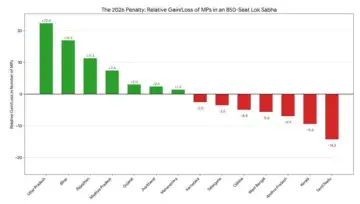
Flip the coin: the Hindi heartland's share of the Lok Sabha balloons from 38% to over 43% with 2011 data, and to 46% with 2026 data. Meanwhile, the South's collective voting power shrinks from 24% to just over 20% (2011) and 19% (2026). This is not an administrative upgrade, it's a mathematical mechanism to permanently dilute the political capital of South Indian states.
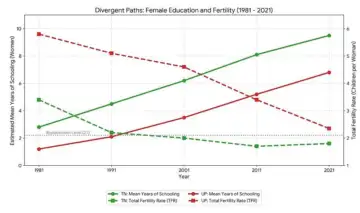
The basic truth often missed is that demography is not accidental. Globally, a girl's years of schooling correlate directly with falling fertility rates. Decades ago, southern states, particularly Tamil Nadu and Kerala, ensured girls' enrolment matched boys', achieving near-universal education through the Higher Secondary level. Today, more than half of Tamil Nadu's girls attend college.
This success ignited a virtuous cycle: educated women delayed childbirth, fertility rates plummeted, smaller families freed women to work, and female labour force participation soared. That female workforce powered a manufacturing base, driving high per capita income and robust tax revenues, which were reinvested into health and education. The Hindi belt, by contrast, largely failed to educate women at comparable rates, resulting in unchecked population growth, a missing female workforce, and economic stagnation.
Delimitation strikes at the core of this success story, and weaponises this demographic failure. Southern states already suffer under heavily skewed fiscal federalism, their wealth siphoned off to subsidise the Hindi heartland. The constitutional freeze on parliamentary seats maintained a delicate compact: the South accepted its role as the economic engine as long as it was not politically subordinated. The 131st Amendment shatters that truce, granting states that failed to educate their girls a permanent majority to dictate the political and economic destiny of the states that succeeded.
If the Union Government insists on pushing this demographic guillotine, one way to safeguard the interests of southern states is radical political and fiscal decentralisation. If the Lok Sabha is destined to become a monopoly of the Hindi heartland, then its overbearing power must be stripped.
Currently, the Union monopolises the power of the purse, collecting nearly two-thirds of all tax revenues generated and spending heavily on subjects that constitutionally belong to the states. Through a sprawling web of Centrally Sponsored Schemes, New Delhi funnels trillions of rupees back into agriculture, health, rural development, and education - using the South's money to dictate state-level policy. This results in poor governance and bad policymaking, and it makes the South feel unequal. This financial and legislative chokehold must be broken. The Union's taxing powers must be rolled back, the Concurrent List pruned, and states allowed to retain the lion's share of their wealth. The Union government must retreat to its core constitutional competencies of defence, foreign affairs, communications, and currency.
A dramatically weakened Union government is the only viable path to peace in a vastly unequal demographic landscape. When New Delhi becomes a lean administrative entity managing borders and macroeconomics, political ambition to capture power at the Centre becomes a low-stakes affair. No state or linguistic bloc will need to fight bitterly over a Centre that cannot siphon wealth, impose cultural hegemony, or dictate local governance. Decentralisation lowers the temperature of the entire republic.
Nilakantan R S is a data scientist, and author of South vs North: India's Great Divide. X: @puram_politics.
Disclaimer: The views expressed above are the author's own. They do not necessarily reflect the views of DH.