





Reading about plants and their histories gives me goosebumps. It feels like digging into the earth and discovering stories hidden beneath familiar leaves and flowers.
Last month, I wrote about the black nightshade, Solanum nigrum, whose stem held the tiger moth's cocoon. I led you through the moth's story but barely spoke about the plant.
Black nightshade belongs to the astonishing genus Solanum, along with potato, tomato, and brinjal. It comes as a surprise that three vegetables that seem to have little in common belong to the same genus.
The potato, for instance, looks as though its greatest ambition is to be stuffed into a spicy samosa or dropped into a masala curry. It gives no hint that becoming the familiar aloo in our kitchens took thousands of years of human selection, observation, and ingenious processing. Its ancestors grew in the high Andes of South America. Indigenous Andean farmers began domesticating potatoes around 8,000 years ago. They cultivated thousands of varieties suited to different soils, altitudes, and degrees of cold. Some of the varieties that tolerated severe frost were too bitter to be eaten directly. Potatoes defend themselves with chemicals called glycoalkaloids. These compounds help discourage insects and grazing animals from feeding on the plants. Unfortunately, at sufficiently high concentrations, they discourage humans too. The Andean farmers did not know "glycoalkaloid". They could not measure glycoalkaloid concentrations in parts per million like modern scientists. They had something else: bitter taste, freezing nights, running water and generations of people who paid very close attention. Potatoes were left outdoors, where they froze at night and thawed and dried during the day.
After several cycles, the softened tubers were trodden upon to remove moisture and loosen their skins. Some were soaked and washed in flowing water before being dried
again. This reduced their bitterness and glycoalkaloid content, while transforming them into chuño, a light, dry food that could be stored for years. Equally fascinating is how the Andean farmers, without knowing the language of genetics, gradually reshaped a defensive wild tuber into one of the world's most important food crops. Over thousands of years, farmers selected potatoes that tasted better and less bitter to propagate. They saved tubers from desirable plants and replanted them. By the time the Inca Empire arose, this knowledge was already ancient. The Incas used chuño as a portable food reserve. Andean ingenuity had taught the potato to survive time.
Centuries later, the potato was recruited to help something else survive time: colour.
In 1907, the brothers Auguste and Louis Lumière introduced Autochrome, the first commercially successful process for colour photography. At the heart of its colour screen was an unexpectedly ordinary material, potato starch. The brothers selected microscopic potato-starch grains, dyed them orange-red, green and blue-violet, and packed them closely across a glass plate. Each translucent grain acted as a tiny colour filter. Light from the scene passed through this mosaic before reaching the photographic emulsion. When the developed transparency was held to the light, the same starch grains filtered it once more, recreating the colours of the scene for the viewer. The potato did not enter the camera as food. It entered as an optical material. A tuber formed in darkness had helped a camera see colour.
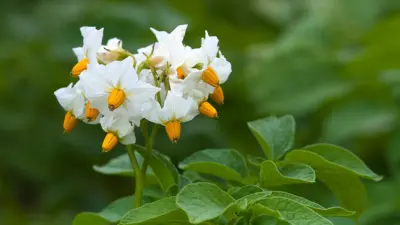
Back in the vegetable garden, tomato, brinjal, and potato bear similar star-shaped flowers, with their yellow anthers gathered into a cone. Pollen is locked inside these anthers and escapes through tiny pores. A blue-banded bee, such as Amegilla zonata, grips the cone and vibrates her flight muscles without taking off. The flower shudders, and pollen bursts out like salt from a shaker. The kinship among the plants is also evident in the diseases they share. Bacterial wilt, caused by members of the Ralstonia solanacearum species complex, can infect all three. I return to the black nightshade, Solanum nigrum, with which this story began, its ripe black berries shining among the leaves. Last month, I saw it mainly as the stem that held a tiger moth's cocoon. Now its relatives have led me from the Andes to colour photography and back to the soil beneath my feet. The plants have not changed; the way I see them has.
Motley Garden is your monthly kaleidoscopic view into a sustainable garden ecosystem. The author believes gardens are shared spaces where plants and creatures thrive together. She can be reached at allthingsinmygarden@gmail.com or on social media at @allthingsinmygarden