




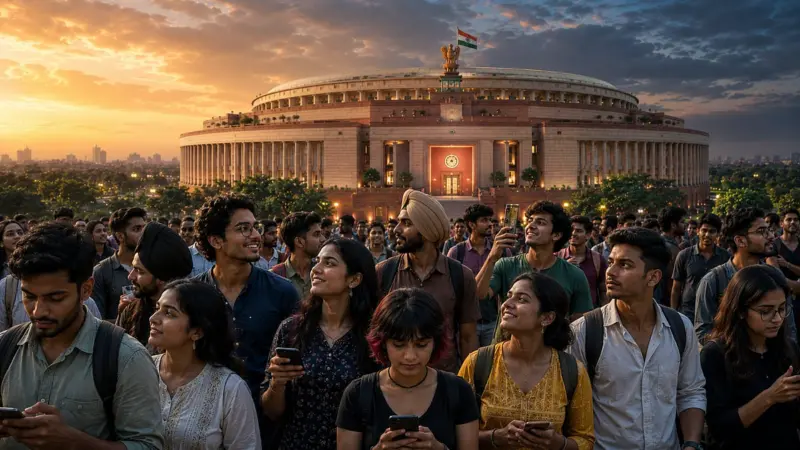

Democracy is entering an unfamiliar age. For much of modern political history, electoral choices were shaped by a relatively stable mix of ideology, leadership, performance and identity.
Governments governed, Opposition mobilised, and voters periodically delivered their verdict. Political change was often dramatic, but the rules of engagement were broadly understood. That certainty is fading.
A new voter psychology is reshaping democratic politics, particularly in younger societies. Gen Z is often described as impatient, disruptive, and politically unpredictable. That is incomplete. The more accurate view is that Gen Z is not disengaged - it is engaging through a different operating system, with profound implications for democracy.
What distinguishes this generation is not merely age, but the environment in which its political instincts were formed. This is the first generation of true digital natives. They are not citizens who adapted to technology, but citizens shaped by it. Their relationship with information, authority, and decision-making is fundamentally different.
Institutional patience is lower. Trust in hierarchies is weaker. Authenticity matters more than ideological coherence. Emotional credibility often trumps policy sophistication. Long-term evaluation competes poorly with immediate perception. This is not political shallowness. It is political rewiring.
The signs are visible across the region. In Bangladesh, digitally networked youth mobilisation demonstrated how rapidly political discontent can scale into a regime-threatening force. In Nepal, anti-establishment protests driven significantly by younger citizens reflected a growing distrust of political institutions and conventional leadership. Tamil Nadu's recent political churn offers another important signal. The rise of Vijay as a serious political force, despite the absence of a clearly articulated ideological or economic doctrine, suggests that symbolic disruption itself has become politically compelling for younger voters.
The pattern is difficult to ignore. Conventional politics increasingly struggles to command emotional loyalty, while political freshness, however undefined, acquires disproportionate traction. The reason lies not only in generational psychology, but in the architecture of the digital public square.
Politics once unfolded through speeches, party organisation, newspapers, institutional messaging, and TV debates. These systems were imperfect, but they imposed friction. Claims could be contested. Narratives evolved. Complexity had space to breathe. Social media dismantled those guardrails. The manifesto has, in many ways, been replaced by the meme.
Political communication is now fragmentary, emotional, and instantaneous. A clipped video, a viral accusation, an influencer commentary, or a manipulated narrative can travel further in hours than institutional communication can in weeks. Algorithms reward engagement, not accuracy. Anger travels faster than analysis. Simplistic certainty outcompetes nuance. For digital natives, this is not distortion - it is the norm. That has altered democratic behaviour in ways political establishments are only beginning to grasp.
Governments are no longer judged periodically. They are judged continuously. Every speech, incident, or misstep is subject to instant emotional referendum. Long-cycle governance becomes politically harder in such an environment. Economic reform is incremental, technical, and slow to show results. Social media rewards immediacy. This mismatch is dangerous.
A government may deliver infrastructure, stability or welfare, but if younger voters perceive it as stale, disconnected or performative, measurable performance loses persuasive force. Politics becomes less about delivery and more about emotional legitimacy.
This creates a paradox. Democracies need youthful disruption. Political systems insulated from younger aspirations decay. Every generation has the right to challenge entrenched assumptions. But democracies also depend on informed judgement, institutional patience, and tolerance for complexity. If electoral behaviour becomes excessively mood-driven, governance itself destabilises. Disruption is not governance. Novelty is not competence. Authenticity is not a substitute for administrative seriousness.
The threat is not merely domestic. The same ecosystem that empowers democratic participation also creates unprecedented vulnerabilities for national security. Foreign interference no longer requires visible propaganda machinery or overt political proxies. It needs only to exploit emotional fault lines.
A fabricated scandal. A synthetic video. Bot-driven outrage. Anonymous accounts. Influencer ecosystems unknowingly amplify engineered narratives. Micro-targeted disinformation tailored to demographic anxieties. The most effective foreign interference may no longer look foreign. That is what makes this moment strategically consequential.
A digitally native electorate - sceptical of institutions, impatient with conventional politics, and highly responsive to emotion - can be democracy's greatest renewal and its greatest vulnerability. India, perhaps more than most democracies, must pay attention.
Few countries combine India's youth demographics, digital penetration, social diversity, political intensity, and geopolitical exposure. Younger voters will shape outcomes across states and nationally. Their political instincts will influence not merely campaign tactics, but the resilience of democratic institutions.
This cannot be viewed simply as a challenge for political parties. It is a challenge to democratic systems. The answer is not censorship, nor suspicion of youthful political energy. Democracies diminish themselves when they fear participation.
The real response lies in stronger civic literacy, faster institutional credibility, sharper democratic communication, better digital resilience and greater public capacity to distinguish authenticity from manipulation.
Political leadership must adapt. Performance alone no longer guarantees legitimacy. Governments will need to communicate with authenticity without surrendering seriousness. Institutions must respond with agility without compromising due process.
The deeper challenge is no longer electoral competition alone. It is informational sovereignty. If democracies once worried about the capture of institutions, they must now worry about the capture of perception. The next great democratic contest may not be fought in polling booths alone. It may be fought in algorithms.
Suman Billa, Additional Secretary and Director General, Ministry of Tourism. X: @Suman_Billa.
(Disclaimer: The views expressed above are the author's own. They do not necessarily reflect the views of DH.)