
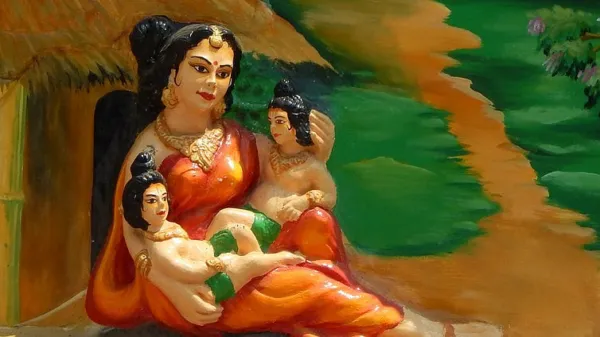

The High Court of Madhya Pradesh recently made news by citing the Ramayana in a ruling that allowed a 10-year-old child to remain with her mother in India instead of sending her back to Canada, where her father lives.
The court pointed out that the twins, Lava and Kusha, stayed with their mother, Sita, in Sage Valmiki's hermitage, rather than with Rama, despite him being the king of Ayodhya.
This is all very well, but need we mention that, given Rama had abandoned Sita, there was no way he would accept her children until she proved her innocence for the second time, and in public view?
This is not to say that the custody of children should be awarded to fathers by default instead: just that the Ramayana is not a great instance of the best family dynamic to emulate.
I am often shocked by the simplistic moral lessons about relationships people take from the two incredible Sanskrit epics, when in fact, the amount of family dysfunction in the epics would keep hordes of therapists in business.
'Varanasi' to have 20 minutes of Ramayana, SS Karthikeya teases epic storyline at Mexico Comic Con 2026In fact, the episode of Sita's abandonment while she is pregnant, and her final plea of innocence, is heartrending - all the more because she really played by the rules of the game. She loved Rama, she always put his interests before her own, and she was utterly devoted to him. Yet, she was abandoned the second time, even after the god of fire, Agni, testified to her innocence in Lanka the first time.
Lakshmana, entrusted with the unenviable task of abandoning Sita near the hermitages on the banks of the Ganga, tries not to show his distress when Sita tells him that she is experiencing some ill-omens.
Her first thought at the ill-omens is not whether all will be well with her - she asks Lakshmana if he is sure that all is well with Rama, his brothers, and his mothers. And yet again, when Lakshmana breaks down at having to abandon her, she asks if Rama is well.
And when Lakshmana tells Sita that Rama has instructed him to abandon her, amidst her loud weeping, one of her first thoughts is this - "I would have plunged into the waters of the Ganga this very day and ended my life, were it not for the fact that Rama's lineage would end with me." Even as she is abandoned by the husband she loves, her concern for her unborn children is that they preserve Rama's royal lineage.
And then, at the end of Sita's story, Rama requests Valmiki to have Sita make another proclamation of her 'purity', with Valmiki as her witness. The sage proclaims that Sita has been faithful to Rama, even promising that he will forfeit all the results of his penance if he is lying.
But Sita's final words are unexpected. Her final words before the earth swallows her up forever speak of her still unconditional love, but also her anguish at repeatedly having to prove her love and fidelity to an audience whose allegations never end, and a husband who needs their approval.
She makes a proclamation, but her proclamation of her fidelity is not to take her place by Rama's side but to remove herself from ever having to prove her love again.
Perhaps the best use of the epics today is not in treating them as templates for the ideal family but in recognising that if Rama's ideal kingdom could not give Sita the justice she deserved, how much more careful should we be?
The writer is the author of How to Love in Sanskrit and likes writing new things about very old things.
(Disclaimer: The views expressed above are the author's own. They do not necessarily reflect the views of DH.)