





Imphal/ Bishnupur/ KangpokpiThe conflict between the Meitei and Kuki communities in Manipur, which erupted on May 3, 2023, brought a triple tragedy upon septuagenarian Philem Ibohol, a former shopkeeper from the Meitei community in Kuki-dominated Churachandpur district.
First, his house and shop were torched during the violence. Then, his two sons - Ramesh (44) and Rabi (34) - died in the relief camp in February 2025.
"Ramesh had liver issues, but Rabi did not have any major health problems," Ibohol and his wife, Yaima, told DH at the relief camp in Laisoi, Bishnupur district, located about 50 km from Imphal, the state capital.
"We could not take them to a good doctor because of the conflict," Yaima added.
The couple had four sons, one of them had died earlier in Churachandpur. Their only surviving son works in Imphal.
"The family is devastated. Because of all this, the mother is now suffering from psychological issues. How much pain can a mother take?" asked Thoibi Thingujam, another displaced person at the relief camp.
The prolonged conflict has left deep scars across communities, with both Kuki and Meitei families in relief camps grappling with deaths, trauma, untreated illnesses, unemployment and growing hopelessness. The lack of timely medical care, poor living conditions and prolonged uncertainty in the relief camps have worsened physical and psychological distress of displaced people, pushing several families to the brink.
The conflict has claimed more than 260 lives and displaced over 60,000 people. Thousands of Kukis were forced to flee the Meitei-dominated Valley and seek refuge in Kuki-majority areas, while Meiteis similarly moved out of Kuki-dominated regions.
More than three years after the violence erupted, the situation remains largely unchanged. Members of the two communities still unable to travel freely to each other's areas due to persistent security concerns and deep-rooted mistrust.
Asem Bimalata, another displaced Meitei woman, sat quietly on a wooden bench with a few other inmates. Her husband, Asem Inao, died in the relief camp in August last year due to a massive heart attack.
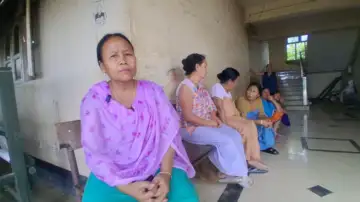
Asem Binalata, whose husband died at Laisoi relief camp in Bishnupur district.
"He did not have any health issues before. The heart attack could have been due to the trauma we have gone through," Bimalata told DH.
Inao, a daily wager, had been under severe distress after losing his home and livelihood.
"How long will this continue?" Bimalata asked.
More than 300 displaced Meiteis from Bishnupur and the adjoining fringe areas have been taking shelter in the buildings of a water sports complex on the banks of the picturesque Loktak Lake, which was converted into a relief camp by the government.
Three injured Kuki youths shifted from RIMS in Manipur amid tight securityThe camp has witnessed the deaths of at least five inmates, while another person died by suicide.
"Two more people here attempted suicide but were saved by neighbours," said Loitongbam Surchand Singh, a teacher from Churachandpur, who has been living in the camp with his family.
"Depression among us is growing because we do not see any hope of this conflict ending anytime soon," he said.
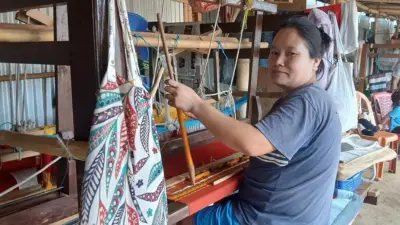
The only silver lining in this camp is that some of the women have taken up income-generating activities such as weaving, tailoring and horticulture, as they try to rebuild their lives.
A similar scene prevails at the Ideal Girls College campus in the Akampat area of Imphal, where more than 400 Meiteis from Moreh and nearby areas in Tengnoupal district, about 120 km away, have been taking shelter since May 2023.
At least four persons have died there, with fellow inmates claiming that they could not be provided timely medical treatment.
"Even today, an elderly woman died. She had heart disease and diabetes, but the family was not in a position to provide treatment," Kh Khamba, an inmate, told DH.
More than 4,000 Meiteis from Moreh are currently taking shelter in nine relief camps across the Valley.
"In the past three years, at least 45 people have died in these nine camps. Trauma, depression and the inability of families to provide proper medical treatment are the main reasons. The government must do something immediately to end this conflict," Khamba added.
Khamba, who ran a transport business in Moreh, a trading hub on the border with Myanmar, is now unemployed.
"There is no work here and we cannot go home. The government has not allowed us to return, citing the fear of attacks by the Kukis. Displaced persons from both communities do not want to languish in relief camps any longer," he said.
Fear of the Kukis
At least three members of the Kuki community have died at the Mandap relief camp, housed in a community hall in Kangpokpi district, about 40 km north of Imphal, with residents attributing the deaths to depression and lack of timely medical care.
"We cannot go to the Valley out of fear of attacks by the Meiteis. Now, we cannot travel to the Naga areas also because of the fresh conflict between the Nagas and the Kukis. If someone here suffers from a serious illness, we have no option but to wait and watch our people die, as there are no proper treatment facilities. Many cancer and kidney patients have died because they could not travel outside for dialysis and other critical treatment," said Lelen Haokip, who worked as a carpenter in Imphal before the conflict, from the relief camp in Kangpokpi.
"Even now, there is a blockade by the Nagas on both sides of our district. The highway has been blocked from the Senapati side, which is Naga-dominated, as well as from the Meitei-dominated Valley," he added.
Kangpokpi remained closed following a bandh called by the Committee on Tribal Unity (CoTU), a Kuki organisation, to protest the killing of two Kukis allegedly by Nagas on June 11. Meanwhile, the inter-district economic blockade imposed by the United Naga Council, the apex Naga body in Manipur, disrupted the movement of trucks carrying essential goods, leading to severe shortages across the state.
As a result, petrol prices touched Rs 350 per litre in Kangpokpi on June 12, while LPG cylinders were being sold at Rs 5,000, residents told DH.
A grim toll
On June 4, the Manipur Home Department disclosed that at least 731 displaced persons had died in relief camps and government-provided prefabricated shelters over the past three years, including 25 classified as "unnatural" deaths. The details were released following an RTI application filed by writer and former bureaucrat Hareshwar Goshwami.
According to the data, Churachandpur recorded the highest number of deaths at 248, followed by Bishnupur with 151 deaths, Kangpokpi with 128, Imphal West with 94 and Kakching with 60.
"The home department, however, has not yet responded to my query on the reasons leading to the deaths. I have moved the commission in this regard," Goshwami, told DH. The home department said 287 displaced persons in relief camps were suffering from terminal illnesses.
"From what I have learnt during my visits to the relief camps, many victims died from hypertension, strokes and trauma triggered by the shock following displacements. The lack of medical facilities, coupled with the inability to transport patients to hospitals because of the conflict, led to many deaths," Goshwami said.
Impact on education
"Can you expect us to concentrate on our studies in such an atmosphere?" asked Thangjangam Khongsai, a second-semester BA student, gesturing towards the tarpaulin-sheet partitions inside a relief camp at the Zalen community hall in Kangpokpi district.
As many as 161 displaced persons, including 60 children, have been living in the camp since 2023.
"I could not attend a Staff Selection Commission interview because of the conflict. We cannot travel to Imphal, and there is no examination centre here," he told DH.
Education has been severely disrupted across Manipur due to the conflict, with the impact extending far beyond the relief camps. Families who can afford it have sent their children to cities such as Delhi, Bengaluru, Guwahati and Silchar to continue their studies.
"Many students struggle to cope with the CBSE curriculum outside the state as they were educated under the state board system here. Several have also missed interviews and other opportunities because of the situation," a student leader in Imphal said.
Naga-Kuki conflict
Even as the government continues its efforts to resolve the Meitei-Kuki conflict, fresh tensions between the Nagas and the Kukis have emerged as a new challenge for security forces and displaced families living in relief camps.
The conflict intensified in February when at least two Kukis and a Naga were killed in separate attacks in Ukhrul district. While Ukhrul is predominantly Naga-inhabited, it is also home to several Kuki settlements. Since then, sporadic attacks and retaliatory violence have claimed the lives of more than 20 people from both communities.
The unrest subsequently spread to Naga- and Kuki-inhabited villages in districts such as Senapati, a Naga-majority district, and Kangpokpi, which is predominantly Kuki.
Tensions escalated further on June 10 with the recovery of the bodies of six Nagas who had been abducted on May 13. At least 20 villagers - 14 Kukis and six Nagas - were abducted following the killing of three church leaders belonging to the Thadou tribe, a constituent group of the Kuki-Zo community.
The anger and mistrust between communities remain deep-rooted. The tensions were evident when local residents staged protests after three Kuki men injured in a gunfight in Kangpokpi district were admitted to the Regional Institute of Medical Sciences (RIMS) in Imphal on June 15. The incident occurred amid the fresh conflict involving the Nagas and the Kukis.
With both the Centre and the Manipur government unable to bring an end to the conflict, and the opposing groups remaining firm on their respective demands, the prolonged crisis has continued to take a heavy toll on those displaced by the violence.
Territorial claims
The genesis of the Naga-Kuki conflict lies in competing territorial claims. The Kukis contend that their ancestral homeland overlaps with the Naga aspiration for "Nagalim" or "Greater Nagaland," comprising Naga-inhabited areas in Manipur, Nagaland, a few districts in Assam and Arunachal Pradesh.
The Naga demand for Greater Nagalim has also generated tensions with the Meitei community, as successive Manipur governments have consistently maintained that the state's territorial integrity must remain intact.
These overlapping claims over land have been a major source of conflict between the Nagas and the Kukis for decades. The dispute culminated in large-scale violence during the early 1990s, resulting in the deaths of more than 1,000 Kukis and over 400 Nagas between 1990 and 1992.
"Given the history of severe conflict between the Nagas and the Kukis, Manipur cannot afford another confrontation at this juncture. The government and the communities must work towards a solution based on mutual accommodation and compromise," Gaidon Kamei, a senior Naga leader told DH.
Government's role
The Centre's attempt to engage all three major communities by installing a "popular government" appears to have fallen short of expectations. The government, formed in February after nearly a year of President's Rule, is headed by a Meitei Chief Minister, Yumnam Khemchand Singh, with Nemcha Kipgen, a Kuki, and Losii Dikho, a Naga, serving as deputy chief ministers.
However, the administration has struggled to bring the Meitei and Kuki communities on board to reach an agreement. At the same time, it has found it difficult to contain the growing tensions between the Naga and Kuki communities.
"Despite frequent agitations by civil society organisations over our demands, there has been no formal communication or dialogue with either the Centre or the new state government since the imposition of President's Rule," Shanta Nahakpam, spokesperson of the Coordination Committee on Manipur Unity (COCOMI), an apex body representing several valley-based civil society organisations, told DH.
COCOMI has been at the forefront of campaigns demanding an National Register of Citizens (NRC) and the abrogation of the Suspension of Operations (SoO) agreement with Kuki armed groups saying "illegal Chin Kuki migrants" pose threat to demography and identity of the "indigenous communities."
"Taking advantage of the SoO agreement, Kuki armed groups are facilitating illegal migration from Myanmar, drug trafficking and illegal poppy cultivation," Nahakpam alleged.
Meitei groups have been pressing for an Assam-like update of the NRC exercise to identify and address the issue of undocumented migrants, particularly those they describe as illegal Chin-Kuki migrants from Myanmar. However, these allegations and demands remain strongly contested by Kuki organisations.
Amid the escalating Naga-Kuki tensions, several Naga and Meitei organisations have recently come together to form a joint forum advocating the abrogation of the Suspension of Operations (SoO) agreement with Kuki armed groups.
Deputy Chief Minister Losii Dikho, a Naga leader, also sought to increase pressure on the Centre to review the Suspension of Operations arrangement after alleging that a Kuki armed group, which is a signatory to the agreement, was involved in the killing of six Nagas.
Naga organisations have further demanded the removal of Deputy Chief Minister Nemcha Kipgen, a Kuki leader, alleging that the Kuki National Front (P), an armed group reportedly led by her husband, was linked to the killings. However, Kipgen rejected the allegations when contacted by DH.
The Kuki groups, on the other hand, remain steadfast in their demand for a "separate administration" in the form of a Union Territory with a Legislature saying that Kukis can no longer live under the same administration given the frequent "atrocities and humiliation."
"The conflict in Manipur reinforces the argument that the crisis is not merely a result of inter-community misunderstanding but is fundamentally about the assertion of distinct political identities," Thangminlen Kipgen, a Kuki leader, told DH.
The Meiteis seek political security within Manipur, the Kukis are looking for a political arrangement that guarantees their safety and future, while the Nagas have long pursued a form of political autonomy. The current situation reflects the growing belief that these communities are finding it increasingly difficult to coexist harmoniously under a single political framework. The new government should convey these realities to the Centre and push for an expedited process to arrive at a long-term political solution," Thangminlen Kipgen added.
Since assuming office as Chief Minister in February, Yumnam Khemchand Singh has repeatedly appealed to the state's communities to "forget and forgive" the past in order to move forward and work towards a lasting solution. However, sporadic incidents of violence and killings have continued, posing a significant challenge to the Centre's efforts to restore peace in Manipur and achieve its broader goal of ending militancy and conflict across the Northeast by 2030. Addressing an event in Imphal on June 17, Singh said his government was making sustained efforts to restore normalcy but emphasised that lasting peace could only be achieved with the cooperation of all sections of society.
"A few people continue to oppose peace because they benefit from the conflict," Singh said, stressing the need to expose such vested interests while encouraging communities to work collectively towards restoring normalcy.
Threads of resilience: Meitei and Kuki women battle despair through weaving in relief campsAddressing an event in Imphal on June 17, Singh said his recent visits to Jiribam, Kangpokpi, Senapati and Ukhrul had revealed encouraging signs of reconciliation in some parts of the state.
"The Kuki, Paite, Hmar and Meitei communities in Jiribam have resumed living together peacefully, sharing meals and gradually returning to their homes," he said, adding that he had personally shared a meal with members of the different communities during his visit.
"Amid our efforts to foster reconciliation, a bomb blast at Tronglaobi in Meitei-dominated Bishnupur that claimed the lives of two children and seriously injured their mother, caused the situation to deteriorate once again," he added.
Meanwhile, the Centre has deployed two battalions of the elite CoBRA (Commando Battalion for Resolute Action) force of the CRPF in Manipur, with each battalion comprising around 1,000 personnel, with a target to "normalise the situation" in one year.
"Neutralise anyone found moving around civilian areas with illegal weapons. If we don't use our weapons, why has the government given us so many weapons," G P Singh, the director general of CRPF told his personnel during an interaction in Manipur, amid the Naga-Kuki conflict. The CoBRA battalions were raised to fight against the Maoists. "After we succeeded in ending Maoists, the Centre has now given us the task to control Manipur in one-and-a-half years," Singh said.
Gaidon Kamei, the Naga leader, however, questioned the Centre's reliance on force as a means to resolve the conflict, saying similar efforts failed in the past.
"The Centre enacted the Armed Forces (Special Powers) Act (AFSPA) in 1958 to combat insurgency in the Northeast. Many have died in attacks and counter attacks since then. Has that ended militancy? Dialogue based on a spirit of mutual accommodation and compromise is the only way forward, both for the government as well as the communities," he said.