




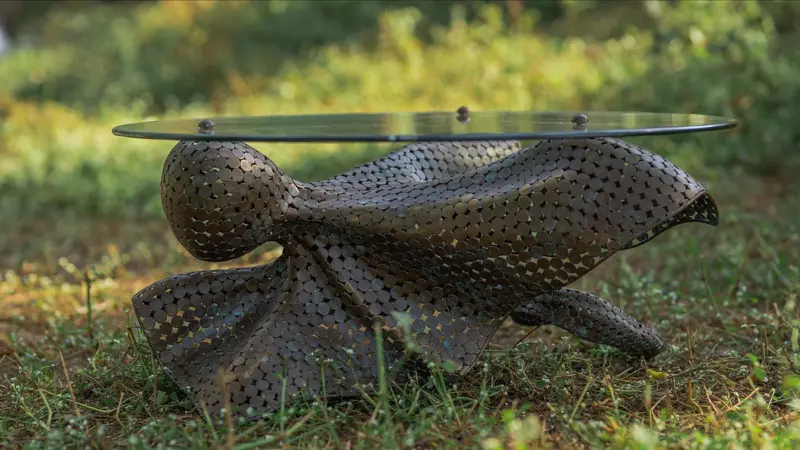

A chair that looks like it paused while folding into itself. A table that looks like it is about to shift. A surface that feels like a landscape caught halfway through forming.
Across a new set of contemporary furniture, form is no longer fixed. It appears to hover in transition, as if caught in the middle of becoming something else.
This approach marks a shift in design thinking. Furniture is shaped for use and for the moments it holds. These pieces slow you down, pulling your attention as much as they serve a function.
Frozen landscape
The making follows the material. The slab is first studied for its internal lines and direction. Cutting and shaping respond to this rather than override it.
At Ravoh, a handmade furniture and design collaboration co-founded by Somya Vohra, the focus is on stone. Here, the material is approached like terrain, with its internal patterns guiding how the piece takes shape.
"Stone doesn't give you second chances. Once you cut, you commit," Vohra notes. The process calls for accuracy, but also knowing when to stop. Every part that is refined and what is left untouched shapes how the object is read.
In the Picasso dining table, the surface looks like a piece of landscape caught mid-change. Veining moves across it like currents, hinting at water or geological shifts. "For us, it started with moving away from the idea of the table as a fixed form," shares Vohra.
The design works with what's already in the slab. The veining sets the direction, and the changes stay minimal. The surface holds a sense of movement because it isn't overpolished. The base is kept simple and secondary, so the top gets the spotlight.
Mid-gesture
The tactile approach continues at Kosh, a sculptural furniture practice co-founded by Nidhi Gupta. The pieces feel mid-gesture, as though they are still arriving at their final state. The Aven Totem is a shelving system, but reads as something more sculptural. Staggered shelves jut out from a central spine in uneven spacing, each offset like a moment paused mid-rotation. The mix of metal, wood, and marble adds variation in textures.
That idea of incompletion continues in the Solene centre table. It carries an irregular marble top without a clear edge. The surface has natural variations with a mottled finish in muted tones that mimic cosmic textures without depicting anything specifically. "It is meant to be read as a fragment of a larger form rather than a complete object," says Gupta. The tabletop rests on three supports. Here, asymmetry is used as a structured imbalance that still holds steady.
A similar tension appears in the Siona lounge chair. It has a bean-like extension that curves into the main chair, wrapping around it. The gesture suggests a hug, but stops short of closing. A deep red back cushion symbolises an upturned heart, creating a visual centre. Soft contours keep it from becoming rigid. That concept of softness continues in the accompanying side table, formed by two maroon-toned inverted hemispheres that do not quite line up. One is nudged off-centre, so the form looks imbalanced and in tension, even though it is structurally stable. A stone inlay on top brings contrast.
Still in motion
At Design Ni Dukaan, a multidisciplinary design studio founded by Veeram Shah, the tension between movement and stillness is central. The studio's table designs draw from fluid and soft forms. Yet these are made with hard materials like stone and metal. It is through this contrast that Shah achieves the final look.
Balletic takes its cue from dance. Mild steel, typically associated with rigidity, is shaped to feel pliable.
The process begins in clay, so the form is shaped freely, before being built in metal through multiple welded parts. These are refined into a continuous surface. The final piece reads like a movement held in suspension, with parts opening outward while a central core anchors it.
That sense of movement held in check carries into Divalent. Rounded forms come close to touching but don't. A larger central piece is paired with a slimmer extension, with brass details adding contrast. It feels steady, but like it could shift with a small change.
The same push between order and movement appears in Deconstruction. A simple grid first fixes the layout, with columns and a flat surface. Into this, curved elements are introduced, cutting through the linear system and opening it up. Brass supports hold a glass top, while trays and a wooden box sit within the frame. These elements can be moved, letting the composition shift its arrangement.
Across these practices, furniture moves beyond utility into something more open-ended. Nothing feels fully resolved, and that's the point. The forms hold a slight tension, like they could still shift, but choose not to.