





Like a dhow leaning into favourable winds, India and the United Arab Emirates (UAE) are navigating a new wave in which economic ballast, strategic rigging, and diplomatic seamanship are being tightened at pace.
The UAE has become an economic and strategic oasis for India: bilateral trade, post-FTA, crossed $100 billion in 2026.
An oasis that exports energy and capital
Energy security now forms the bedrock of the partnership. In 2025, the UAE supplied roughly 11% of India's crude imports. Long-term liquefied natural gas contracts with Abu Dhabi add another layer of energy interdependence. In 2025, India imported $5 billion-worth, about 25% of its natural gas requirement, from the UAE.
The mega agreement finalised during Modi's visit provides a strategic energy security anchor to store up to 30 million barrels of UAE-owned crude in India's Strategic Petroleum Reserves at pre-agreed prices.
From LPG to defence partnership: Delving into India, UAE's key agreements during PM Modi's visitFor New Delhi, it is a hedge against Gulf volatility. For Abu Dhabi, it is a bid to anchor India not as a transient customer but as a strategic custodian of Emirati energy, and partly a cushion for its OPEC exit.
Behind the sovereign-grade energy deals, a $5 billion fresh UAE commitment into Indian banking and infrastructure gives the partnership a second, and equally important, anchor. Announced during Modi's Abu Dhabi stop, Emirates NBD, the UAE's largest bank, is set to invest around $3 billion to acquire a controlling stake in RBL Bank, making it one of the largest foreign investments in India's banking sector.
Sailing into a cyclone
India's dhow, however, is sailing closer to a cyclone. The Pakistan-Saudi Arabia nexus complicates India's options in West Asia. The strained Saudi Arabia-UAE relationship is adding another layer of navigational difficulty.
In this matrix, India's calculus is clear: diversify, not displace. The UAE will not erase Saudi Arabia from India's crude mix. Riyadh will remain an important pillar of New Delhi's energy security, and may yet emerge as a large investor in downstream refineries in India. New Delhi is not choosing between Abu Dhabi and Riyadh, but it is widening the channels through which energy, capital, and strategic access flow..
Defence co-operation with the UAE, however, is where the strategic angle sharpens. India is looking to export major defence systems like the Brahmos missile to the UAE. With India already embedded in a broader geometry that includes Israel and the United States, the UAE-India axis can acquire a more pronounced security-industrial dimension.
Four million sails
The Indian dhow is not just powered by oil and weapons. Its true keel is the four-million-strong Indian community in the UAE. This labour and services corridor has underpinned Gulf-scale construction, retail, finance, and healthcare for decades. Yet it is also vulnerable to every geopolitical squall that crosses the region.
That vulnerability has been exposed by the turmoil generated by the Iran conflict. An estimated 400,000 Indians have returned from the UAE amid the economic dislocation caused by the war and its spillovers. Many others have seen salaries squeezed, business prospects shrink, and consumer demand weaken.
A sturdier rigging
The broader significance of the relationship lies in its architecture. The UAE is no longer merely a Gulf entrepôt through which Indians trade, work, and remit money. It is becoming a strategic platform: a source of oil and gas, capital, logistics access, intelligence co-operation, and potentially a defence-industrial partnership. For India, the UAE is no longer only a supplier of hydrocarbons; it is a theatre where diverse trade and investment increasingly overlap with a military dimension and the diaspora's strengths.
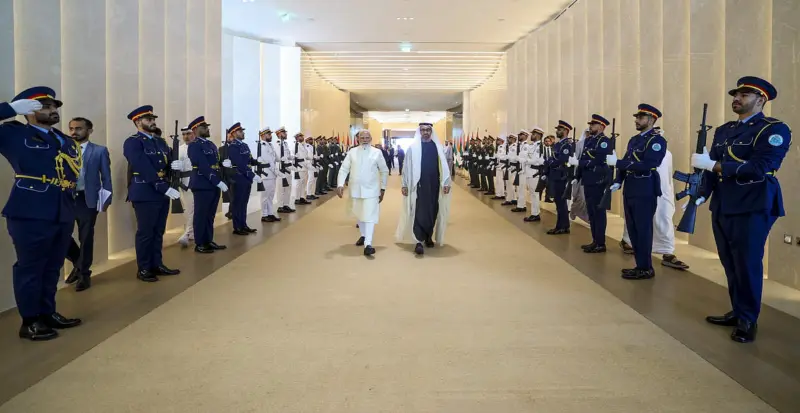
Modi's visit signals a deeper strategic commitment to the UAE, one that could dramatically enhance New Delhi's standing and long-term engagement with Abu Dhabi. A vote of confidence in the Emirates' future, shaken and tested by the war in Iran. India signals that it is with the UAE for the long run, and the diaspora has India's back.
Ninad D Sheth is a senior journalist. X: @ninadsheth.
(Disclaimer: The views expressed above are the author's own. They do not necessarily reflect the views of DH)