






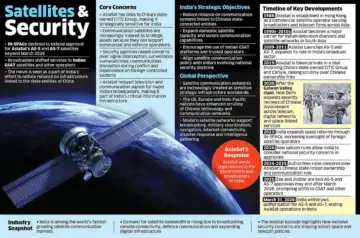
The Indian National Space Promotion and Authorisation Centre (IN-SPACe) has cancelled an agreement with Hong Kong-based Asia Satellite Telecommunications Company Limited (AsiaSat), prohibiting the use of the company's AS-5 and AS-7 satellites for communication services in India after March 31, 2026. AsiaSat was put on notice a year ago, and users in India have migrated to other platforms.
The decision was driven by national security concerns arising from AsiaSat's links to China, particularly the 50.5% ownership stake held by China International Trust and Investment Corporation (CITIC) Group Corporation. It underscores India's concern that commercial satellite infrastructure and communication networks can pose security risks due to potential foreign control or influence, especially from China, a strategic adversary.
Evolution of commercial satellites
Globally, commercial satellite applications began expanding in the early 1960s, marking the emergence of paid space-based communication networks. In 1962, Telstar 1 became among the first active communication satellites to transmit television signals across the Atlantic, demonstrating real-time international communication. This was followed by Syncom 3 in 1964, the first geostationary communication satellite, enabling live television coverage of the Tokyo Olympics. The commercial potential of satellite communications was established in 1965 with the launch of Intelsat-I, built by Hughes Aircraft Company for COMSAT, providing television, telephone and fax connectivity between Europe and the United States. Since then, the commercial satellite industry has expanded rapidly, becoming critical to communications, navigation, weather forecasting and digital connectivity.

For decades, the commercial satellite industry has thrived, with countries purchasing transponder bandwidth and services according to requirements. In recent years, private agencies have also started providing satellite-based internet connectivity. Such services were long treated as neutral infrastructure, but not anymore. As space technologies ranging from earth imaging to communications and navigation mature, it has become evident that service providers could covertly use networks for espionage. Space systems inherently possess dual-use characteristics, serving civilian and military agencies. This increases security risks, as systems designed for civilian applications can also support strategic operations. Today, several military conflicts depend on commercial satellite services.
Growing security concerns
AsiaSat's AS-5 and AS-7 satellites are communication systems used mainly for television broadcasting and telecommunications. They are high-capacity systems for VSAT, TV and broadband services. Reliance on commercial satellite systems always comes with challenges, ranging from espionage and cyber-attacks to intentional service disruptions. Naturally, India would have apprehensions about systems having Chinese links. In this case, the reported connections between AsiaSat and Chinese state-linked entities appear to have triggered a reassessment of the risks associated with allowing such infrastructure to operate within India's communication ecosystem.
Given the growing strategic rivalry between India and China, it is predictable that New Delhi would be cautious about allowing communication infrastructure with potential Chinese links to operate within sensitive national networks. In the case of AsiaSat, its connections with Chinese state-linked entities present a risk for India, hence the withdrawal from the deal.
Today, communication satellites support sectors like banking, energy and emergency response systems. Dependence on foreign-controlled satellite infrastructure comes with risks like data capture, cyber vulnerabilities, intentional service disruptions and electronic surveillance. The countries need to be careful while selecting service providers and avoid engaging satellite operators linked, directly or indirectly, to strategic competitors.
India's strategic recalibration
With India celebrating the first anniversary of Operation Sindoor on May 7, policymakers would remember that China had provided Pakistan with intelligence inputs derived from satellite surveillance capabilities, including imagery and battlefield awareness support. India's decision to cancel the contract with AsiaSat must also be viewed within the context of its broader strategic recalibration towards China in recent years. Since the 2020 Galwan Valley clashes, India has been cautious regarding Chinese-linked investments and procurement of telecommunications equipment and digital services from agencies with Chinese links. India has also banned several Chinese mobile applications and imposed restrictions in sectors such as telecom and critical infrastructure. Naturally, the space sector was also expected to come under scrutiny, though contractual obligations may have delayed the move and prompted the advance notice given to AsiaSat a year ago. India has only recently exited networks with Chinese associations.
In future, India is expected to look for a 'trusted space partner' framework, similar to the 'trusted telecom vendor' concept implemented by the National Cyber Security Coordinator (NCSC) through the Trusted Telecom Portal (TTP) to secure telecom infrastructure. India must ensure there are no security compromises while selecting foreign commercial satellite service providers. At the same time, it needs to meet the demands of one of the world's fastest-growing digital and connectivity ecosystems. Indian space systems are currently unable to fulfil the rising demand for satellite broadband and related services, and dependence on foreign satellite operators is likely to continue.
On May 3 this year, Indian space-tech startup GalaxEye launched a satellite called Drishti featuring unique sensor technology. However, India's space startup sector will require several more years to mature before developing and launching indigenous communication satellites for downstream applications. While India's push for indigenous satellite constellations is a positive step, translating this vision into operational solutions will take time.
For outer space, the legal architecture exists. However, these rules were designed for the challenges of an earlier era, and agencies are now exploiting them to suit their purposes in a changed environment. The existing space architecture remains complex and opaque in addressing issues related to sovereignty, ownership, accountability in the event of mishaps, supply chain vulnerabilities and competing private interests. Space technologies are inherently dual-use, serving both civilian and military purposes. A comprehensive global legal regime is unlikely soon. The countries must exercise caution while engaging foreign commercial satellite service providers. Orbital infrastructure cannot be viewed separately from terrestrial geopolitics.
(The writer is Deputy Director General, Manohar Parrikar Institute for Defence Studies and Analyses, New Delhi)