




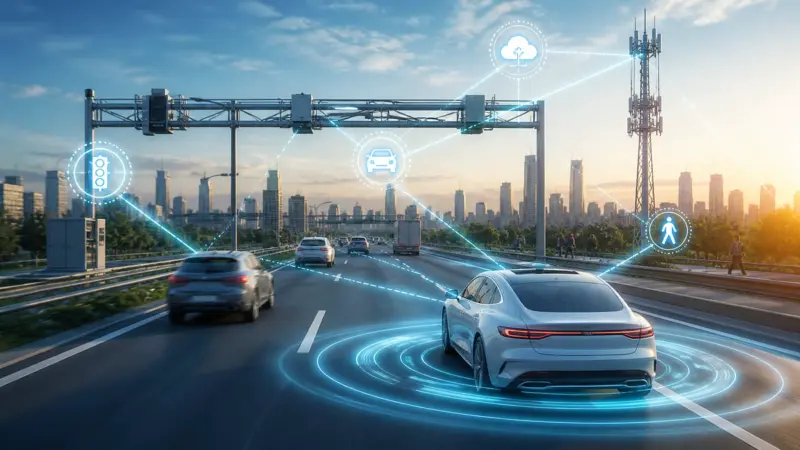

New Delhi: Soon, your car could automatically receive real-time warnings about road accidents, poor road conditions, or dense fog from vehicles ahead, thanks to Vehicle-to-Everything (V2X) communication technology.
The Telecom Regulatory Authority of India (TRAI) on Thursday released a consultation paper on the regulatory framework for V2X, setting the stage for spectrum allocation and pricing norms to enable wireless communication between vehicles and their surroundings.
V2X technology allows vehicles to wirelessly exchange real-time data with other vehicles (V2V), road infrastructure (V2I), pedestrians (V2P), and mobile networks (V2N).
This includes critical information such as location, speed, braking, and blind-spot alerts, significantly enhancing road safety, reducing traffic congestion, and supporting autonomous driving.
The spectrum allocation for the Vehicle-to-Everything (V2X) communication technology will also pave the way for the introduction of self-driven cars in India.
Union Road Transport Secretary V Umashankar had earlier stated that Vehicle-to-Vehicle (V2V) communication will alert drivers in real time about nearby vehicles' speed, location, acceleration, and braking, especially in low-visibility conditions like fog.
Good initiative to fix accident-prone roadsOn-board units (OBUs), similar to a SIM card, will be installed in vehicles to enable 360-degree direct communication without relying on mobile networks.
The technology is expected to be highly effective in preventing rear-end collisions with stationary vehicles and reducing large-scale pile-ups during dense fog, a common winter hazard in India.
According to official data, V2X will operate on the dedicated 5.9 GHz spectrum band. The Department of Telecommunications (DoT) has agreed to allocate 30 MHz (5875-5905 MHz) for initial C-V2X deployment, with an additional 20 MHz reserved for future Intelligent Transportation Systems.
The TRAI said that nearly 92 per cent of road accidents in India are caused by human error.
With India recording about 5 lakh road accidents and 1.8 lakh deaths annually, studies suggest V2X technology could potentially prevent up to 80 percent of accidents caused by human mistakes.
The consultation paper invites stakeholder comments by May 28, 2026, and counter-comments by June 11, 2026.