




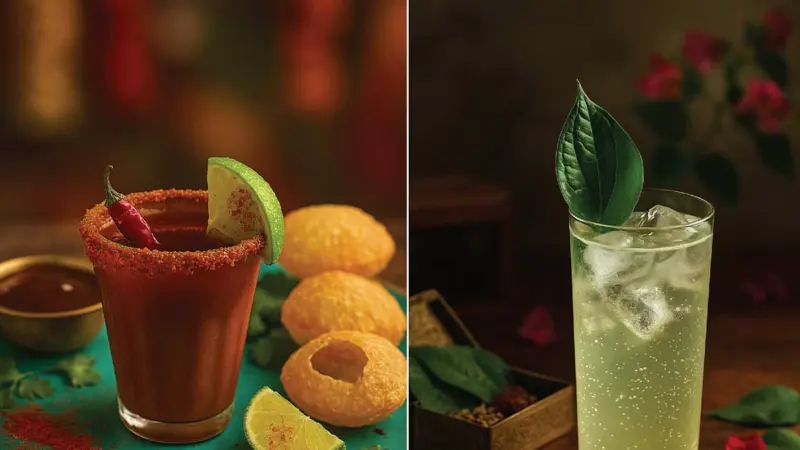

Get a cocktail in Mumbai or Delhi today, and chances are you are sipping something that didn't really start here, gin and tonic, whisky and soda, vodka and citrus, rum and cola.
They are dependable, easy to recognise, easy to go back to. But if you were to open a kitchen cupboard in almost any Indian home, you would find the beginnings of something far more interesting, ingredients rooted in memory, habit, and place, in ways no imported format can quite match.
India has never struggled with flavour. If anything, it has always understood ingredients instinctively. What to soak, roast, dry, or ferment. What cools the body, what balances heat, what works in summer and what carries you through winter. I still think about summer afternoons at my grandmother's house, when a steel glass of something slightly tangy would just appear, already sweating in the heat, and you knew, without asking, that it would cool you down. That was surely not experimentation; that was instinct.
And yet, when it comes to what we drink today, especially in cities, we often start from somewhere else. We start with a structure that is not really ours.
Indian mixology has come a long way in the last decade. Bars across the country are more confident, menus more thoughtful, techniques more refined. But underneath it all, there is still a quiet dependence. We borrow formats, structures, even language, and then try to slot Indian ingredients into them. Kokum becomes a souring agent. Tamarind becomes a twist. Jaggery steps in for sugar and suddenly feels "different." But these ingredients were never meant to play supporting roles; they were always meant to lead.
Flavours and their origin stories
At some point, I found myself thinking less about recipes and more about where flavours actually come from. That line of thought eventually became the theme of my book. The book is not really about cocktails as much as it is about the stories behind ingredients. Because in India, flavour is never isolated, it is always tied to a place, a habit, or a memory.
Mahua isn't just a spirit. It is those early mornings in forest regions, where flowers are gathered before the sun gets too high. Kokum is not just acidity; it takes me back to Ratnagiri, where it quietly exists as part of everyday life. Tamarind is not just tang; it feels like Guntur, where it is used instinctively, without measurement. Jaggery is not just another sweetening agent; it reminds me of places like Gwalior, where it still holds its own in ways sugar never quite could. Curry leaf is the crackle when it hits hot oil, the beginning of something real. Betel leaf is the pause at the end of a meal, lingering a little longer than expected.
When you start to see ingredients this way, they stop being functional. They become stories.
Take mahua. For generations, it is been around, sometimes overlooked, sometimes misunderstood, but always present. It has a natural softness, a quiet sweetness that does not need much interference. A drink built around mahua, with a lift of gondhoraj lime and maybe a touch of black pepper, does not feel like a variation of something else. It feels complete in itself.
Kokum doesn't behave like lime or lemon. It is softer, slower, and it lingers. Tamarind brings both tang and depth; it does not just brighten a drink, it rather grounds it. Pair it with a darker spirit and a hint of jaggery, and suddenly you have something that feels less like a cocktail and more like a memory. Something you do not rush through.
Jaggery adds warmth, not a clean, polished sweetness, but something deeper, more textured. Curry leaf, when lightly bruised or infused, brings in a note that is unmistakably Indian without overwhelming the drink. Betel leaf, used carefully, creates a pause; it makes you think for a second before the next sip.
A drink that truly belongs
What really changes things isn't just the ingredient; it is where you begin. Instead of asking how to "Indianise" a known cocktail, the better question is: what does this ingredient want to become? Start there, and the drink doesn't feel adapted; it feels like it belongs.
You can imagine a warm evening with a kokum-based drink in hand, its deep colour catching the light, a gentle tartness rising before the first sip, everything rounded rather than sharp. Or a slower drink where tamarind and jaggery come together, leaving behind a warmth that feels oddly familiar, even if you can not quite place why. These are not strict recipes; they are guiding directions.
Layered flavour system
India does not need to catch up with global mixology. If anything, it is sitting on something far richer all along, a flavour system that is already layered, complex, and emotional. The issue is not about availability. These ingredients are everywhere. What has been missing is attention.
That is beginning to change through a renewed focus on ingredients, their origins, and the stories they carry. Some initiatives are part of that shift, bringing the conversation back without forcing it. It is often called innovation, but it is surely not; it is recognition, it is about seeing what has always been there, shaping the drink instead of just decorating it.
The next time you pick up a cocktail, maybe the question to ask is not how India fits into the cocktail world, but whether the cocktail world has caught up with India yet.
(The writer is author of Madira: India's Forgotten Spirits and Cocktail Revival, published by Rupa Publications.)
This article is for informational purposes only and is not intended to promote or condone the abuse of alcohol. Alcohol should be consumed responsibly and in moderation by individuals of legal drinking age.