
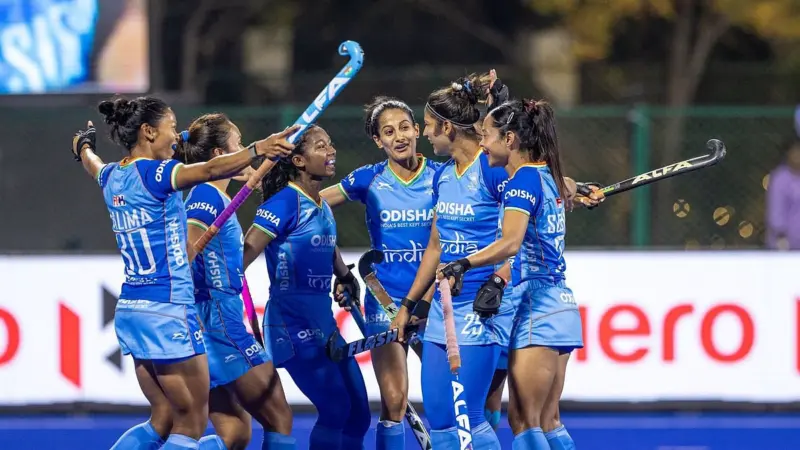

Bengaluru: Peak summer in the Netherlands and Belgium during August has temperatures ranging between 15 and 22 degrees Celsius. Approximately 13,000 km away, during September in Japan, the transitional climate from summer to autumn ranges between 26 to 30 degrees Celsius.
In between these diverse weather conditions, different time zones, relevance of the moment and several other variables, lies a grey area that the men's and women's Indian hockey teams find themselves in. This is because both the national squads will be in fray at the World Cup in the Netherlands and Belgium from August 15-30 before beginning their campaign at the Asian Games in Japan from September 19 to October 4.
While the Indian men's team's lone world title came way back in 1975, their women counterpart's fourth-place finish in 1974 remains their best result. At the Asiad, however, India are the powerhouses with the men starting as the defending champions and the women as top contenders for gold.
That was the gist of what the two national sides will face in a busy second-half of the year. The devil, however, is in the details. A mere 18-day turnaround time between the two big tournaments, a World Cup in Europe against the sports' top sides - where India's chances of finishing on the podium are considered a tall order, and the continental bash being a 2028 Los Angeles Olympic-qualifier (gold medallists at Asian Games seal their Olympic spot) are factors that have sent the think-tank into an overdrive.
Stadiums built, standards missing: Why India struggles to host big sports eventsSo then, should India field their best squads for both the events? Should it be a mix of the cream and the second rung players for the first and their premier line-up for the second? Will fielding two completely different teams for each be a gamble worth taking? Such in-depth deliberation is primarily to avoid/ manage physical and mental fatigue of players during their quest to churn out optimum performance in a jam-packed schedule.
Concerned about the same, last Monday, news of the Sports Ministry expressing its view on the matter spiced up the debate further. They want Hockey India to field the best teams for the Asiad and B teams for the biennial World Cup. Though the squads are yet to be finalised and named, the Sports Ministry's perspective is in contrast with the sport's national federation and the two head coaches - Craig Fulton and Sjoerd Marijne - of the men's and women's sides, respectively, who maintain that their best players will play both crucial events.
"We need to understand that most of the boys (in the national set-up) are above 100 caps. So, I think, physically, it shouldn't be a problem," feels VR Raghunath, former player and dragflick expert who scored 132 goals in 228 international matches for India.
"It will be more of a psychological and mental challenge. Imagine, things turn out well and they fare well at the World Cup. That positivity will definitely be carried forward into the Asian Games. We were in a similar position in 2014," offers the 37-year-old double Olympian from Kodagu.
What Raghunath is referring to is in 2014 the Glasgow Commonwealth Games were held between July 23 and August 3 and the Incheon Asian Games were held from September 19 to October 4. While the Indian men's side finished second, after losing 0-4 to Australia in the final, at the CWG, they went on to grab gold by beating Pakistan through a penalty shootout in the final of the Asiad. Of course, in this scenario, the turnaround time was more than a month, but Raghunath's point is that competing in back-to-back big high-intensity tournaments has always existed and given the ever evolving hockey ecosystem, players are trained for such tasks.
"Our squad for both were almost the same and we medalled at both. Back then, a match was 70 minutes with two halves of 35 minutes each. Now, it is a total of 60 minutes with four quarters of 15 minutes each and unlimited change of players (substitutions). It will all be about balancing and managing on-field duties. How players are injected and rested according to the intensity of a game, taking full responsibility of individual roles, proper rest and recovery and such micro management are key," points out Raghunath.
Speaking about the unique challenge of the tricky dilemma faced mostly by the Asian hockey-playing countries, MM Somaya, former India captain and three-time Olympian, feels no single option will please everybody. He insists that tough decisions on team composition based on players' latest fitness and form will need to be made as the two assignments approach.
Perform or perish: How India's new Asian Games guidelines will reshape sports squads"Look, there is no doubt this is a demanding schedule. So the composition of the final teams will be a collective decision based on the best interest of the players and India's chances at doing well," says Somaya, who was part of the gold medal-winning men's side at the 1980 Moscow Olympics, captained India at the 1988 Seoul Olympics, and was part of two World Cups (1982 and 1986).
"Along with Hockey India, the government and coaches, the feedback from the players will definitely be taken seriously. Because in 1986 we won the Asian Games (Seoul) bronze beating Malaysia on September 29 and immediately flew to London to play our first match at the World Cup scheduled six days later.
"India and Pakistan were the only two teams who went through this double challenge. Both of us were capable of finishing in the top-5 at the World Cup but ended up fighting for the 11th and 12th spots. It definitely has left a lasting scar on me because had we had sufficient gap between the two maybe, we would have performed better. So the concern is actually healthy," offers the Madikeri-born 66-year-old Somaya.
While all eyes will be on every probable player and the workings of coaches Fulton and Marijne to put the right pieces of the puzzle together, both Somaya and Raghunath stress on the enormous responsibility that lies on the shoulders of the support staff in preparing both sides before and during the events.
"Keeping the players injury-free and keeping things light-hearted outside the field will definitely be the main focus of the support staff. I'm sure they will chalk out each session, have a clarity of specific roles even 60-70 days prior to the events," opines Raghunath.
Somaya adds: "Compared to 45-50 years ago, the training, practice and emphasis on mental fitness have become so scientific. There are renowned coaches for every department, including strengthening and conditioning. The world's top psychologist will be guiding them. Yes, the challenge is massive but I think with top class support staff and their commitment will surely help in tackling the tough task better."
Given the format, each of the Indian teams will play a minimum of six matches at the World Cup before the 18-day buffer and then wield their sticks again for a minimum of another five games at the Asiad.
Gruelling, yes. The answer to this conundrum hinges on the next 100 days of prep work during the Indian summer and monsoon months.