




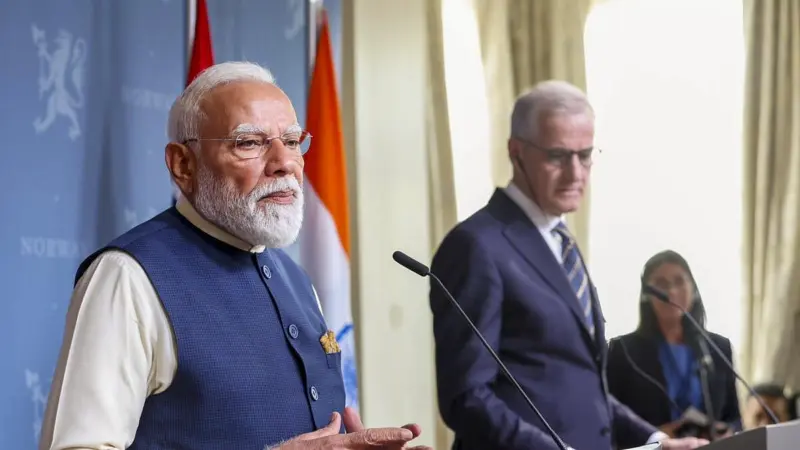

New Delhi: India and Norway on Monday elevated the bilateral relations to a green strategic partnership as Prime Minister Narendra Modi and his counterpart in the Northern European nation, Jonas Gahr Støre, met in Oslo and witnessed the signing of agreements for cooperation in space, digital development, health and technology.
Quick summary - click for full detailsConcise summary of key highlights
India-Norway raise bilateral ties to green strategic partnership
In one lineIndia and Norway elevate bilateral ties to a Green Strategic Partnership, focusing on clean energy and climate resilience.Key points• Green strategic partnershipIndia and Norway upgraded their bilateral relations to a Green Strategic Partnership, emphasising collaboration in clean energy, climate resilience, blue economy, and green shipping.• Bilateral agreements signedBoth nations signed agreements for cooperation in space, digital development, health, technology, and specialised consultancy services for tunnel construction and slope stability.• Investment and job targetsIndia aims to attract $100 billion in investments from EFTA nations, including Norway, and create one million jobs over the next 15 years under the India-EFTA trade deal.• Shared global commitmentsBoth leaders reaffirmed support for a rule-based international order, peaceful conflict resolution in West Asia and Ukraine, and reform of global institutions.• Historical context and solidarityModi highlighted Norway's support for India after the 2025 terrorist attacks in Jammu and Kashmir, underscoring the strength of their bilateral friendship.Key statistics$100 billionInvestment target from EFTA nations1 million jobsJob creation target over 15 yearsOctober 1, 2025Effective date of India-EFTA trade dealProcessed with AI. Reviewed by DH Digital Team.
New Delhi and Oslo also inked an agreement for providing specialised consultancy services for the construction of tunnels, slope stability and capacity building.
PM Modi calls for peaceful resolution of conflicts in West Asia and Ukraine"Today, we are elevating India-Norway relations into a Green Strategic Partnership," Modi said after meeting with Støre. "Through this strategic partnership, our companies will develop global solutions across sectors - from clean energy to climate resilience, and from the blue economy to green shipping - by combining India's scale, speed, and talent with Norway's technology and capital."
Modi called for greater Norwegian investments in India in key sectors such as the blue economy, shipbuilding, green transition, renewable energy, health-tech, critical minerals, and start-ups. He also underscored India's ambitious green transition agenda, emphasising the country's scale, growing energy demands, climate commitments, and rapid expansion in renewable energy, grid infrastructure, green hydrogen, and clean energy.
He appreciated Norway's global leadership in clean energy investments, maritime decarbonization, ocean sustainability, and climate finance. He urged the business communities of both countries to forge new partnerships, identify emerging areas of collaboration, and strengthen economic cooperation.
Modi noted that 10 % of Norway's ships were presently being made in India, and called for efforts to take it to 25%.
A century after Tagore's Sweden visit, PM Modi, Kristersson honour Rabindranath's enduring legacyThe prime minister flew to Oslo from Gothenburg after completing his tour of Sweden. He and Prime Minister Ulf Kristersson of Sweden had on Sunday agreed to elevate the bilateral relations between New Delhi and Stockholm to a strategic partnership.
Earlier, Modi and Dutch Prime Minister Rob Jetten had also agreed to raise the relations between India and the Netherlands to the level of a strategic partnership.
Modi commenced his latest foreign tour from the United Arab Emirates on Friday. He will leave Oslo for Rome on Tuesday and will leave for New Delhi on Wednesday after a two-day visit to Italy.
His visit to Oslo was the first by a prime minister of India to Norway.
Norway is one of the four members of the European Free Trade Association (EFTA), which inked a Trade and Economic Partnership Agreement with India in March 2024. The India-EFTA trade deal came into effect on October 1, 2025.
Modi on Monday said that New Delhi had set the target to bring in investments of $100 billion into India from the EFTA nations under the trade deal, in addition to creating one million jobs over the next 15 years. "Today, both sides (India and Norway) took several important decisions to translate the promise of this agreement into tangible outcomes."
"I think that the trade and economic partnership agreement is an open door," said Støre, adding: "We have certain ambitions to contribute in India, but it's important for me to say also to the Norwegian public that this will also help the job solidity and creation in Norway. We work together to reduce emissions, improve healthcare, and contribute to supply chains and security of transactions."
The prime minister noted that he had planned to visit Norway around the same time last year, but the terrorist attacks in Pahalgam in Jammu and Kashmir on April 22, 2025, had forced him to reschedule the visit.
PM Modi holds talks with Norwegian counterpart"During that difficult time, Norway stood firmly with India against terrorism, reflecting the strength of our friendship. Today, as I visit Norway, I express my heartfelt gratitude for that support and solidarity," said Modi. "India and Norway agree that reform of global institutions was essential to address the growing global challenges. "And eliminating terrorism in all its forms and manifestations is our shared commitment."
He said that India and Norway both believed in a rule-based order, dialogue, and diplomacy. "We agree that no issue can be resolved through military conflict. Whether it is Ukraine or West Asia, we support and will continue to support every effort toward an early end to the conflicts and the restoration of peace," said the prime minister.
"One thing that I have discussed with Prime Minister Modi today is the fact that countries that believe in a rule-based order, which is not static, it is always developing and kind of responding to what is happening around them, but countries that believe in certain standards and certain stability in trade and geopolitics and how countries deal with each other, they have to move closer together," said Støre.
Modi said that India and Norway were in agreement that reform of global institutions was essential to address the growing global challenges. "And eliminating terrorism in all its forms and manifestations is our shared commitment," he said.