




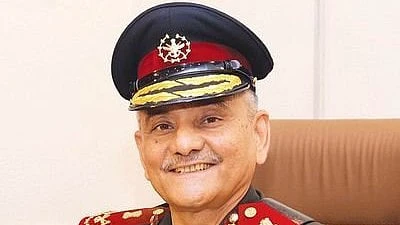

Shirdi: Emphasising that India's defence preparedness requires a "whole-of-nation approach," Chief of Defence Staff Anil Chauhan said Saturday that the dimensions of modern warfare are rapidly changing, with technology and innovation emerging as decisive factors in future conflicts.
Speaking at the inauguration of Nibe Limited's defence and aerospace manufacturing complex in Shirdi in Maharashtra's Ahilyanagar district, Gen Chauhan said India's national security architecture can no longer remain dependent solely on the armed forces and must increasingly draw strength from industry, manufacturing ecosystems and indigenous technological capabilities.
More than 5 lakh crore defence projects approved carry focus on indigenisation: Air Marshal Ashutosh Dixit"India's defence preparedness is no longer only a subject of the armed forces, but has now become a whole-of-nation approach," the CDS said.
The mega-project has been spearheaded by Nibe Ltd Chairman and Managing Director Ganesh Nibe, who hails from Shirdi.
Among those present were Samir V. Kamat, Chairman of the Defence Research and Development Organisation; Lieutenant General Dhiraj Seth, chief of the Pune-headquartered Southern Command; and Lieutenant General Anoop Shinghal.
Describing the transformation underway in military doctrine globally, Gen Chauhan said warfare is no longer centred merely on manpower or conventional weapons platforms.
"We must realise that warfare, the art of war, and methods of war are changing very rapidly. Modern warfare today is no longer based only on manpower, conventional weapons, or platform-centric operations. Artificial intelligence, robotics, cyber systems, drones, autonomous platforms, space technologies, precision-strike weapons and information dominance are shaping the future battlefield in a decisive way," he said.
The CDS said future wars would increasingly become "multi-domain" in nature, involving the simultaneous integration of land, sea, air, cyber, space and cognitive warfare capabilities.
"I believe that every future war will be multi-domain, where land, sea, air, cyber, space and cognitive warfare will operate together. Today's battlefield will not remain limited only to geographical space. Information networks, digital ecosystems, cyber infrastructure and data environments will become part of the future battlespace," he said.
The remarks assume significance amid growing global military emphasis on integrated warfare doctrines following conflicts in Russia-Ukraine and West Asia, where drones, cyber operations, electronic warfare, satellite intelligence and information campaigns have increasingly shaped battlefield outcomes alongside conventional combat.
Gen Chauhan also stressed that operational success in future conflicts would depend as much on industrial and technological ecosystems as on military capability.
"In the evolving situation, national security does not depend only on the courage of soldiers, sailors and air warriors. It also depends on technological ecosystems, industrial capability, manufacturing strength and innovation capacity," he said.
Calling India's armed forces among the best in the world, the CDS said even the most capable military requires a strong domestic industrial base and resilient supply chains for ammunition, surveillance systems, autonomous platforms and advanced weapon technologies.
Highlighting India's growing defence manufacturing ecosystem, he said domestic defence production had touched a record nearly Rs 1.27 lakh crore, while defence exports had crossed Rs 38,000 crore.
'Bhakti meets Shakti': Shirdi to emerge as defence manufacturing hub with Rs 1,000 cr project"Today, India is exporting defence products to more than 100 countries," he said.
Referring to the role of private industry, Gen Chauhan said facilities such as that of Nibe Limited reflected rising confidence in India's indigenous defence manufacturing capabilities.
"The company's work in missile systems, ammunition, autonomous platforms, energetics and emerging technologies reflects the maturity of the private defence sector," he said, adding that nations which innovate, manufacture and adapt faster would gain long-term strategic advantage.