
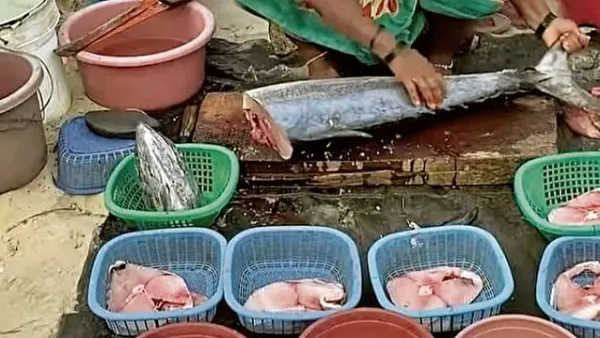

On a Sunday morning, as I made my way towards the fish market in Uttara Kannada's Gokarna, the sea-scented air greeted me first. Within moments of reaching there, the calm gave way to a rising chorus: fishermen chattering about their catch, buyers negotiating and baskets of fish changing hands.
But cutting through the noise, a common name that echoed across the market was 'Ishwana'.
From October to May, Uttara Kannada coast sees an abundant arrival of Ishwana, known in English as seer fish. During this period, fish markets become noticeably crowded, as Ishwana is widely regarded as the king of coastal flavours. Locally, it is called Surmai or simply referred to as the "big fish" due to its impressive length of around 80 cm. Belonging to the mackerel family, it is a rich source of protein, omega-3 fatty acids, vitamins, and minerals.
The arrival of Ishwana from the sea boosted the mood of the Gokarna fish market instantly. A sense of enthusiasm took over. Fish lovers had waited for the Ishwana season with quiet eagerness much like a farmer waiting for the rain, and the bounty had finally arrived. Equally happy, fishers and sellers saw Ishwana as a crowd-puller.
Odette's Chef-owner Julien Royer interview: 'A customer named her baby after our restaurant'Along the Arabian Sea coast of Karnataka, October is not just another month on the calendar. It signals a shift in the mood of the sea. Cool winds and a light mist along the shore serve as cues for the fisher community: the Ishwana season has begun.
Locals identify two types of Ishwana: Hennu Ishwana (female) and Dandi Ishwana (male). Only experienced buyers can distinguish between a male and a female by just looking at its head. A female usually weighs up to five kilograms, while a male can grow up to 25 kilograms. Many prefer the female for its richer taste.
During the season, Ishwana is priced between Rs 600 and Rs 700 per kilogram. In some markets, it is sold in pieces, with price per piece ranging from Rs 80 to Rs 400 depending on size and demand. Restaurants compete to source it, as Ishwana fry remains popular through the season.
Unlike many fish that contain numerous small bones and are tricky to eat, Ishwana has a single large central bone. This makes it easier to prepare and eat.
However, Ishwana is not easy to dry and preserve. Its flavour and aroma are best experienced fresh.
Inviting aroma
In coastal homes, the arrival of Ishwana brings a sense of occasion to the kitchen. Whether fried, spiced, or prepared as sukka(dry), curry, or chilli fry, each Ishwana dish offers a distinct flavour. A piece of Ishwana coated in masalaand fried in coconut oil releases an inviting aroma, setting the tone for a special meal.
Caught using hooks and nets, Ishwana is not only sold in local markets of Uttara Kannada but also exported abroad. From coastal waters, it travels far, carrying its flavour to distant places.
Even days after I left the Gokarna fish market, the aroma of Ishwana lingered with me. With the Ishwana season now in full swing, its abundance and the excitement around it will continue.
Until May, it will rule Uttara Kannada's kitchens and culinary culture.
(Translated from Kannada by Divyashri Mudakavi)
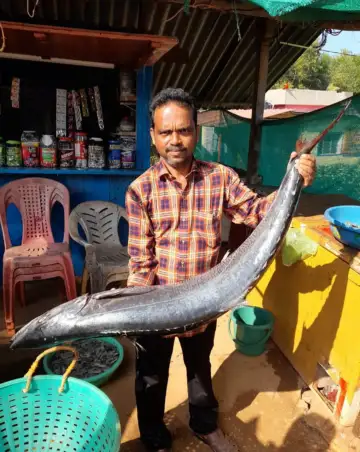 The Ishwana known for its rich taste. Photo by author By Beeranna Nayak Mogata