


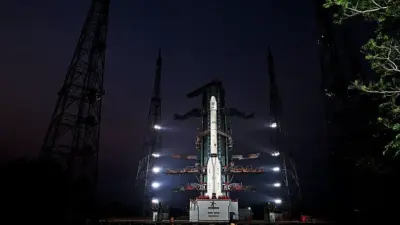

The Indian Space Research Organisation (ISRO) on Friday launched the GSLV-F18 rocket from Satish Dhawan Space Centre in Sriharikota at 11:51 pm.
The vehicle will place NVS-03 satellite into a Geosynchronous Transfer Orbit. It is the third satellite in next generation navigation satellite system envisaged for providing continuity of navigation services for IRNSS series.
ISRO will have four launch pads by 2029, says Chairman V NarayananThe satellite carries Indigenous Atomic clock, along with the procured Atomic clocks. It also includes L1 signal in addition to existing L5/S signals with Coverage over India land mass and a region extending 1,500 km around Indian geopolitical boundary.
"The GSLV F 18 vehicle has successfully injected the NVS-03 satellite into its designated injection orbit. The GSLV F18-NVS03 mission has been successfully accomplished," the space agency said.
The next generation satellite is all set to complement three other navigational satellites in operation including the NVS-01 and it will strengthen infrastructure for a robust IST with the government recently notifying the Legal Metrology (Indian Standard Time) Rules, 2026.
After a flight of about 18 minutes, which saw the successful performance of all three stages including the complex cryogenic upper stage, the primary payload got separated from the launch vehicle and was injected into a Geosynchronous Transfer Orbit (GTO).
The targeted orbit has a planned perigee (closest point to Earth) of 170 km and an apogee (farthest point) of 37,023 km.
The satellite, which features an indigenous Rubidium atomic clock, is a crucial addition to the Navigation with Indian Constellation (NavIC) system and will transmit signals in the L1, L5, and S bands to strengthen India's regional positioning services.
"NVS-03 is the third satellite in next generation navigation satellite system envisaged for providing continuity of navigation services for IRNSS series. The satellite carries Indigenous Atomic clock, along with the procured Atomic clocks. It also includes L1 signal in addition to existing L5/S signals with coverage over Indian land mass and a region extending 1500 km around Indian geopolitical boundary," the space agency said.
(With PTI inputs)