

New Delhi: Chief Justice of India Surya Kant emphasised at the need for a justice delivery system that is "accessible, responsive, and deeply integrated" into the daily lives of the citizens.
Delivering the 4th Ashok Desai Memorial Lecture on the theme 'Reimagining Justice: The Indian Judiciary 50 Years Hence', he said, "The traditional model of justice where citizens must approach courts physically, must give way to a system where justice reaches people efficiently and equitably."
Technology is now a constitutional instrument for equality before law: CJI Surya KantHe said that in a rapidly evolving society, the judiciary must adapt to ensure that access to justice is no longer dependent on location, resources, or procedural complexity.
"Justice is no longer something one must travel to seek, but something that reaches individuals efficiently, equitably and with sensitivity to the realities of a changing society. Judiciary's long-term goal should be to build a system that, over the next five decades, becomes more accessible, transparent, and closely aligned with the needs of society," the CJI said.
He said that judges of the future cannot remain confined to being mere interpreters of statutes and precedents, but must develop a broader understanding of emerging fields.
He pointed out that the movement towards a paperless system is already underway, so the future will demand far more than the digitisation of existing processes.
"Evidence may be recorded, stored, and verified through distributed systems that ensure authenticity and permanence. Case records could exist in forms that are tamper-proof and universally accessible, reducing delays while enhancing trust in the system," the CJI said.
He also said that technology will also redefine the manner in which judges engage with information. "Artificial intelligence, already in its early stages within our judicial systems, through software -- such as SUVAS, SUPACE and LegRAA -- will evolve into a far more sophisticated and capable assistant. ΑΙ will surely not replace judicial reasoning but its role will become enormous in sifting through vast volumes of material, identify relevant precedents, and present structured insights, enabling judges to devote their attention to interpretation, fairness," he said.
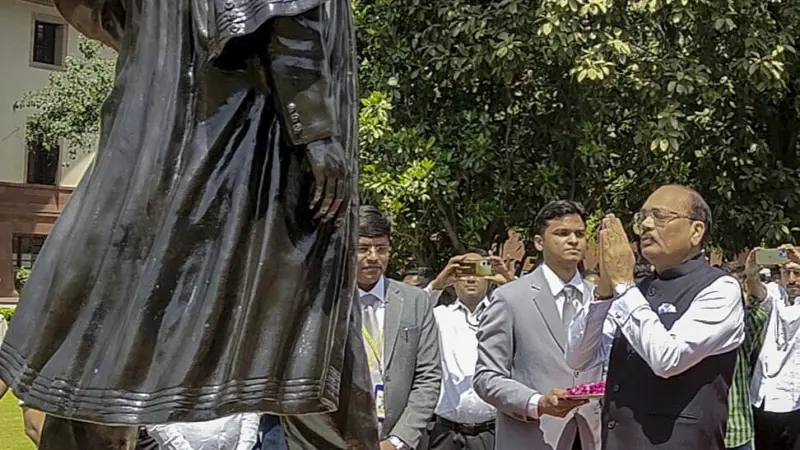
Meanwhile, the CJI and other Supreme Court judges on Tuesday paid tributes to Dr B R Ambedkar on his birth anniversary on Tuesday inside the apex court's premises. The CJI said that Dr Ambedkar provided the nation with a "comprehensive Constitution designed to safeguard the rights of every citizen."