
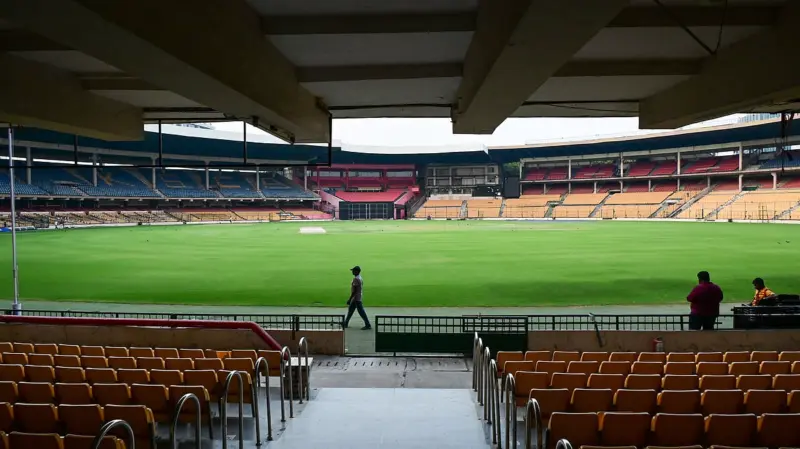

Bengaluru: Building cricket stadiums, some of them mega-sized, seems to have become a new trend among several state governments. At the moment, at least four states, with Karnataka being the latest, have either proposed or begun constructing new venues in various parts of the country.
In a country that has historically frowned upon spending on sports infrastructure as a waste of resources, this might seem like a welcome change. But is it really?
Consider the Karnataka government's approach. It has used the tragic June 4 stampede, which left 11 RCB fans dead, outside the Chinnaswamy Stadium to justify the need for a bigger and better venue. While the intention may be sound, instead of persuading the Karnataka State Cricket Association, which governs the sport in the state, to build a new stadium, the government has chosen to take matters into its own hands. It plans to build a stadium in Anekal, about a 50-minute drive from the city center. The proposed capacity is 80,000, estimated to cost over Rs 900 crore.
Having stadiums on the outskirts does have advantages. Open land provides the space needed for large, modern infrastructure. Bigger area allows for ample parking, which helps reduce traffic congestion in surrounding areas. They also make security management easier, improving the overall match-day experience. Many recently built cricket stadiums in cities such as Ahmedabad, Pune and Rajkot largely follow this model. Notably, these venues were developed by their respective state associations with significant financial support from the Board of Control for Cricket in India.
Despite criticism over its opaque functioning and occasionally allowing the Indian team to be used for political mileage, the BCCI remains one of the most professionally run sports organisations in the country. A key reason for its success is the relative absence of political interference in cricket administration, which has allowed the sport to grow beyond one's imagination. It is important that this independence is protected.
The speed with which the state government has moved forward with the new stadium is striking. It issued a tender soon after the KSCA invited expressions of interest to expand the Chinnaswamy Stadium. While this efficiency is unusual, it also exposes misplaced priorities, especially when other sports are in crying need for attention.
Karnataka's flagship multipurpose venue, Sree Kanteerava Stadium, built ahead of the 1997 National Games, is now outdated and inadequate by modern standards. Several sports infrastructure initiatives announced in the state budgets are yet to take off. Some are stalled, while others are progressing at snail's pace. Most Olympic sports depend heavily on government assistance, whether for training infrastructure or financial incentives. In this context, focusing on a sport that is already self-sufficient appears needless indulgence.
There is also the question of how matches will be hosted at the new venue. The BCCI allocates matches to the KSCA, purportedly on rotational basis, and the association is free to choose where to host them. However, it is unclear why the KSCA would shift matches away from its existing stadium. While the government could pressure the association to use the new facility, such a move risks conflict. If the situation is not resolved amicably, there is a real possibility that the BCCI could choose not to allot matches to the KSCA at all.
Wasn't this evident when BCCI took away the women's ODI World Cup matches last year from Chinnaswamy and didn't allot any matches during the T20 World Cup this year due to a stand-off between the state government and the KSCA?
With no steady income, maintaining the facility itself may become a huge financial burden for the government
as it requires, for the size of the Chinnaswamy stadium, an annual expenditure of nearly Rs 1 crore for the upkeep of the stadium, including salaries for ground staff and outsourced labourers, expenses on water, flood light, fuel, sand, among others. And it would easily cost three times to maintain the proposed stadium.
In such a scenario, the stadium could well turn into a costly white elephant.