
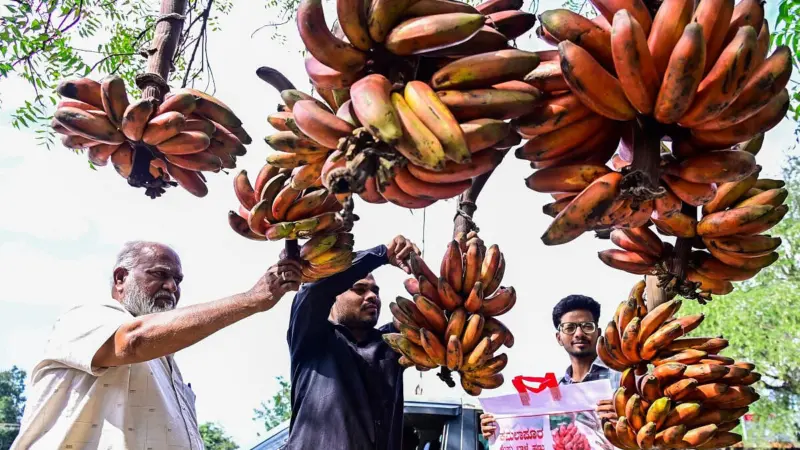

Kalaburagi: The GI-tagged Kamalapur red banana is on a path beyond the platter of banana buffs, with the state government planning to develop high-value biomolecules and value-added products from the fruit.
The banana variety, which was accorded the Geographical Indication tag in 2009, is facing an existential threat due to shrinking cultivation area -- In Kalaburagi, it is planted only in 30-40 acres.
Now, officials are planning to scientifically enhance the value of the red banana biomass (fruit, peel, pseudostem, floral parts, etc.) for extraction and development of high-value medical and nutraceutical biomolecules. These include polyphenols, flavonoids, antioxidants; anti-diabetic, anti-inflammatory and wound-healing biomolecules; gut-health-promoting compounds, bioactive dietary fibers and prebiotic fractions.
CITU flags 'betrayal' as Karnataka moves to implement Labour Codes, seeks Kharge's interventionThe Kamalapur red bananas are known for their thick red skin, creamy and sweet pulp, and high nutritional value with rich iron content, potassium and vitamin B6. The fruit is often prescribed to people with anaemia, diabetes and digestive issues.
The IT-BT department has established an advanced commercial tissue culture laboratory dedicated for the GI-tagged red banana in Bengaluru, integrating plant tissue culture, microbial biotechnology and bio-hardening innovations. The department is planning to set up a new laboratory in Kalaburagi soon.
The initiative will also focus on zero-waste, high-value product development, including nutraceutical powders, capsules, functional food ingredients, dietary supplements and bioactive extracts, among others.
Scientists claim the production ecosystem of red bananas is currently under stress due to non-availability of quality planting material, severe diseases, pest pressure and unstable yields, resulting in underutilisation of its full economic and biomedical potential.
This has resulted in yield fluctuations, poor crop uniformity and reduced plantation longevity. The absence of organised systems for value addition and biomedical utilisation of red banana biomass has prompted the scientists to draw a strategy for integrated disease and yield enhancement.
"We have established a tissue culture lab and implemented bio-hardening technology for Kamalapur red banana and this initiative integrates agriculture, biotechnology, medical biomolecule development and value addition. This also intends to enhance the farmer income, and sustainable and climate-resilient agriculture, apart from bio-economy, startup ecosystem development, banana crop protection and global market positioning," said Dr Saravanan Ravi, senior manager of agri and food technology at the Bengaluru Bioinnovation Centre established by the IT-BT department.
Rs 200 per dozen
The Kamalapur red banana is grown only in Rajnal, Navanihal and Okali villages in the district and is sold only in one or two places around the Kamalapur bus stand, located between Kalaburagi and Bidar.
Its price varies from Rs 200 to Rs 250 per dozen against Rs 40 per dozen for normal bananas. The red banana plant grows 12-15 feet tall and around 800 saplings can be planted in one acre. Its crop duration is around 18 months against one year for normal bananas.
The farmers are selling the produce on their own on the roadside to avoid middlemen.
"The number of farmers engaged in the cultivation of red bananas has reduced considerably due to the high cost of production and less profit. The soil and weather conditions of Kamalapur are most suitable for cultivation of these bananas. It requires a specific, nutrient-rich cultivation process. Only a few people who know about its health benefits prefer to buy the produce," Ashok Sugur, a Kamalapur red banana grower, said.
The Minister for Rural Development & Panchayat Raj and IT/BT, Priyank Kharge, said the government is exploring ways to promote the red banana as a super food and enhance its other uses.
He also said the agricultural accelerator programme adopted for GI-tagged tur crop will also be extended to the red banana. "We will hold discussions with various institutions to make multiple use of red bananas once the state Budget session is over. We will try to enhance the nutrition and protein values of bananas by utilising every aspect, including its roots, shoots and leaves to ensure that farmers get more bang for their buck," the minister said.
Rich in content, poor in acreage
* Fruit known for thick red skin, creamy and sweet pulp
* High nutritional value with rich iron content, potassium and vitamin B6
* Often prescribed to people with anaemia, diabetes and digestive issues
* Govt plans to to enhance value of the red banana biomass
* Will extract high-value medical and nutraceutical biomolecules
* Facing an existential threat due to shrinking cultivation area
* In Kalaburagi, it is planted only in 30-40 acres
* Production under stress due to lack of of quality planting material, diseases, pests