
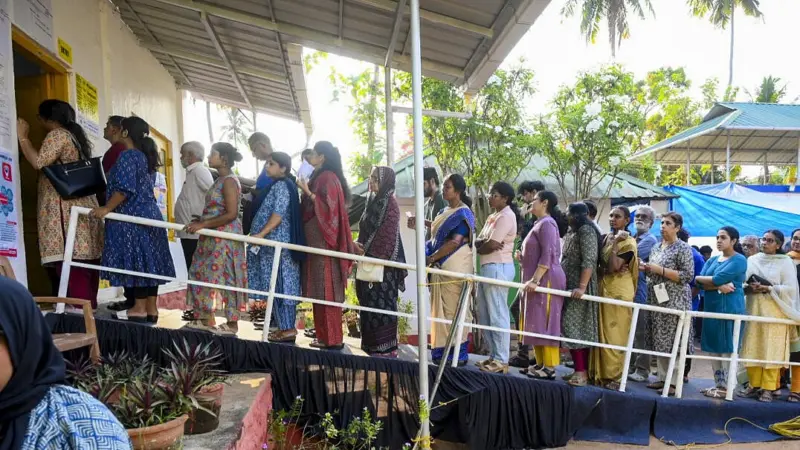

The first Assembly election in Kerala after the Special Intensive Revision (SIR) of electoral rolls has recorded one of the highest voter turnouts in the State's history.
At the end of the polling day on Thursday, Kerala recorded a turnout of 78.27% as opposed to 76% in 2021, 77.35% in 2016 and 75% in 2011.
Quick summary - click for full detailsConcise summary of key highlights
Kerala votes big after SIR: What previous elections reveal about turnout trends
In one lineKerala's high voter turnout after SIR defies traditional assumptions about UDF and LDF support.Key points• Highest turnout in decadesKerala recorded 78.27% voter turnout in the latest election, one of the highest in its history, after the SIR process.• No consistent turnout patternHistorical data shows no clear correlation between high turnout favoring UDF or low turnout benefiting LDF.• LDF seeks third termThe LDF, led by Chief Minister Pinarayi Vijayan, aims for a rare third consecutive term despite anti-incumbency pressures.• UDF and BJP strategiesUDF interprets high turnout as anti-incumbency against LDF, while BJP targets triangular contests to gain ground.• Political analyst insightsAnalysts suggest higher turnout often signals anti-incumbent sentiment, regardless of the ruling party.Key statistics78.27%Voter turnout in 2026 elections76%Voter turnout in 2021 elections77.35%Voter turnout in 2016 elections75%Voter turnout in 2011 elections80.54% in 1987Highest historical turnoutProcessed with AI. Reviewed by DH Digital Team.
For decades, a widely held belief in Kerala has been that higher turnout favours the United Democratic Front (UDF), while lower polling benefits the Left Democratic Front (LDF). Yet, an examination of electoral history shows no consistent pattern to back this assumption.
The latest election, conducted after the controversial SIR process, which saw the deletion of over eight lakh voters, has naturally pushed up turnout figures. The percentage of votes cast tends to rise, making direct comparisons with previous elections less straightforward.
The stakes are particularly high this time. The Left Democratic Front (LDF), led by Chief Minister Pinarayi Vijayan, is aiming for a rare third consecutive term after breaking Kerala's tradition of alternating governments every five years, in 2021. The UDF, led by Leader of the Opposition V D Satheesan, is banking on anti-incumbency sentiments, while the NDA had put out an intensified campaign, hoping to convert increased visibility into electoral gains.
Over the past four decades, voter turnout has remained above 70 per cent in all Assembly elections. The highest turnout - 80.54% in 1987 and the lowest - 71.16% in 1996 - both resulted in LDF victories. In 2011, the UDF won when the voting percentage was 75.26% and in the subsequent polls in 2016, the LDF came back to power when the voting percentage increased to 77.35%.
Assembly Elections 2026 | Kerala records higher voter turnout; LDF, UDF confident of sweeping victory, BJP predicts hung assemblyThe UDF interprets that the higher turnout this time around is a sign of strong anti-incumbency at the grassroots level. "Looking at the way people turned up at the polling booths right from early morning, we can say that there is a certain level of anti-incumbency against the Pinarayi government, which will work in our favour. This time around, people voted consciously to change the party in power," said a local-level Congress worker in Thiruvananthapuram.
Meanwhile, the LDF has rejected this narrative, asserting that its cadre vote has been fully polled and that voting patterns remain consistent. On the other hand, the BJP is optimistic about making inroads, particularly in constituencies witnessing triangular contests such as Nemom, Kazhakoottam and Palakkad.
Political commentator, analyst and academic J Prabash told DH that usually a higher turnout would indicate a trend against an incumbent government, regardless of whichever party is in power.