
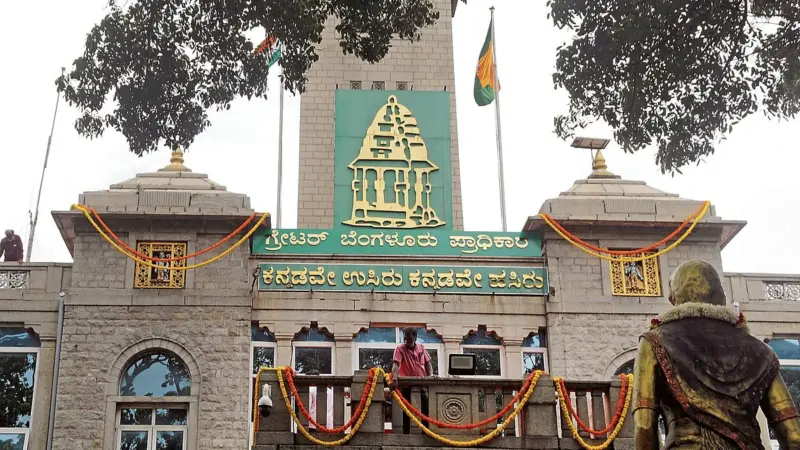

Bengaluru has gone over five and a half years without an elected city government, resulting in prolonged bureaucratic rule under direct State control.
After years of political manoeuvring, administrative restructuring, and litigation - including a standoff between the State Election Commission and the government - Bengalureans may finally elect their local representatives by June.
The city has witnessed extraordinary growth over the past decade, with the population increasing by nearly 50 per cent. The Bengaluru Urban district's GDP has risen from Rs 2.69 lakh-crore in 2015-2016 to nearly Rs 10 lakh-crore in 2023-2024, while per capita income has nearly tripled to Rs 7.39 lakh.
The Greater Bengaluru Governance Act, 2024, introduces a new structure: five city corporations under an integrated metropolitan body, the Greater Bengaluru Authority (GBA). The number of wards has increased from 198 to 369 (including 176 seats reserved for women), reducing the average population per ward to about 40,000-50,000 - far lower than in Mumbai or Delhi. In theory, this should bring governance closer to citizens.
Draft rolls show sharp drop in ward size ahead of Bengaluru civic pollsHowever, even as the city expands in scale and ambition, and its governance structure transitions, everyday challenges such as water scarcity, waste management, strained public transport, traffic congestion, and walkable roads persist. As elections approach, the central question is not just who wins, but who will take ownership of solving these problems.
Urban local elections are marked by low participation and weak civic engagement. Mumbai's recent municipal elections saw a turnout of just 52.9 per cent, while Bengaluru recorded 45 per cent in 2015. Chennai (44 per cent), Lucknow (39 per cent), and Hyderabad (47 per cent) show similar trends. This reflects a deeper disconnect with city governments that shape everyday life. A study by Janaagraha and Brown University across eight cities found that only 35 per cent of respondents could name their councillor. Another survey found that 87 per cent had never interacted with one.
In this context, the role of the 369 councillors under the GBA becomes critical. Their effectiveness will depend on their ability to act as public problem-solvers - working in collaboration with citizens, officials, and higher elected representatives. This engagement must begin before elections, with candidates articulating ward-level visions, debating solutions, and building trust with communities. After elections, councillors must keep communities informed and engaged in neighbourhood planning and development.
Another concern is the shrinking space for independent civic leaders in city governance. While municipal elections appear competitive, they are increasingly shaped by party identities, higher-level political narratives, and leadership image. In Mumbai's recent civic elections, none of the 535 independent candidates won. Across Maharashtra, the number of elected independents has sharply declined - from 178 between 2009 and 2013 to just 19 in 2026 across 29 city corporations. Bengaluru reflects a similar trend: only seven independents were elected in the 2015 BBMP polls.
For a city known for strong civic culture and citizen-led initiatives, this signals high entry barriers for non-party-affiliated candidates. Local governments at the third tier were envisioned as spaces for grassroots leadership, relatively free from state and national political dominance. Bengalureans, as patrons of innovation and start-ups, can break the pattern this time by giving a fair chance to political entrepreneurs with a strong vision and commitment to implement it.
Rising financial barriers further limit electoral choice. Local elections, as at the higher tiers, are increasingly tilting in favour of those with deeper pockets. In the 2026 municipal elections in Mumbai, nearly 79 per cent of winning candidates declared assets above Rs 1 crore. In Delhi, 67 per cent of winners in 2022 were crorepatis. Bengaluru shows similar patterns. While declared wealth is not the same as campaign expenditure, it reflects who can afford to compete in a costly electoral arena. In Mumbai, Pune, and Bengaluru, campaign costs are estimated to run into several crores.
As elections become more expensive, the probability of capable local leaders without financial backing dropping out is high. For a city with a large base of middle and lower-income citizens, this raises a critical question: Will financial muscle determine representation?
The upcoming elections offer Bengaluru a rare opportunity to reset its civic politics after years without elected representation. With more wards and potentially closer citizen-representative links, accountable local leadership is within reach. The choice before Bengalureans is clear: elect representatives who manage the status quo, or leaders who are committed to making the city more liveable. If voters can overcome cynicism, reject political stereotypes, look beyond party labels, and engage meaningfully with candidates on issues that shape everyday life, Bengaluru can yet again set a benchmark - this time in democratic participation, urban governance, and hence in shaping a truly liveable, world-class metropolis.
(Santosh is Director, Policy Engagement and Sarish is Associate, Strategy and Partnerships, Janaagraha)
Disclaimer: The views expressed above are the author's own. They do not necessarily reflect the views of DH.