





Christopher Nolan famously prefers the real thing over CGI and VFX whenever he can. Morocco gives him the perfect excuse.
A small town on the edge of the Sahara has been playing dress-up for more than four decades.
With its dramatic light, ochre landscapes and weathered kasbahs, Ouarzazate already looks as though it has wandered out of a historical epic.
A little outside the town is Atlas Studios, where Egyptian temples are just a short stroll from medieval Jerusalem, a Chinese monastery neighbours a Greek village, and a crashed helicopter rests not too far from a pharaoh's throne. Unlike most film studios, Atlas rarely dismantles its sets. Instead, they are repainted, recycled and reimagined for the next production. The props enjoy equally long afterlives. Military vehicles from 'Black Hawk Down', replica fighter jets from 'The Jewel of the Nile', giant Egyptian statues and half-forgotten movie relics lie scattered across the grounds. The result feels less like a studio tour and more like a chaotic museum. More than 200 films and television productions, including 'Gladiator', 'Kingdom of Heaven', 'The Mummy', 'Prince of Persia', 'Asterix & Obelix: Mission Cleopatra', 'Aladdin', 'Game of Thrones' and even 'Prison Break', have filmed here or in the surrounding landscape.
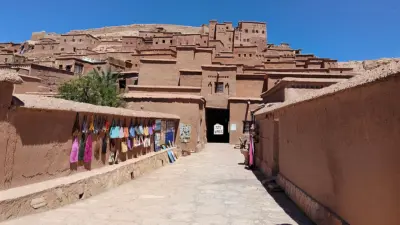
Home to around 80,000 people, most of them Amazigh, the indigenous people of North Africa, Ouarzazate has become one of Hollywood's favourite outposts. Its perfectly blue skies often serve as a 'green screen' while its sun-baked terrain is in sync with ancient kingdoms, biblical lands and fantasy worlds. Nolan's 'The Odyssey', one of this year's most anticipated films, is the latest to join the club. Parts of the film were shot around Ouarzazate and the nearby mud-brick citadel of Aït Ben Haddou, transformed into the city of Troy. The UNESCO World Heritage Site will already be familiar to 'Game of Thrones' fans as the slave city of Yunkai, with dragons and armies added later through visual effects. Ridley Scott's 'Gladiator' apparently enlisted hundreds of local horsemen and extras for its sweeping battle scenes.
In fact, this is a town full of extras! One year they are Roman soldiers, the next Crusaders, Egyptian priests or ordinary citizens fleeing invading armies. Entire families have built thriving side incomes around Hollywood's periodic invasions and, as our guide joked, have become "experts at looking terror-stricken". One veteran extra told me his colouring allows him to pass for a Greek, Roman or southern European, though he prefers playing a Roman. Why? "Because the Roman armies usually win; I stay alive longer, and I get paid for more days."
(The writer was in Morocco recently at the invitation of the Moroccan National Tourist Office)