




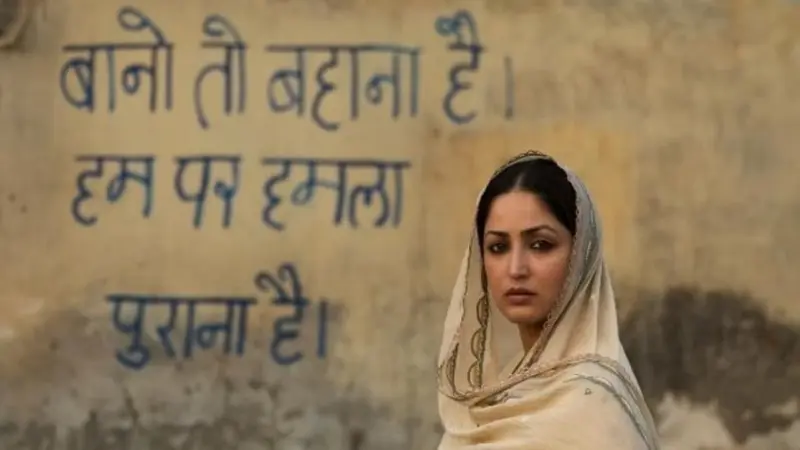

The recent Netflix release of the social drama Haq has drawn attention for its focus on Muslim women's rights. It presents a story of legal reform that recentres majoritarian authority within a narrative of minority struggle.
As a cultural text about law and justice, the film shapes how audiences understand reform and who drives it. Its framing casts the State and the majority as the main agents of change, while the efforts of Muslim women and lawyers fade into the background. At a moment when Muslim identity and women's rights are deeply politicised, such narrative choices carry particular weight.
Cultural texts that claim a progressive stance often influence how audiences make sense of law. Through narrative and character, they shape how people see who suffers and what justice should look like. They are seldom neutral retellings of history. They are produced from somewhere, and they invite audiences to see from particular standpoints. In the Indian context, where legal change is deeply entangled with religious identity, such texts can quietly perform ideological work by translating contested legal histories into simplified moral narratives. This kind of narrative authority operates through omission as much as assertion.
The film draws on the legal battle of Shah Bano, who approached the courts seeking maintenance from her husband following divorce. Decided by the Supreme Court in 1985, the case marked a significant moment in Indian law by affirming that Muslim divorced women were entitled to maintenance under the general criminal law framework. The decision drew opposition from some Muslim religious groups, who argued that it displaced Muslim personal law.
In the film, Shazia (the fictional counterpart of Shah Bano) is represented in the Supreme Court by Bela Jain, a non-Muslim lawyer. In reality, Shah Bano was represented by a prominent Muslim advocate, Daniel Latifi, whose role was central in the case. This substitution casts the non-Muslim lawyer as an almost redemptive figure through whom justice is made possible, while Shazia receives little meaningful support from her community.
Most Muslim characters are shown as oppositional, silent, or easily swayed; only Shazia and her father recognise the injustice, and even his support appears driven by familial duty rather than principle. This portrayal departs from the historical record, where Muslim women's organisations and advocacy networks actively mobilised around the case. By shifting agency away from the subjects of reform and toward external benevolence,
the film reshapes how justice and change are understood.
Shah Bano's claim had also provoked opposition from several Muslim bodies. That resistance was articulated in terms of religious autonomy and anxiety about expanding State authority over personal law. The film does present this opposing view, but the way the story conveys it is important. Fears of cultural erasure are voiced by an unsympathetic antagonist (Shazia's husband) and framed as manipulative. When these concerns are instantly dismissed by the heroic lawyer, the narrative invites the audience to dismiss them as well. This move matters because it reduces minority distrust to bad faith, rather than situating it within a history of uneven State action and contested citizenship that has shaped minority experience.
Trust in law comes from institutional conduct. People cooperate when the State proves reliable over time. Where citizenship has been unevenly enforced through documentation regimes and selective action, scepticism toward new reforms is a rational response. In this context, the film's quick dismissal of minority concerns oversimplifies the political conditions that make such fears understandable. Minority appeals to constitutional principles are often treated as bad faith, and the film repeats this logic by assigning fear to an unlikeable character and dismissing it rather than taking it seriously.
The film closes with Shazia winning her right to maintenance, followed by a passing remark from the judge that a uniform civil code would resolve similar issues. An end title card then steps in to explain what happened after the events portrayed. It tells the viewer that the Shah Bano judgment was soon diluted by legislation introduced by the government of the time. This is factually correct, but it is only part of the story. The film omits that Daniel Latifi challenged the law and that the Supreme Court interpreted it to protect Muslim women's maintenance rights and preserve the core of the Shah Bano ruling.
The title card notes that the present government criminalised triple talaq but does not mention that the Supreme Court had already declared the practice unconstitutional in Shayara Bano (2017). It skips the long, uneven legal history between the dilution of Shah Bano and this law, during which Muslim women repeatedly went to court and secured gains in maintenance, marital rights, and personal liberty.
By reducing this history to a sequence of State actions, the film offers a State-centred account of reform, where change appears to come from above and the sustained labour of Muslim women and their allies fade from view.
(The writers are assistant professors of law at the School of Law, RV University)