
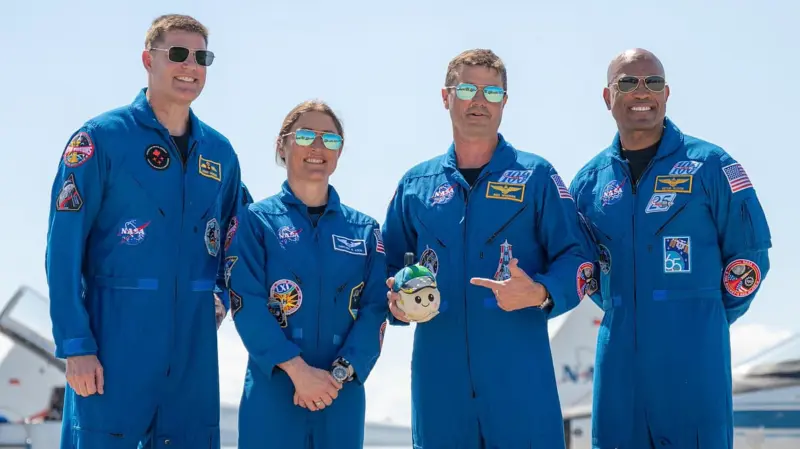

Four astronauts are all set to fly to the Moon for NASA's Artemis II mission. The liftoff is scheduled for 3:54 am IST on April 2 from the Kennedy Space Center in Florida, taking humanity back to the Moon in over 50 years.
The crewed lunar mission, first since 1972, will break and set several records over the course of ten days, and mark a major step toward human landings in 2028 during Artemis IV.
The mission crew will board the Orion spacecraft that will complete a flyby of the Moon before returning home without landing. It will be loaded with dozens of payloads that will symbolise humanity's return to the Moon, as NASA has been endorsing Artemis II.
One of these payloads is 'Rise,' a zero-gravity indicator that will occupy a tiny space in the Orion spacecraft. Zero-g indicators are objects astronauts carry to get an idea when a capsule has reached space - when this untethered object starts floating, it means the spacecraft is in vacuum. These objects often carry deep symbolic meaning and are chosen after careful consideration.
Rise was introduced to the world on March 28 by Artemis II astronauts who explained the significance of the object. It was selected from thousands of submissions from over 50 countries. The winner was submitted by 8-year-old Lucas Ye from California.
"The crew personally participated in selecting our buddy (Rise) to fly with us and this little guy resonated with us because the theme is actually 'Earthrise' - a photo taken on Apollo 8 which is inspirational to all of us," Artemis II mission specialist and NASA astronaut Christina Koch said.
But Rise is not just a zero-g indicator. It also has a zipper at the base which is carrying a micro SD card that has millions of names of ordinary citizens from around the world who signed up for the Artemis II digital boarding pass.
Explained | How NASA's Artemis II moon mission will unfoldThe historic Artemis II mission
Artemis II is a ten-day mission to test the Orion spacecraft in deep space with humans onboard. Accompanying Koch are NASA's Reid Wiseman (commander) and Victor Glover (mission pilot) and Canadian Space Agency's Jeremy Hansen (mission specialist). Together, they will conduct several experiments in high-radiation regions to advance research on plant and human health.
While Koch will be first woman to be part of a Moon mission, Glover is the first person of colour to fly on a lunar mission.
NASA said on Wednesday that weather is 80 per cent favourable for the launch although teams are watching primary concerns such as cumulus clouds, ground winds, and solar weather around the launch site.