




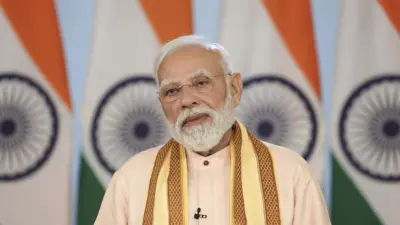

Ing Prime Minister Narendra Modi and his cohorts within the Bharatiya Janata Party (BJP) sycophantically celebrate, first his 76th birthday and subsequently, the silver jubilee of his unbroken run in executive office, cannot but arouse a supreme, almost cruel, irony.
The almost 20-day period, from September 17 to October 7, points to a merciless paradox - after having spent a quarter of a century perfecting the craft of absolute dominance, first as the Hindu Hriday Samrat (Emperor of Hindu Hearts) of Gujarat, and later, as the infallible emperor seated in New Delhi, Modi walks past a monumental milestone, not at the peak of his power, but at its most visible decline since October 2001.
Authority shaken
The public construct of Modi, the electoral and political phenomenon that he has been since assuming office, was based on the idea of being an invincible leader with unconcealed zeal to break every record of governance and statesmanship from the past.
Every imagination of him had no disputing: Modi worked towards emerging as an electorally unassailable personality and a messianic ruler (he once told me about being god-gifted to conjure up previously unheard solutions to complex problems, besides, of course, his infamous declaration in 2024 of being a non-biological being), whose authority was absolute and personal brand subsumed both State and party.
Yet, as the party and official apparatus rolled out the ceremonial spectacles to mark his unbroken run, a combination of forces - from exacting allies and elders in the Sangh parivar to a re-energised Opposition, and from previously de-politicised youth brigade who have now shed the fear of staging protests to an electorate that hinted at the power it held with the mandate of 2024 - have taken away the one attribute he prized above all else: total, unquestioned control.
It is more than two months since Modi secured the resignation of the education minister, Dharmendra Pradhan, under public and Opposition pressure. With multiple new protests rearing their heads across India, Modi faces a deficit of something that he was always successful in invoking: a counter strategy to fell his adversaries with one perfect stroke.
A lateral entrant
Within the BJP, Modi was a lateral entrant to governance. Although inducted from the Rashtriya Swayamsevak Sangh (RSS) into the BJP in 1987, he was deployed in the organisational wing of the party, and not its legislative branch, which leads to governmental roles in the event of the party securing a legislative majority.
Modi had never contested an election when he was deputed to Gandhinagar in October 2001, to assume charge as chief minister, replacing the ineffective Keshubhai Patel. His brief was to urgently set the house in order, and get the state government back on track.
'Not a day's off in 25 years': Piyush Goyal hails Modi's uninterrupted tenure as CM, PMStreamlining relief and rehabilitation in Kutch after the devastating earthquake on January 26, 2001, was a prerequisite to this. Positive intervention in post-natural disasters was a long tradition within the RSS, and Modi had toiled in such activities, especially the Machchhu dam failure in August 1979, which remains the worst flood disaster in Saurashtra's history.
A 29-year-old Narendra Modi, then a young RSS pracharak, was dispatched from Ahmedabad to act as one of the key 'first responders' leading the ground-level operations.
Abandoning political ethics
Politically, however, Modi made little headway. Bye-elections to three Assembly seats were held in February 2002. The BJP won just one of these - vacated for Modi to become a legislator. The Congress wrested the other two seats from the BJP.
With Assembly polls scheduled in early 2003, the portents were not good. The Godhra carnage and the consequent riots across Gujarat provided Modi with a huge 'opportunity' and he harnessed it to the fullest, abandoning political ethics.
From statements justifying the carnage as a trail of "action and reaction", to the recent declaration of close aide and Union Home Minister Amit Shah that the Uniform Civil Code (UCC) will be implemented across all 21 NDA-ruled states before the 2029 Lok Sabha elections, Hindutva remains Modi's go-to agenda over the past 25 years.
Lal Krishna Advani may have shepherded the Ram temple agitation into the national arena, but Modi it is, who normalised alienation of minorities, especially Muslims and Christians, as State policy. He also regularised the use of pejoratives against them, especially during elections. Other BJP leaders have taken to aping him and litter India's political terrain with corrosive vocabulary.
Spin and centralisation
Realising early that Hindutva must be tactically veiled at times, he turned to institutionalising Vibrant Gujarat Global Investor Summits, repositioning his public image around economic governance and industrial growth. Modi also fast-tracked clearances for big corporations, and claimed with pride to have introduced 'single-window clearance'.
In the Gujarat of that time, it was also a synonym for over-centralisation, or what was given the spin as 'Gujarat Model'. Ministers merely occupied positions, and party office-bearers whiled away their days while the all-powerful Chief Minister's Office, alongside chosen bureaucrats in other ministries and departments, emerged as the all-pervasive political force. Since 2014, this became India's model too - now even the majority of BJP-governed states are remote-controlled by the Prime Minister's Office.
India's UNGA story | From Rao-Vajpayee consensus to Modi-Jaishankar patternEventually, centralisation became State policy, and in September 2021, the Centre launched a centralised one-stop shop - National Single Window System - to obtain all requisite central and state regulatory approvals and clearances required to start and run businesses in India.
Economic disparity in India is at its highest, and even among the big corporates, a handful of them always appear to have special privileges and greater proximity to Modi and his close associates.
Agenda rollout
From the outset, the Hindutva narrative was allowed a free-run. Horrific incidents of mob-lynching and hate speech - the latter even by BJP leaders holding official positions - were not put down sternly.
But, after securing an enhanced parliamentary majority in 2019, Modi went the whole hog. Ban on Triple Talaq, abrogation of Article 370 and 35A, upscaling repressive facets of the Unlawful Activities Prevention Act (UAPA), passage of the Citizenship Amendment Act (CAA), which legislatively intertwined citizenship rights with religious identity, were pushed through in quick time.
Many would even argue that the Centre quietly prodded the Supreme Court on the pending Ayodhya matter and secured a verdict which awarded the disputed properties to Hindu parties and placed them under the PMO's control.
Chinks in the armour
Undeniably, Modi presides over the most ideologically driven regime in independent India's history. The quarter of a century that he has occupied high offices, represents the most significant consolidation and centralisation of political power in post-Independence India. This was coupled with the weakening of autonomous State institutions, democratic values, and ideas on which the republic was founded.
Seva Sankalp Abhiyan | Modi's birthday celebration in shadow of political setbacksYet, at the precise moment when the political command celebrates its unprecedented tenure, Modi is faced with unanticipated structural vulnerabilities. His brand of muscular nationalism in the wake of the terrorist strike at Pahalgam, appeared to have made the 2024 verdict and its political fallout, a bad dream.
But the limits of hyper-centralised strongman politics in a complex, multi-layered federal democracy have been proven, especially in a political phase where Modi is constrained by coalition dependence. Additionally, the government is facing challenges from new forms of demographic movements coupled with social-media-driven takedowns of Modi.
Over the past 25 years, Narendra Modi has navigated past political criticism and countered personalised attacks with greater coarseness, but is now at sea when faced with mockery and lampooning. Quite clearly, the leak of the NEET examination paper proved to be the crucial tipping point, and by the time Pradhan bowed out, disparate groups had brought diverse issues for redress to Jantar Mantar.
In his entire political innings, Modi has, to use a cricketing analogy, not faced such hostile bowling. How he navigates the play post-celebrations, whether or not he succeeds in drawing a countermove, will greatly determine his epitaph.
Nilanjan Mukhopadhyay is a journalist and author of 'Narendra Modi: The Man, The Times' and 'The RSS: Icons of the Indian Right'. X: @NilanjanUdwin
(Disclaimer: The views expressed above are the author's own. They do not necessarily reflect the views of DH.)