




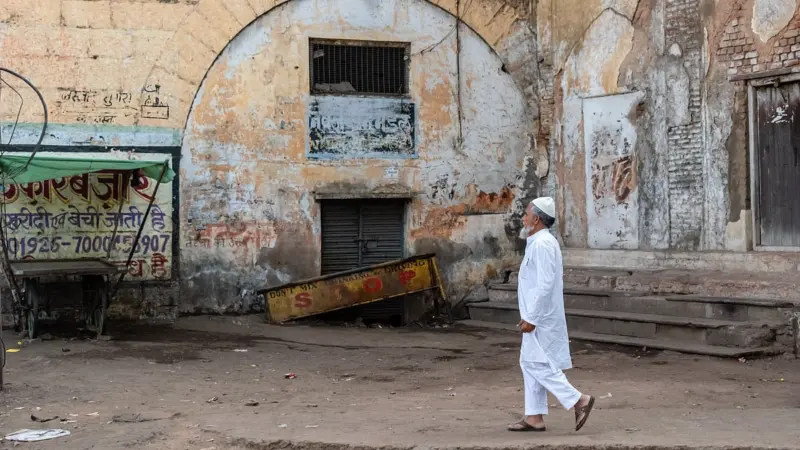

While walking through any of India's cities, one is bound to see towering differences in adjacent neighbourhoods, with more affluent ones running side by side with the poorer ones, which lack even basic amenities like drinking water and waste collection facilities.
However, the divide is not just financial; a recent study has identified a pattern to it, highlighting that residential segregation in India is among the highest in the world, with Muslims and Scheduled Caste (SC) communities impacted worst by it.
The research that studied across 15 lakh urban and rural neighbourhoods has found that residential segregation of Muslims and SCs in India is only marginally lower than Black-White segregation in the United States, a benchmark long considered one of the starkest examples of residential division.
Using standard measures - the Dissimilarity Index and the Isolation Index - the researchers found that in such segregation, India ranks considerably higher than Brazil, the only other major developing country for which comparable estimates are available, and sits in the middle of the spectrum relative to immigrants' segregation in European cities - higher than Italy but lower than non-White segregation in England and Wales.
The researchers also highlighted that while segregation in Indian neighbourhoods is comparable with that in the US, between 1980 and 2020, the Black-White segregation fell by an average of 6% per decade compared with a marginal fall of 1-3% in SC segregation in India.
Crime dips 6% across India, but Delhi still worst major city for women, children and elderly: NCRBThe study, published in The University of Chicago Stone Centre Working Paper Series, by economists from Imperial College London, Dartmouth College, the University of Chicago, Harvard University, and the Development Data Lab, linked records across three Indian censuses: the Population Census 2011, the Socioeconomic and Caste Census (SECC) 2012, and the Economic Census 2013.
The concentration is particularly pronounced for Muslims. Around 26% of urban Muslims live in neighbourhoods where Muslims constitute more than 80% of residents, compared with 16% of SCs living in equivalently concentrated SC neighbourhoods.
Notably, urban and rural segregation are highly correlated for both groups, suggesting that Indian cities, despite rapid urbanisation and changing residential patterns, are not forging new, more integrated identities; instead, they largely replicate centuries-old rural settlement patterns shaped by caste hierarchy and communal division.
The research highlighted that while most social groups express preferences for living around members of their own group, this is further reinforced by informal and formal discrimination by landlords and home sellers.
The consequences of this spatial sorting go well beyond the social scape; they are measurable in terms of public services that the State provides. The study found that compared with a neighbourhood with no Muslim residents, a fully Muslim neighbourhood in the same city is 10% less likely to have access to piped water. A neighbourhood with 50% Muslim share is 22% less likely to have a public secondary school.
Neighbourhoods with greater than 50% Muslim share stand out for being particularly underprovisioned; while only about 10% of neighbourhoods have such a high Muslim share, over half of the country's urban Muslims live in them.
Trying to find the origin of these disparities, the researchers found that most of the disadvantage is generated at the most local, least scrutinised level of governance within towns and villages. In urban areas, higher levels of government - States and districts - often allocate resources in ways that are neutral or even marginally favourable to marginalised groups. However, those gains are undone by how services are distributed at the neighbourhood level, a process driven by informal political bargaining and local power brokers.
Previous studies have shown that districts with more SCs and Muslims had fewer public services, including health facilities and secondary schools, in 1971, but that the gap closed almost entirely or even reversed for SCs by 1991, but little changed for Muslims. However, the new study highlighted that the cross-district SC advantage is almost completely undone at the local neighbourhood-level allocation.
The researchers argue that owing to the lack of neighbourhood-level data, administrators at the district or higher level could arrive at incorrect conclusions about the regional disparities, leading to blunting the efficacy of affirmative policies. As the Union government undertakes the Census 2027, the study proposes the collection of such neighbourhood-level data to address the segregation of SCs and Muslims.