




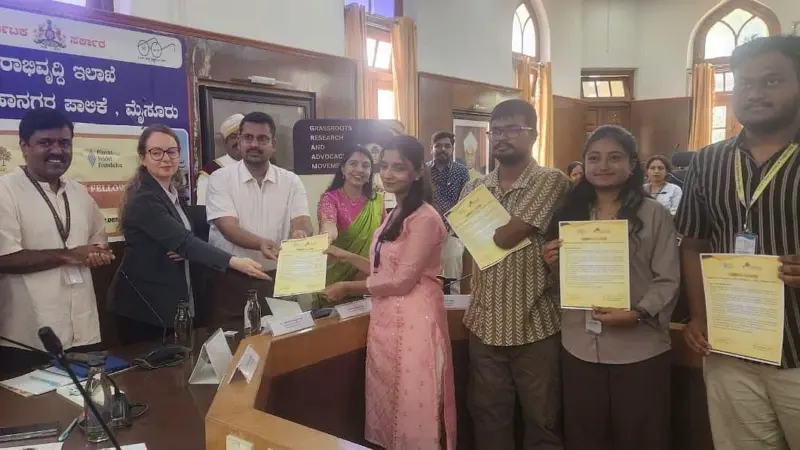

Mysuru: Highlighting that the rapid transformation of urban landscapes requires more than just capital, Mysuru City Corporation (MCC) Commissioner Shaik Tanveer Asif called for a fundamental shift toward 'Design Thinking' in urban administration.
Speaking at the inauguration of the fifth Cohort of the Youth Governance Fellowship (Y4G), organised by the Grassroots Research and Advocacy Movement (GRAAM) in partnership with the Hanns Seidel Foundation (HSF), in Mysuru, the MCC commissioner emphasised that affordability and sustainability must be the dual pillars of modern urban development.
Shift to execution
Asif pointed out that Urban Local Bodies (ULBs) like Mysuru have seen a significant increase in financial devolution. However, he cautioned that the availability of funds does not automatically translate into progress.
"The bottleneck today is not just money; it is effective utilisation, meticulous planning, and robust execution. Apply a 'Design Thinking' framework - a methodology that prioritises the actual needs and lived experiences of the end-user - to solve pressing local issues. We should move beyond theory and tackle 'ground-level friction' in areas such as parking management, regulation of street vending, and enhancing urban mobility, ensuring that solutions remain administratively viable and socially inclusive," Asif stated.
Myth of youth apathy
Executive director of GRAAM Basavaraju R Shreshta noted that youth participation in formal governance remains low, but the blame does not lie with the younger generation alone. "It is the collective responsibility of the government and civil society to create platforms, where engagement is possible," Shreshta asserted.
Resident representative of Hanns Seidel Foundation India Judith Weinberger-Singh reaffirmed HSF's commitment to decentralised governance, noting that partnerships between civil society, academia, and the state are essential for inclusive communities.
Additional Commissioner of the MCC B N Veena asked the fellows to work directly with various government departments. She noted that such collaboration is essential to make governance more 'people-centric' and responsive to the unique needs of a heritage city like Mysuru.
The inaugural function was attended by professor H P Jyothi from the department of Social Work, University of Mysore, advocate Tejaswini Bhat, professor M Shivaprasad from Teresian College, head of projects in GRAAM Mallikarjuna Swamy, and project coordinator Pavan.