
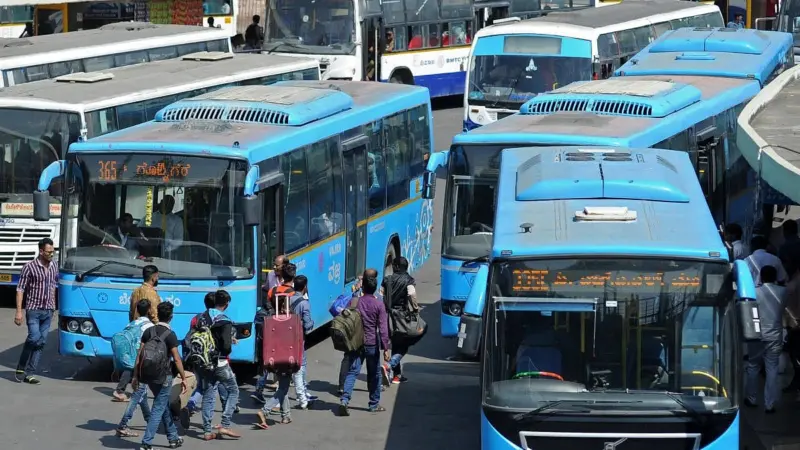

Bengaluru: A commuter waiting for a Bangalore Metropolitan Transport Corporation (BMTC) bus at the Bhashyam Circle bus stop in Sadashivanagar usually goes home by 8.45 pm, catching buses in the 176 series.
The BMTC sometimes changes some other buses to the 176 route by changing the board, but that night, this did not happen. Finally, a bus arrived at 9.30 pm after 45 minutes of waiting, but it was not visible on the Namma BMTC app, BMTC's Intelligent Transport System (ITS).
This is a common problem with the ITS. There are other technical glitches plaguing it.
"Buses with last update time of more than 5 minutes ago are a common problem on the K-2 route," says Shreya, a Class 11 student who uses BMTC for her commute. But she finds the BMTC commute pleasant because she travels during the daytime and buses are frequent, even though they do not appear on the app. If it were at night, a bus not appearing on the app would be problematic, as the bus frequency is lower, she says.
Why do buses go off the grid? A source in the know said that out of more than 7,000 BMTC buses, about 4,000 buses have been onboarded to the ITS system. "The old buses do not exist on ITS. Even newer electrical buses are updated on ITS," the source said.
"Traffic congestion can also cause delays at signals, and GPS data can be delayed. This is one reason why sometimes buses can go off the grid," says Vinay Baindur, an independent researcher.
Why BMTC's big e-bus push is not without risksBMTC sources agree with this. They also say that sometimes, on some buses, the announcement systems are intentionally turned off, so the voice announcements do not work. But these are minor problems that are easily fixable.
"New electric vehicles are not onboard the BMTC ITS. For example, if I search for 285-M on the Yelahanka route, the app shows old Volvos and other buses, but not the new electric buses (KA-01 ARC series). There is a problem with how they have onboarded the new vehicles on the app," says Vikram Shetty, a public transport enthusiast based in Yelahanka.
He says the facility should be built into the Namma BMTC app itself to buy tickets, rather than navigating to another app, because sometimes the QR codes on the bus panels do not work as intended due to vehicle movement, crowd, and lighting issues.
"On the technology front, they can do a lot. They can introduce pre-loaded wallets through which commuters can pay for tickets. They update every 30 seconds. On faster routes, this makes the tracking a bit unreliable because the bus would have gone if you miss those 30 seconds," he adds. The map/GPS refresh rate has to be optimised, he adds.
'Use the commuter data in better ways'
"Pressure from the private sector on BMTC is too much to share data freely. BMTC itself should use the commuter data to divert more buses to particular areas. It should use the data for the public benefit and to decongest the roads," says Vinay.
Rationalisation of schedules based on real-time operational data from ITS is one of the objectives presented in the White Paper on Effective Transport Management Initiatives for implementation in Karnataka's Transport sector. Sources say this is implemented to a certain extent.
"Nowadays, everything is UPI-based, and the BMTC has real-time data on commuters on any given route and buses. Depending on passenger load, they should increase bus frequency and adjust dynamic bus routing based on specific events and areas. But that is not happening," says Vikram.
Data show that there are 4,400 bus stops and 2,870 public transport routes in the greater Bengaluru Metropolitan Region, with 1,684 of them in the GBA area. Various studies have tried to come up with plans for feeder buses around metro stations and analyse the traffic situation etc., in order to improve last-mile connectivity. Namma BMTC has been a useful addition to Bengaluru's public transport scene, but it can be better if the existing loopholes are identified and fixed, say public transport enthusiasts.
Other digital initiatives
BMTC's digital pass system allows people to buy daily, weekly, or monthly bus passes via a mobile app using online payments. Each pass has a unique ID and QR code, which conductors scan or validate during travel using electronic ticketing machines.
Ticket payments via UPI have also been game-changers. "We do not need to carry change now. We can directly pay using the UPI or the QR codes given on the bus panels," says Vinod V, a college student studying in a college in Basaveshwaranagar.
"BMTC used to have a commuter comfort task force, but it is no longer functional. It exists on paper only," says Vinay. However, since the officials and depot managers are approachable to the public, the complaint redressal is not a hassle, say other commuters.
BMTC officials did not respond to the queries DH posed.
Connecting commuters through messaging groups
Sathish S, a BMTC official who served as the depot manager in Whitefield until 2022, says BMTC officials started a Telegram group to help commuters on the KIA-15 route. They started going to apartments around here and speaking with people, spreading the word about bus routes and the Telegram group.
As a result, more people started using the bus, and the Telegram channel grew rapidly. The revenue on the route also increased.
Girish C, an active member of this group, reveals more. "Looking at the number of people using the group and their struggles, a thought came to my mind: Why can't I build an app dedicated to the route?"
So, being a developer himself, he built an app for the KIA-15 route. "The app gives information like crew details, timings, location, etc. for each bus on the particular route," he explains. It draws its information from the BMTC server itself, with permission from the public transport body. People find it useful because it provides information not available on the Namma BMTC app and makes their commute smoother.
The app is available for both Android and iOS. The Android version has 1,500 downloads, and the iOS version has around 500 downloads. Girish is all praise for BMTC officials supporting his efforts.
"Now there are around 8,000 people, all of whom depend upon KIA-15 regularly," Girish explains.
Why do citizens need crew details? "People can coordinate or plan their commute, call the crew if they don't see a bus and go for alternatives in case of problems," says Girish. On remote routes, if commuters are nearby, buses can even stop for a few minutes to help them, say other commuters.
Another such Telegram group focuses on the KIA-5D route (Art of Living-Airport). Not just the people going to the airport, but those alighting midway use these buses. It works out economically because bus fares are lower for non-airport stops and within city limits. Girish has also developed a microapp for this.
Satish moved to but did not keep quiet. He now handles the K R Puram depot and has begun another WhatsApp group, this time for metro feeder buses (MF-10,10A,10B (G2) Kithaganur/Bidrahalli/Kadugodi/Tin Factory Metro) with the same agenda of helping commuters and boosting the revenue, a win-win for both the BMTC and the commuters, also helping Metro connectivity in the process. Officials post the feeder bus numbers and timings in the group.
"We can't do this for major routes. We do this because it is an interior area," says Sathish. More than 1800 commuters use this group as a resource.