




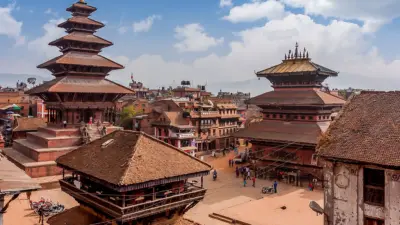

I arrive in Bhaktapur just as the morning light begins to gild its ancient brick facades, and almost immediately, time loosens its grip.
Barely 13 kilometres from Nepal's capital city Kathmandu, this UNESCO World Heritage City feels like a parallel universe - one where centuries-old rhythms still dictate the pace of daily life, and where art is not displayed in galleries but embedded into the very fabric of existence.
The first thing that strikes me is the texture - of terracotta, of timber, of time itself.
Bhaktapur is a city sculpted as much as it is built. Its narrow lanes open unexpectedly into expansive squares, each one a stage for architectural drama. I find myself standing in Durbar Square, surrounded by an ensemble of palaces, courtyards, and temples that seem to rise organically from the earth. The intricacy is overwhelming: windows carved like lace, doors adorned with mythological guardians, columns that appear almost fluid in their craftsmanship.
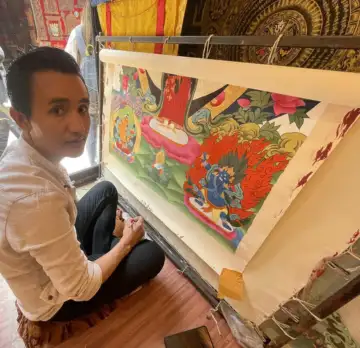
An artist working on thangka paintings. (Photo by author)
At the heart of this square stands the 55-Window Palace, its façade a masterpiece of woodwork that has endured centuries. Nearby, the Golden Gate glows with quiet authority, its repoussé metalwork depicting deities and mythical beasts in exquisite detail. I run my fingers lightly over the carvings, aware that these are not mere decorations but expressions of devotion, each motif guided by sacred geometry and spiritual intent.
Craft as a way of life
As I wander deeper into the city, I begin to notice how seamlessly art and life intertwine here. In Bhaktapur, craftsmanship is not a relic - it is a living tradition. Every corner reveals a workshop, every doorway a glimpse into a process honed over generations.
Bhutan: Land of peak happinessIn a shaded courtyard, a wood carver chips away at a block of timber, his movements precise and meditative. The patterns he creates are not improvised; they follow strict iconographic rules rooted in Hinduism and Buddhism, ensuring that every piece carries both aesthetic and spiritual resonance.
I am drawn next to Taumadhi Square, where the towering Nyatapola Temple dominates the skyline. Rising five storeys high, it is the tallest temple in Nepal, and its symmetry is both commanding and serene. Each tier is guarded by pairs of stone figures - wrestlers, elephants, lions, griffins, and goddesses - each believed to be ten times more powerful than the one below. Climbing the steep steps, I pause frequently to absorb the quiet dignity of the structure. From the top, the city unfolds in a patchwork of red roofs and temple spires, framed by distant hills.
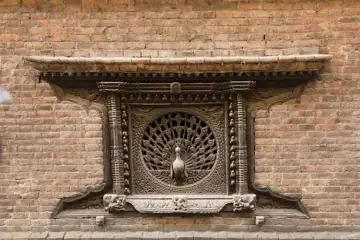
The city is known for windows with traditional wood art.
Yet it is not just the grand monuments that captivate me; it is the smaller, almost unnoticed details that linger. A sunlit alley where hundreds of clay pots dry in neat rows. This is Pottery Square where artisans shape clay with an ease that belies the labour involved. The earth here is carefully sourced, kneaded, and spun into form on simple wheels. A young boy sits beside an older man learning the subtle pressure needed to coax symmetry from spinning clay. Rows of freshly made pots bask in the sun, their uniformity a testament to discipline rather than machinery. Nearby, kilns smoulder quietly, transforming fragile forms into durable vessels. It is a cycle of creation that feels both ancient and immediate.
Not far from Pottery Square, I step into a different world - one where silence feels almost sacred. Inside a modest studio, thangka artists sit cross-legged on the floor, bent over canvases stretched taut on wooden frames. The room smells of natural pigments and glue, and every movement is deliberate, almost meditative. A young apprentice Pema Pokharel carefully outlines a deity's form while an older master fills in impossibly fine details with a brush so thin it seems barely there. I learn that thangka painting, rooted in Tibetan Buddhism, is governed by strict iconographic rules - proportions, colours, and symbols all prescribed by sacred texts. "These are not mere paintings but spiritual maps, aids for meditation and devotion," informs Pokharel as I pore over his work.
ing him, I am struck by the patience the art demands; a single piece can take months to complete. Like the potters shaping clay outside, these artists are not just preserving a craft - they're sustaining a philosophy, one careful stroke at a time.
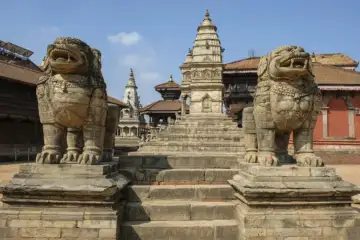
Lions standing guard at Durbar Square.
Stories in stone
What fascinates me most is how Bhaktapur has preserved its identity despite the pressures of modernity. The city suffered significant damage during the 2015 earthquake, yet what I see today is a testament to resilience. Restoration here is not about replacing the old with the new but about reviving traditional techniques. Craftsmen have rebuilt temples using the same methods and materials as their ancestors thousands of years back, ensuring continuity rather than compromise.
As the day wanes, I find myself in a quiet corner of the city, watching the light soften against the brick walls. The air carries the faint scent of incense and wood smoke, and somewhere in the distance, a bell rings - a gentle reminder of the spiritual pulse that underlies everything in Bhaktapur.